Make Way for the Real Nanopod: Researchers Create First Fully Functional Nanotube Radio
Make way for the real nanopod and make room in the Guinness World Records. A team of researchers with the US Department of Energy's Lawrence Berkeley National Laboratory and the University of California at Berkeley have created the first fully-functional radio from a single carbon nanotube, which makes it by several orders of magnitude the smallest radio ever made.
“A single carbon nanotube molecule serves simultaneously as all essential components of a radio -- antenna, tunable band-pass filter, amplifier, and demodulator,” said physicist Alex Zettl, who led the invention of the nanotube radio. “Using carrier waves in the commercially relevant 40-400 MHz range and both frequency and amplitude modulation (FM and AM), we were able to demonstrate successful music and voice reception.”
Given that the nanotube radio essentially assembles itself and can be easily tuned to a desired frequency band after fabrication, Zettl believes that nanoradios will be relatively easy to mass-produce. Potential applications, in addition to incredibly tiny radio receivers, include a new generation of wireless communication devices and monitors. Nanotube radio technology could prove especially valuable for biological and medical applications.
“The entire radio would easily fit inside a living cell, and this small size allows it to safely interact with biological systems,” Zettl said. “One can envision interfaces with brain or muscle functions, or radio-controlled devices moving through the bloodstream.”
It is also possible that the nanotube radio could be implanted in the inner ear as an entirely new and discrete way of transmitting information, or as a radically new method of correcting impaired hearing.
Zettl holds joint appointments with Berkeley Lab's Materials Sciences Division (MSD) and the UC Berkeley Physics Department where he is the director of the Center of Integrated Nanomechanical Systems. In recent years, he and his research group have created an astonishing array of devices out of carbon nanotubes - hollow tubular macromolecules only a few nanometers in diameter and typically less than a micron in length – including sensors, diodes and even a motor. The nanotube radio, however, is the first that – literally – rocks!
“When I was a young kid, I got a transistor radio as a gift and it was the greatest thing I could imagine - music coming from a box I could hold in my hand!” Zettl said. “When we first played our nanoradio, I was just as excited as I was when I first turned on that transistor radio as a kid.”
The carbon nanotube radio consists of an individual carbon nanotube mounted to an electrode in close proximity to a counter-electrode, with a DC voltage source, such as from a battery or a solar cell array, connected to the electrodes for power. The applied DC bias creates a negative electrical charge on the tip of the nanotube, sensitizing it to oscillating electric fields. Both the electrodes and nanotube are contained in vacuum, in a geometrical configuration similar to that of a conventional vacuum tube.
Kenneth Jensen, a graduate student in Zettl’s research group, did the actual design and construction of the radio.
“We started out by making an exceptionally sensitive force sensor,” Jensen said. “Nanotubes are like tiny cat whiskers. Small forces, on the order of attonewtons, cause them to deflect a significant amount. By detecting this deflection, you can infer what force was acting on the nanotube. This incredible sensitivity becomes even greater at the nanotube’s flexural resonance frequency, which falls within the frequencies of radio broadcasts, cell phones and GPS broadcasting. Because of this high resonance frequency, Alex (Zettl) suggested that nanotubes could be used to make a radio.”
Although it has the same essential components, the nanotube radio does not work like a conventional radio. Rather than the entirely electrical operation of a conventional radio, the nanotube radio is in part a mechanical operation, with the nanotube itself serving as both antenna and tuner.
Incoming radio waves interact with the nanotube’s electrically charged tip, causing the nanotube to vibrate. These vibrations are only significant when the frequency of the incoming wave coincides with the nanotube’s flexural resonance frequency, which, like a conventional radio, can be tuned during operation to receive only a pre-selected segment, or channel, of the electromagnetic spectrum.
Amplification and demodulation properties arise from the needle-point geometry of carbon nanotubes, which gives them unique field emission properties. By concentrating the electric field of the DC bias voltage applied across the electrodes, the nanotube radio produces a field-emission current that is sensitive to the nanotube’s mechanical vibrations. Since the field-emission current is generated by the external power source, amplification of the radio signal is possible. Furthermore, since field emission is a non-linear process, it also acts to demodulate an AM or FM radio signal, just like the diode used in traditional radios.
“What we see then is that all four essential components of a radio receiver are compactly and efficiently implemented within the vibrating and field-emitting carbon nanotube,” said Zettl. “This is a totally different approach to making a radio - the exploitation of electro-mechanical movement for multiple functions. In other words, our nanotube radio is a true NEMS (nano-electro-mechanical system) device.”
Because carbon nanotubes are so much smaller than the wavelengths of visible light, they cannot be viewed with even the highest powered optical microscope. Therefore, to observe the critical mechanical motion of their nanotube radio, Zettl and his research team, which in addition to Jensen, also included post-doc Jeff Weldon and graduate student Henry Garcia, mounted their nanotube radio inside a high resolution transmission electron microscope (TEM). A sine-wave carrier radio signal was launched from a nearby transmitting antenna and when the frequencies of the transmitted carrier wave matched the nanotube resonance frequency, radio reception became possible.
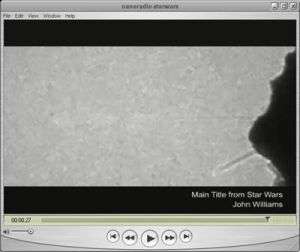
“To correlate the mechanical motions of the nanotube to an actual radio receiver operation, we launched an FM radio transmission of the song Good Vibrations by the Beach Boys,” said Zettl. “After being received, filtered, amplified, and demodulated all by the nanotube radio, the emerging signal was further amplified by a current preamplifier, sent to an audio loudspeaker and recorded. The nanotube radio faithfully reproduced the audio signal, and the song was easily recognizable by ear.”
When the researchers deliberately detuned the nanotube radio from the carrier frequency, mechanical vibrations faded and radio reception was lost. A “lock” on a given radio transmission channel could be maintained for many minutes at a time, and it was not necessary to operate the nanotube radio inside a TEM. Using a slightly different configuration, the researchers successfully transmitted and received signals across a distance of several meters.
“The integration of all the electronic components of a radio happened naturally in the nanotube itself,” said Jensen. “Within a few hours of figuring out that our force sensor was in fact a radio, we were playing music!”
Added Zettl, “Our nanotube radio is sophisticated and elegant in the physics of its operation, but sheer simplicity in technical design. Everything about it works perfectly, without additional patches or tricks.”
Berkeley Lab’s Technology Transfer Department is now seeking industrial partners to further develop and commercialize this technology.
Source: Lawrence Berkeley National Laboratory


