MIT's 'electronic nose' could detect hazards
A tiny "electronic nose" that MIT researchers have engineered with a novel inkjet printing method could be used to detect hazards including carbon monoxide, harmful industrial solvents and explosives.
Led by MIT professor Harry Tuller, the researchers have devised a way to print thin sensor films onto a microchip, a process that could eventually allow for mass production of highly sensitive gas detectors.
"Mass production would be an enormous breakthrough for this kind of gas sensing technology," said Tuller, a professor in the Department of Materials Science and Engineering (MSE), who is presenting the research Oct. 30 at the Composites at Lake Louise Conference in Alberta, Canada.
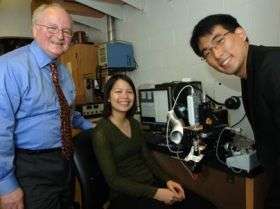
The prototype sensor, created by Tuller, postdoctoral fellow Kathy Sahner and graduate student Woo Chul Jung, members of MIT's Electroceramics Group in MSE, consists of thin layers of hollow spheres made of the ceramic material barium carbonate, which can detect a range of gases. Using a specialized inkjet print head, tiny droplets of barium carbonate or other gas-sensitive materials can be rapidly deposited onto a surface, in any pattern the researchers design.
The miniature, low-cost detector could be used in a variety of settings, from an industrial workplace to an air-conditioning system to a car's exhaust system, according to Tuller. "There are many reasons why it's important to monitor our chemical environment," he said.
For a sensor to be useful, it must be able to distinguish between gases. For example, a sensor at an airport would need to know the difference between a toxic chemical and perfume, Tuller said. To achieve this, sensors should have an array of films that each respond differently to different gases. This is similar to the way the human sense of smell works, Tuller explained.
"The way we distinguish between coffee's and fish's odor is not that we have one sensor designed to detect coffee and one designed to detect fish, but our nose contains arrays of sensors sensitive to various chemicals. Over time, we train ourselves to know that a certain distribution of vapors corresponds to coffee," he said.
In previous work designed to detect nitrogen oxide (NOx) emissions from diesel exhaust, the researchers created sensors consisting of flat, thin layers of barium carbonate deposited on quartz chips. However, the films were not sensitive enough, and the team decided they needed more porous films with a larger surface area.
To create more texture, they applied the barium carbonate to a layer of microspheres, hollow balls less than a micrometer in diameter made of a plastic polymer. When the microspheres are burned away, a textured, highly porous layer of gas-sensitive film is left behind.
The resulting film, tens of nanometers (billionths of a meter) thick, is much more sensitive than flat films because it allows the gas to readily permeate through the film and interact with a much larger active surface area.
At first, the researchers used a pipette to deposit the barium carbonate and microspheres. However, this process proved time-consuming and difficult to control.
To improve production efficiency, the researchers took advantage of a programmable Hewlett-Packard inkjet print head located in the MIT Laboratory of Organic Optics and Electronics. The inkjet print head, like that in a regular inkjet printer, can deposit materials very quickly and controllably. The special gas-sensitive "inks" used in this work were optimized for printing by Amy Leung, an MIT sophomore in chemical engineering.
This allows the researchers to rapidly produce many small, identical chips containing geometrically well-defined gas-sensing films with micrometer dimensions. Patterns of different gas-sensitive inks, just as in a color printer, can be easily generated to form arrays with very little ink required per sensor.
In future studies, the team hopes to create large arrays of gas-sensitive films with controlled three-dimensional shapes and morphologies.
Source: MIT


