Researchers identify the brain circuits that control hunger
October 31, 2007 Researchers identify the brain circuits that control hunger

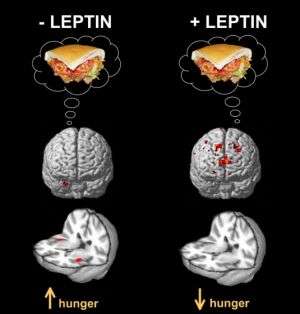
In adults who have a rare gene that confers leptin deficiency, food cues produce hunger and increase activity in the insula and other brain regions linked to hunger (left). Leptin supplementation reduces hunger while increasing activity in the prefrontal cortex, a brain region linked to inhibitory control and satiety (right).

Researchers at UCLA have identified the brain circuits involved in hunger that are influenced by the hormone leptin, the signaling molecule produced by fat cells. In clinical trials, leptin supplementation has produced moderate weight loss in some obese patients by inhibiting hunger and promoting feelings of satiety. The new findings suggest possible new therapeutic targets for obesity, an increasing problem in both adults and children.

Reporting in the Oct. 29 online edition of Proceedings of the National Academy of Science, Edythe London, professor of psychiatry at the Semel Institute for Neuroscience and Human Behavior at UCLA, Kate Baicy, a graduate student in London's lab, and colleagues report that leptin reduces activation in regions of the brain linked to hunger while enhancing activation in regions linked to inhibition and feelings of being full.

The researchers used functional magnetic resonance imaging (fMRI) to measure brain activity before and after leptin supplementation in three adults from a Turkish family who lack the leptin (ob) hormone due to a mutation. Such a mutation in the ob gene causes leptin deficiency and morbid obesity.

The study involved only three subjects, London said, because "having a genetic deficiency in leptin is extremely rare. We were fortunate in finding them."

Indeed, research published in 2005 by Dr. Julio Licinio, then a researcher at UCLA, used the same three family members to show that when leptin replacement was provided, body weight and eating behavior were normalized. Also in 2005, London and her team showed that leptin produced sustained changes in the tissue composition of the cerebral cortex in the same individuals.

To determine the neural circuits through which leptin alters human feeding behavior, the researchers showed images of food to the family members while they underwent fMRI imaging, both before and after leptin treatment. After leptin replacement, feelings of hunger induced by the images and activity in certain brain regions associated with hunger — the insular, parietal and temporal cortices — were reduced, while brain activity increased in the prefrontal cortex, an area of the brain previously associated with feeling full or satisfied.

London said that despite the limitations of having only three subjects with the ob mutation, "we think knowing the mechanisms by which leptin alters brain function in congenital leptin deficiency can provide understanding of normal leptin physiology. Ultimately, that may help identify new targets for the treatment of obesity and related metabolic disorders."

The research was supported in part by the National Institutes of Health and the UCLA General Clinical Research Center. During the course of this study, Amgen Inc. graciously provided leptin; Amylin Inc. now provides leptin to these patients. Neither Amgen nor Amylin contributed to the design, analysis or writing of this study.

Other authors involved with the study were John Monterosso, Tuncay Delibasi and Anil Sharma of the Semel Institute and the David Geffen School of Medicine at UCLA, and Ma-Li Wong and Julio Licinio of the University of Miami Miller School of Medicine.

Source: UCLA


print this article email this article download pdf blog this article bookmark this article     Stumble it Digg this share on Facebook retweet share on Reddit add to delicious
Rate this story - 4.3 /5 (8 votes)

Rank Filter

Move the slider to adjust rank threshold, so that you can hide some of the comments.


Display comments: newest first

  • legendmoth - Nov 02, 2007
    • Rank: not rated yet
    The article mentioned that lepton activates "regions linked to inhibition." Does a lack of leptin affect a persons ability to control other aspects of life unrelated to eating or only eating?

October 31, 2007 all stories

Comments: 1

4.3 /5 (8 votes)
  • Stumble this up

  • Digg this

  • share this

  • hide
  • Related Stories


  • hide
  • Relevant PhysicsForums posts

  • nesfatin
    created 13 hours ago
  • Obsessive Compulsive Disorder
    created Nov 20, 2009
  • West's zone 2 starling resistor respiratory physiology
    created Nov 18, 2009
  • 50-0-50 rule
    created Nov 18, 2009
  • More from Physics Forums - Medical Sciences

Other News

New cancer target for non-Hodgkin's lymphoma

Medicine & Health / Cancer

created 14 hours ago | popularity 5 / 5 (1) | comments 0

Physician-scientists from Weill Cornell Medical College have discovered a molecular mechanism that may prove to be a powerful target for the treatment of non-Hodgkin's lymphoma, a type of cancer that affects lymphocytes, ...


Surface bacteria maintain skin's healthy balance

Medicine & Health / Research

created 15 hours ago | popularity 5 / 5 (4) | comments 0

On the skin's surface, bacteria are abundant, diverse and constant, but inflammation is undesirable. Research at the University of California, San Diego School of Medicine now shows that the normal bacteria living on the ...


Gene mismatch influences success of bone marrow transplants

Medicine & Health / Genetics

created 14 hours ago | popularity 4 / 5 (1) | comments 0

A commonly inherited gene deletion can increase the likelihood of immune complications following bone marrow transplantation, an international team of researchers reports in the November 22 advance online issue of Nature Ge ...


New understanding about mechanism for cell death after stroke leads to possible therapy

Medicine & Health / Research

created 15 hours ago | popularity not rated yet | comments 0

Scientists at the Brain Research Centre, a partnership of the University of British Columbia Faculty of Medicine and Vancouver Coastal Health Research Institute, have uncovered new information about the mechanism by which ...


Cancer metabolism discovery uncovers new role of IDH1 gene mutation in brain cancer

Medicine & Health / Cancer

created 14 hours ago | popularity not rated yet | comments 0

Agios Pharmaceuticals today announced that its scientists have established, for the first time, that the mutated IDH1 gene has a novel enzyme activity consistent with a cancer-causing gene, or oncogene. This breakthrough ...