Researchers warn Gulf of Mexico 'dead zone' could grow
October 31st, 2007 Researchers warn Gulf of Mexico 'dead zone' could grow

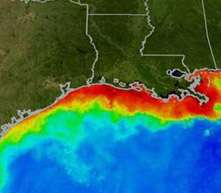
Photo courtesy of NASA/Goddard Space Flight Center Scientific Visualization Studio

The New Jersey-size Gulf of Mexico "dead zone" will likely grow in coming years unless federal policies to control it change, in part because the demand for corn-based ethanol fuel will worsen the problem, University of Michigan scientists say.

The dead zone forms each spring off the Louisiana and Texas coast when oxygen levels drop too low to support most life in bottom and near-bottom waters. This summer the oxygen-starved zone swelled to 7,900 square miles, the third-largest Gulf of Mexico dead zone recorded since measurements began in 1985.

Fertilizer runoff from as far away as the Corn Belt is largely blamed for the annual low-oxygen, or hypoxic, event, which threatens the half-billion-dollar Gulf Coast fishery, says U-M researcher Donald Scavia.

"We have made no progress in controlling it. And if we continue to put more land into corn because of the ethanol craze, then there'll be more nitrogen and larger dead zones," said Scavia, a U-M School of Natural Resources and Environment scientist who led the first federal integrated assessment of the Gulf dead zone in 2000.

In the journal Environmental Science & Technology, Scavia and U-M researcher Kristina Donnelly conclude that the best way to shrink the dead zone is to reduce amounts of two key nutrients—nitrogen and phosphorous—that flow down the Mississippi River and into the Gulf.

Previous efforts focused only on cutting nitrogen, which is used to make crop fertilizer.

Scavia and Donnelly took new U.S. Geological Survey estimates of nutrient levels entering the Mississippi River and plugged them into a U-M computer model that projects the future of Gulf hypoxia.

Their study showed that reducing phosphorous alone—a course advocated by some in the agricultural industry—could trigger the growth of even bigger dead zones in the waters of the western Gulf. Phosphorous is found in the discharge from sewage treatment plants, as well as in fertilizers.

The article will be available online Oct. 31 and will be published in the Dec. 1 hard-copy edition of Environmental Science & Technology.

"We understand what needs to be done, and the technology needed to do it is available," Scavia said. "All we really need is the political will and the funding."

The 2000 assessment concluded that excess nitrogen from fertilizers fueled the Gulf dead zone's growth in the 1970s. In 2001, a Hypoxia Action Plan was delivered to Congress and the president. Its goal was to shrink the dead zone by reducing nitrogen runoff into waterways.

The 2001 plan is now under review by the Environmental Protection Agency's Science Advisory Board. Scavia briefed the EPA panel on his latest computer-model results earlier this year, and the new nitrogen-and-phosphorous approach was adopted in the panel's recently released draft assessment.

"The data in this (Environmental Science & Technology) paper influenced that recommendation," Scavia said. "Prior to our paper, the EPA panel had no strong basis to come to the conclusion it did."

Each year in late spring and summer, nutrients from the Mississippi River fuel explosive algae blooms in the Gulf of Mexico. The algae eventually die and sink to the bottom, where bacteria decompose them, consuming oxygen in the process.

In this year's State of the Union address, President Bush called for the production of 35 billion gallons of ethanol by 2017, which would equal about 15 percent of U.S. liquid transportation fuels. In August, the Agriculture Department forecast a 2007 corn harvest of 85.4 million acres, the most since 1933 and 14.8 million more acres than last year.

Last month, the National Research Council issued a study concluding that projected increases in corn-based ethanol production could harm U.S. groundwater and rivers, as well as coastal and offshore waters.

Source: University of Michigan


print this article email this article download pdf blog this article bookmark this article     Digg this Stumble it share on Facebook share on Reddit add to delicious save to Yahoo! bookmarks
4.8/5 after 13 votes

Rank Filter

Move the slider to adjust rank threshold, so that you can hide some of the comments.


Display comments: newest first

  • forrest - Mar 15, 2008
    • Rank: not rated yet
    If the Oxygen level is low why can't windmills be set to pump the air into the ocean? Isn't that the way they do small ponds?

October 31st, 2007 all stories
Space & Earth / Environment

Comments: 1
Rank: 4.8/5 after 13 votes

  • Stumble this up

  • Digg this

  • Share it:
  • share on Facebook
  • share on MySpace
  • share on Slashdot
  • rss-newsfeed
  • share on Google
  • share on Reddit
  • add to delicious
  • save to Yahoo! bookmarks
  • share on Windows Live
  • Add to Mixx!
Rating: 4.8/5 after 13 votes

  • Related Stories

  • New study ranks 'hotspots' of human impact on coastal areas
    created 7 hours ago | popularity not rated yet | comments 0
  • Study highlights massive imbalances in global fertilizer use
    created Jun 22, 2009 | popularity not rated yet | comments 0
  • Is the Pacific Ocean's chemistry killing sea life?
    created Jun 21, 2009 | popularity not rated yet | comments 0
  • Study highlights massive imbalances in global fertilizer use
    created Jun 18, 2009 | popularity not rated yet | comments 0
  • Researchers predict large 2009 Gulf of Mexico 'dead zone'
    created Jun 18, 2009 | popularity not rated yet | comments 0

Tags


  • Transform a ball into a rock -- or make it invisible -- using transformation optics
    Transform a ball into a rock -- or make it invisible -- using transformation optics
    Physics / General Physics
    created 10 hours ago | popularity 3.7 / 5 (3) | comments 0
  • Could a quantum motor do work?
    Physics / General Physics
    created Jul 07, 2009 | popularity 4 / 5 (12) | comments 0
  • Physicists Demonstrate Quantum Memory with Matter Qubits
    Physicists Demonstrate Quantum Memory with Matter Qubits
    Physics / General Physics
    created Jul 03, 2009 | popularity 4.3 / 5 (21) | comments 1
  • 'Holey' Nanosheets for Wastewater Dye Removal
    Nanotechnology / Nanomaterials
    created Jul 01, 2009 | popularity 5 / 5 (5) | comments 1
  • Jellyfish Robot Swims Like its Biological Counterpart
    Jellyfish Robot Swims Like its Biological Counterpart
    Electronics / Robotics
    created Jun 26, 2009 | popularity 4.4 / 5 (9) | comments 1
  • Other News

    Living fossils hold record of 'supermassive' kick

    Living fossils hold record of 'supermassive' kick

    Space & Earth / Astronomy

    created 3 hours ago | popularity 4.5 / 5 (2) | comments 1

    The tight cluster of stars surrounding a supermassive black hole after it has been violently kicked out of a galaxy represents a new kind of astronomical object and a fossil record of the kick.


    Methane-eating microbes can use iron and manganese oxides to 'breathe'

    Methane-eating microbes can use iron and manganese oxides to 'breathe'

    Space & Earth / Earth Sciences

    created 6 hours ago | popularity 4.7 / 5 (3) | comments 0

    Iron and manganese compounds, in addition to sulfate, may play an important role in converting methane to carbon dioxide and eventually carbonates in the Earth's oceans, according to a team of researchers ...


    Tremors on southern San Andreas Fault may mean increased quake risk

    Tremors on southern San Andreas Fault may mean increased quake risk

    Space & Earth / Earth Sciences

    created 5 hours ago | popularity not rated yet | comments 0

    (PhysOrg.com) -- Increases in mysterious underground tremors observed in several active earthquake fault zones around the world could signal a build-up of stress at locked segments of the faults and presumably ...


    A Galaxy Collision in Action

    A Galaxy Collision in Action

    Space & Earth / Astronomy

    created 5 hours ago | popularity 4.8 / 5 (4) | comments 1

    This beautiful image gives a new look at Stephan's Quintet, a compact group of galaxies discovered about 130 years ago and located about 280 million light years from Earth. The curved, light blue ridge running ...


    Aerial view of a flooded area in Bolivia in 2007

    'El Nino' arrives in Pacific for a months-long stay

    Space & Earth / Earth Sciences

    created 6 hours ago | popularity 3 / 5 (1) | comments 0

    US scientists on Thursday said that the El Nino warming trend of the Pacific Ocean waters has returned, bringing with it almost certain changes in weather patterns around the world.