Catch a Comet - No Telescope Required
October 31, 2007 Catch a Comet - No Telescope Required

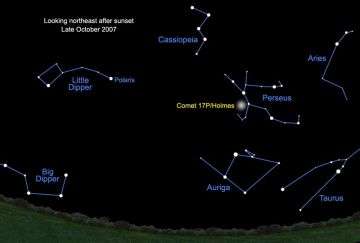
Sky chart showing location of comet Holmes in late October. Image credit: NASA/JPL

Usually comets are challenging little no-see-um fuzzballs. To see one often requires a dark sky, a good chart or a telescope that can "go-to" the object automatically.

This week there is a newly visible comet in the sky and it can be seen with the unaided eye! Last week, Periodic comet Holmes (17P/Holmes), a very faint comet far from the sun experienced an outburst and brightened a million times in just a few hours. The comet puffed up (it's still expanding), changed color and wowed viewers around the world.

The Astronomy Photo of the day for October 30 (visit http://antwrp.gsfc.nasa.gov/apod/ap071030.html) shows the comet's current apparent size in the sky - compared to Jupiter, which you can also see in the west after sunset.

To see the comet, all you have to do is step outside and look to the Northeast. You should be able to see the "W" that is the constellation Cassiopeia - it's standing on its end. One and a half "fists" away to the right is a bright star in the constellation Perseus.

You probably won't be able to see all the Perseus stars, but the bright one - Mirfak - should be visible. It marks the top of a triangle, which is about the size of your thumb held at arms length away. The triangle's lower left corner is the comet! Use our chart to the right to help find the comet.

The comet will stay with us for a while, so weather permitting, you'll get a look this week or next.

Source: by Veronica McGregor/JPL


print this article email this article download pdf blog this article bookmark this article     Stumble it Digg this share on Facebook retweet share on Reddit add to delicious
Rate this story - 4.3 /5 (13 votes)


October 31, 2007 all stories

Comments: 0

4.3 /5 (13 votes)
  • Stumble this up

  • Digg this

  • share this

  • hide
  • Related Stories

  • Astronomers unveil an amazing, interactive, 360-degree panoramic view of the entire night sky
    created Sep 14, 2009 | popularity not rated yet | comments 0
  • The Perseids are Coming
    created Aug 10, 2009 | popularity not rated yet | comments 0
  • STAR TRAK for November
    created Nov 03, 2008 | popularity not rated yet | comments 0
  • New comet discovered in Canada
    created Oct 14, 2008 | popularity not rated yet | comments 0
  • Mars makes a special appearance
    created Nov 01, 2007 | popularity not rated yet | comments 0


  • hide
  • Relevant PhysicsForums posts

  • Some help with a X-Ray astronomy question please!
    created 49 minutes ago
  • Help with Images and Optical Instrument Question..
    created 12 hours ago
  • Redshift as a distance indicator
    created 19 hours ago
  • Question about 2-body gravity
    created Nov 24, 2009
  • More from Physics Forums - General Astronomy

Other News

Past regional cold and warm periods linked to natural climate drivers

Space & Earth / Earth Sciences

created 16 hours ago | popularity 3.6 / 5 (12) | comments 18

Intervals of regional warmth and cold in the past are linked to the El Niño phenomenon and the so-called "North Atlantic Oscillation" in the Northern hemisphere's jet stream, according to a team of climate scientists. These ...


Astronauts surprised by holiday turkey dinners (AP)

Astronauts surprised by holiday turkey dinners

Space & Earth / Space Exploration

created 19 hours ago | popularity 5 / 5 (1) | comments 0

(AP) -- Space shuttle Atlantis' astronauts thought they were going to give thanks with pantry leftovers Thursday as their mission drew to a close, but found turkey dinners awaiting them.


Gullies and Flow Features on Crater Wall

Gullies and Flow Features on Crater Wall

Space & Earth / Space Exploration

created 20 hours ago | popularity 5 / 5 (1) | comments 0

(PhysOrg.com) -- This image from the High Resolution Imaging Science Experiment (HiRISE) camera on NASA's Mars Reconnaissance Orbiter shows a sample of the variety and complexity of processes that may occur ...


Thanksgiving last full day in space for shuttle (AP)

Thanksgiving last full day in space for shuttle

Space & Earth / Space Exploration

created 23 hours ago | popularity not rated yet | comments 0

(AP) -- Space shuttle Atlantis' astronauts will spend Thanksgiving checking their ship for the ride home.


Is global warming unstoppable?

Space & Earth / Environment

created Nov 23, 2009 | popularity 3.4 / 5 (34) | comments 42

In a provocative new study, a University of Utah scientist argues that rising carbon dioxide emissions - the major cause of global warming - cannot be stabilized unless the world's economy collapses or society builds the ...