Stem cells can improve memory after brain injury
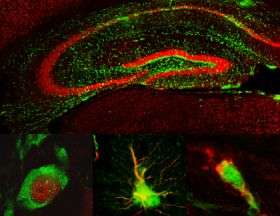
New UC Irvine research is among the first to demonstrate that neural stem cells may help to restore memory after brain damage.
In the study, mice with brain injuries experienced enhanced memory – similar to the level found in healthy mice – up to three months after receiving a stem cell treatment. Scientists believe the stem cells secreted proteins called neurotrophins that protected vulnerable cells from death and rescued memory. This creates hope that a drug to boost production of these proteins could be developed to restore the ability to remember in patients with neuronal loss.
“Our research provides clear evidence that stem cells can reverse memory loss,” said Frank LaFerla, professor of neurobiology and behavior at UCI. “This gives us hope that stem cells someday could help restore brain function in humans suffering from a wide range of diseases and injuries that impair memory formation.”
The results of the study appear Oct. 31 in the Journal of Neuroscience.
LaFerla, Mathew Blurton-Jones and Tritia Yamasaki performed their experiments using a new type of genetically engineered mouse that develops brain lesions in areas designated by the scientists. For this study, they destroyed cells in the hippocampus, an area of the brain vital to memory formation and where neurons often die.
To test memory, the researchers gave place and object recognition tests to healthy mice and mice with brain injuries. Memories of place depend upon the hippocampus, and memories of objects depend more upon the cortex. In the place test, healthy mice remembered their surroundings about 70 percent of the time, but mice with brain injuries remembered it just 40 percent of the time. In the object test, healthy mice remembered objects about 80 percent of the time, while injured mice remembered as poorly as about 65 percent of the time.
The scientists then set out to learn whether neural stem cells from a mouse could improve memory in mice with brain injuries. To test this, they injected each mouse with about 200,000 neural stem cells that were engineered to appear green under ultraviolet light. The color allows the scientists to track the stem cells inside the mouse brain after transplantation.
Three months after implanting the stem cells, the mice were tested on place recognition. The researchers found that mice with brain injuries that also received stem cells remembered their surroundings about 70 percent of the time – the same level as healthy mice. In contrast, control mice that didn’t receive stem cells still had memory impairments.
Next, the scientists took a closer look at how the green-colored stem cells behaved in the mouse brain. They found that only about 4 percent of them turned into neurons, indicating the stem cells were not improving memory simply by replacing the dead brain cells. In the healthy mice, the stem cells migrated throughout the brain, but in the mice with neuronal loss, the cells congregated in the hippocampus, the area of the injury. Interestingly, mice that had been treated with stem cells had more neurons four months after the transplantation than mice that had not been treated.
“We know that very few of the cells are becoming neurons, so we think that the stem cells are instead enhancing the local brain microenvironment,” Blurton-Jones said. “We have evidence suggesting that the stem cells provide support to vulnerable and injured neurons, keeping them alive and functional by making beneficial proteins called neurotrophins.”
If supplemental neurotrophins are in fact at the root of memory enhancement, scientists could try to create a drug that enhances the release or production of these proteins. Scientists then could spend less time coaxing stem cells to turn into other types of cells, at least as it relates to memory research.
“Much of the focus in stem cell research has been how to turn them into different types of cells such as neurons, but maybe that is not always necessary,” Yamasaki said. “In this case, we did not have to make neurons to improve memory.”
Source: UC Irvine


