Satellite data used to warn oil industry of potentially dangerous eddy
March 1, 2006 Satellite data used to warn oil industry of potentially dangerous eddy

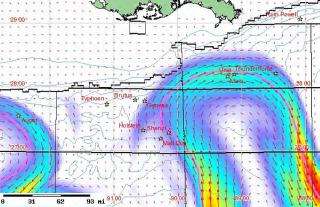
The forecast shows current speeds in the Loop progressively weakening, and the gap between the Loop and Eddy Walker increasing. Credits: Ocean Numerics 2006

Ocean FOCUS began issuing forecasts on 16 February 2006 – just in time to warn oil production operators of a new warm eddy that has formed in the oil and gas-producing region of the Gulf of Mexico.

These eddies, similar to underwater hurricanes, spin off the Loop Current – an intrusion of warm surface water that flows northward from the Caribbean Sea through the Yucatan Strait – from the Gulf Stream and can cause extensive and costly damage to underwater equipment due to the extensive deep water oil production activities in the region.

The Ocean FOCUS service is a unique service that provides ocean current forecasts to the offshore oil production industry to give prior warning of the arrival of eddies. The service is based on a combination of state-of-the-art ocean models and satellite measurements.

Oil companies require early warning of these eddies in order to minimise loss of production, optimise deep water drilling activities and prevent damage to critical equipment.

The Loop Current and eddies shedding from it pose two types of problems for underwater production systems: direct force and induced vibrations, which create more stress than direct force and results in higher levels of fatigue and structural failure.

The impact of these eddies can be very costly in terms of downtime in production and exploration and damage to sub sea components. Information provided by Ocean FOCUS gives industrial operators an accurate and up-to-date analysis of the present situation to support production management decisions.

In addition, Ocean FOCUS forecasts will be used by oil and gas companies planning major operations such as installing new equipment – which are very sensitive to local conditions and may require prolonged 'windows' of low current speed to achieve successful completion.

The Loop Current is presently to the north of its average position, sparking concerns that more eddies could be generated over the next few weeks. The current eddy, dubbed 'Walker', was detected breaking away from the Loop Current in mid February.

Source: European Space Agency


print this article email this article download pdf blog this article bookmark this article     Stumble it Digg this share on Facebook retweet share on Reddit add to delicious
Rate this story - 4.2 /5 (6 votes)


March 1, 2006 all stories

Comments: 0

4.2 /5 (6 votes)
  • Stumble this up

  • Digg this

  • share this

  • hide
  • Related Stories

  • Beyond sunlight: Explorers census 17,650 ocean species between edge of darkness and black abyss (w/ Video)
    created Nov 22, 2009 | popularity not rated yet | comments 0
  • Liquid battery big enough for the electric grid?
    created Nov 19, 2009 | popularity not rated yet | comments 0
  • One word: bioplastics
    created Nov 17, 2009 | popularity not rated yet | comments 0
  • Tackling new Arctic challenges from space
    created Nov 05, 2009 | popularity not rated yet | comments 0
  • INL scientist is harnessing the power of plasma
    created Oct 27, 2009 | popularity not rated yet | comments 0


Other News

Astronauts rest up after 3 spacewalks

Space & Earth / Space Exploration

created 37 minutes ago | popularity not rated yet | comments 0

(AP) -- The astronauts aboard the orbiting shuttle-station complex are resting after their three successful spacewalks.


Kepler Mission Manager Update

Space & Earth / Space Exploration

created 14 minutes ago | popularity not rated yet | comments 0

(PhysOrg.com) -- Kepler experienced a safe mode event on Nov. 18, 2009.


'Cosmic fruit machine' matches collisions

'Cosmic fruit machine' matches collisions

Space & Earth / Astronomy

created 2 hours ago | popularity not rated yet | comments 0

(PhysOrg.com) -- A new website will give everyone the chance to contribute to science by playing a 'cosmic fruit machine' and compare images of colliding galaxies with millions of simulated images of galactic ...


New computer-developed map shows more extensive valley network on Mars

New computer-developed map shows more extensive valley network on Mars

Space & Earth / Space Exploration

created 15 hours ago | popularity 4.5 / 5 (8) | comments 0

New research adds to the growing body of evidence suggesting the Red Planet once had an ocean.


Supervolcano eruption -- in Sumatra -- deforested India 73,000 years ago

Supervolcano eruption -- in Sumatra -- deforested India 73,000 years ago

Space & Earth / Earth Sciences

created 17 hours ago | popularity 4.3 / 5 (10) | comments 2

A new study provides "incontrovertible evidence" that the volcanic super-eruption of Toba on the island of Sumatra about 73,000 years ago deforested much of central India, some 3,000 miles from the epicenter, ...