Scientists rotate electron spin with electric field
November 1, 2007 Scientists rotate electron spin with electric field

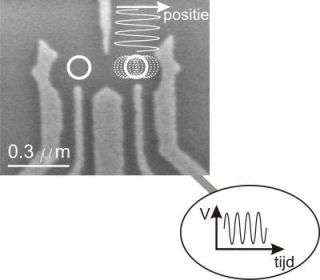
An electron microscope photo of a nanostructure similar to that used in the experiment. The light-grey colors show the metal structure (made of gold) used to create an electric trap (white lines) for the electrons. A voltage (V) that changes with time is applied to the rightmost piece of metal. As a result, the electron, which is locked in the right trap, feels an electric field. This electric field causes the electron to move (white dotted line), so that the position of the electron changes with time. Credit: TU Delft

Researchers at the Delft University of Technology’s Kavli Institute of Nanoscience and the Foundation for Fundamental Research on Matter (FOM) have succeeded in controlling the spin of a single electron merely by using electric fields. This clears the way for a much simpler realization of the building blocks of a (future) super-fast quantum computer.

The scientists will publish their work in Science Express on Thursday 1 November.

Controlling the spin of a single electron is essential if this spin is to be used as the building block of a future quantum computer. An electron not only has a charge but, because of its spin, also behaves as a tiny magnet.

In a magnetic field, the spin can point in the same direction as the field or in the opposite direction, but the laws of quantum mechanics also allow the spin to exist in both states simultaneously. As a result, the spin of an electron is a very promising building block for the yet-to-be-developed quantum computer; a computer that, for certain applications, is far more powerful than a conventional computer.

At first glance it is surprising that the spin can be rotated by an electric field. However, we know from the Theory of Relativity that a moving electron can ‘feel’ an electric field as though it were a magnetic field. Researchers Katja Nowack and Dr. Frank Koppens therefore forced an electron to move through a rapidly-changing electric field. Working in collaboration with Prof. Yuli V. Nazarov, theoretical researcher at the Kavli Institute of Nanoscience Delft, they showed that it was indeed possible to turn the spin of the electron by doing so.

The advantage of controlling spin with electric fields rather than magnetic fields is that the former are easy to generate. It will also be easier to control various spins independently from one another - a requirement for building a quantum computer - using electric fields. The team, led by Dr. Lieven Vandersypen, is now going to apply this technique to a number of electrons.

Source: Delft University of Technology


print this article email this article download pdf blog this article bookmark this article     Stumble it Digg this share on Facebook retweet share on Reddit add to delicious
Rate this story - 4.7 /5 (54 votes)


November 1, 2007 all stories

Comments: 0

4.7 /5 (54 votes)
  • Stumble this up

  • Digg this

  • share this

  • hide
  • Related Stories


  • hide
  • Relevant PhysicsForums posts

  • How do you separate things from centrifugal force?
    created 2 hours ago
  • Physical Science...need help
    created 2 hours ago
  • Calculating a Damping Constant
    created 4 hours ago
  • Bodies in motionÂ…..
    created 6 hours ago
  • More from Physics Forums - General Physics

Other News

The LHC tunnel

Peckish bird briefly downs big atom smasher

Physics / General Physics

created 16 hours ago | popularity 3.8 / 5 (9) | comments 11

A peckish bird briefly knocked out part of the world's biggest atom smasher by causing a chain reaction with a piece of bread, the European Organisation for Nuclear Research (CERN) said Monday.


First Bose-Einstein condensation of strontium

First Bose-Einstein condensation of strontium

Physics / Quantum Physics

created 10 hours ago | popularity 5 / 5 (4) | comments 1

In an international first, scientists from the Institute of Quantum Optics and Quantum Information (IQOQI, Austria) produced a Bose-Einstein condensate of the alkaline-earth element strontium, thus narrowly ...


Solving big problems

Solving big problems with new quantum algorithm

Physics / Quantum Physics

created 4 hours ago | popularity 4.3 / 5 (10) | comments 0

(PhysOrg.com) -- In a recently published paper, Aram Harrow at the University of Bristol and colleagues from MIT in the United States have discovered a quantum algorithm that solves large problems much faster ...


Ginzburg helped develop the Soviet Union's hydrogen bomb in the late 1940s and early 1950s

Russian bomb physicist Ginzburg dead at 93

Physics / General Physics

created 18 hours ago | popularity 5 / 5 (4) | comments 0

Nobel Physics prize winner Vitaly Ginzburg, who helped develop the Soviet hydrogen bomb, has died at age 93, the Russian Academy of Sciences said Monday.


Contracts Awarded for Production of NSLS-II Storage Ring Magnets

Physics / General Physics

created 2 hours ago | popularity not rated yet | comments 0

(PhysOrg.com) -- All seven contracts for the production of the NSLS-II storage ring magnets have now been awarded -- a significant milestone for the project. The magnets -- 750 in total -- will be made by vendors in the United ...