Rutgers physicists show how electrons 'gain weight' in metal compounds near absolute zero
Rutgers University physicists have performed computer simulations that show how electrons become one thousand times more massive in certain metal compounds when cooled to temperatures near absolute zero – the point where all motion ceases. The models may provide new clues as to how superconductivity works and how new superconducting materials could be fabricated.
In a paper posted to Science Express, a Web site of research reports slated for upcoming print editions of Science, the researchers describe how electrons interact with other particles in these compounds to morph into what physicists call a fluid of “heavy quasiparticles” or a “heavy fermion fluid.” While this effect has been previously observed in some materials, the Rutgers work employs new materials to provide a level of detail that has eluded scientists so far.
“In this paper, we essentially track the fate of electrons as we lower the temperature,” said Gabi Kotliar, Board of Governors Professor of Physics in the School of Arts and Sciences. “Experimental physicists may have seen different aspects of this behavior, or they may have seen behaviors they did not understand. Our calculations reconcile what they’ve seen.”
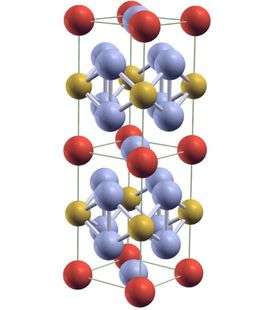
The Rutgers researchers based their models on experiments using a new metallic crystalline compound made of the elements cerium, indium and iridium. This and similar compounds that substitute cobalt and rhodium for iridium are excellent test beds for observing heavy electron behavior.
Earlier investigations used high-temperature superconducting materials called cuprates, which failed to give physicists a clear view of electron behavior because of disorders in the crystalline structure caused by doping. The new cerium-based compounds are simpler to study because they are free of dopants.
“The new compounds are for us what fruit flies are for genetics researchers,” said Kristjan Haule, assistant professor of physics and astronomy. “Fruit flies are easy to breed and have a simple gene makeup that’s easy to change. Likewise, these compounds are easy to make, structurally straightforward and adjustable, giving us a clearer view into the many properties of matter that arise at low temperatures. For example, we can use a magnetic field to kill superconductivity and examine the state of matter from which superconductivity arose.”
These compounds are examples of strongly correlated materials, or materials with strongly interacting electrons, that can’t be described by theories that treat electrons as largely independent entities. The terms “heavy quasiparticles” refers to how electrons interact with each other and, as a result of those interactions, form a new type of particle called a “quasiparticle.”
In explaining how this effect appears at low temperatures and vanishes at higher ones, Haule noted that electrons in f-orbitals are tightly bound to cerium atoms at room temperature. But as the temperature drops, the electrons exhibit coherent behavior, or delocalization from their atoms. At 50 degrees above absolute zero, or 50 degrees Kelvin, the researchers clearly observe quasiparticles as electrons interact with each other and other electrons in the metal known as conduction electrons.
Source: Rutgers University


