New designer toxins kill Bt-resistant insect pests
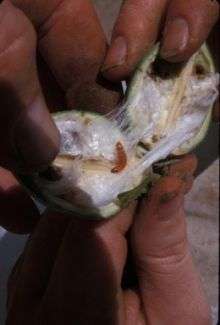
A new way to combat resistant pests stems from discovering how the widely used natural insecticide Bt kills insects. Figuring out how Bt toxins punch holes in the cells of an insect's gut was the key to designing the new toxins, according to a Mexico-U.S. research team.
Some insects have developed resistance to Bt toxins, naturally occurring insecticides used worldwide to combat pests of crops such as cotton and corn and also disease-carrying mosquitoes.
"This is the first time that knowledge of how Bt toxins work and how insects become resistant have been used to design toxins that kill resistant insects," said research team member Bruce Tabashnik of The University of Arizona in Tucson.
The discovery is important for cotton-growing areas such as northern Mexico, Texas and Arizona. More than 90 percent of Arizona's approximately 200,000 acres of cotton are planted in the biotech cotton known as Bt cotton.
"Our goal is to control insects in environmentally friendly ways so we can limit the damage that insects do to crops and the harm they do to people by transmitting disease," said Tabashnik, head of the UA's entomology department and a member of the UA's BIO5 Institute.
"Bt toxins are great for that because they only kill certain insects and don't harm other living things. These new designer toxins give us another environmentally friendly way to control insects."
The Mexico team developed the designer toxins by tweaking the gene that codes for the toxin, a protein. The researchers then teamed up with Tabashnik to test their modified toxins on UA's colony of Bt-resistant pink bollworms, major cotton pests.
Team member Alejandra Bravo, a research scientist at Universidad Nacional Autonóma de México (UNAM) said, "We proposed that changing a small part of the toxin would kill the insect -- and we did it."
The team's research article, "Engineering Modified Bt Toxins to Counter Insect Resistance," is scheduled for publication in Science Express, the online version of the journal Science, on Thursday, Nov. 1.
The collaboration between the UNAM team of molecular biologists and the American expert in the evolution of pest resistance happened by accident.
Mario Soberón and Alejandra Bravo, a husband-wife research team, had invited Tabashnik to give a talk in Cuernavaca, Mexico, at a scientific conference on pore-forming bacterial toxins such as Bt solution.
Tabashnik said, "While I was there, I got turista -- which is caused by pore-forming bacterial toxins. I was pretty sick."
The couple cared for Tabashnik while he recovered. He asked what he could do to repay their kindness, and Soberón suggested collaborating to test their designer toxins on UA's resistant insects.
"It was the perfect match," Tabashnik said. "We knew what made our strains resistant, and they hypothesized that their designer toxins could overcome the resistance."
The discovery is based on understanding a receptor molecule called cadherin on the insects' gut membranes. Normal cadherin binds with the Bt toxin in a lock-and-key fashion.
After the toxin binds, an enzyme hacks a bit off each toxin molecule.
The trimmed toxin molecules clump and form pores in the gut membrane cells. The pores let materials flow chaotically in and out of the cells. As a result cells and ultimately the insect die.
Tabashnik and his UA colleagues Tim Dennehy and Yves Carrière knew the Bt-resistant pink bollworms in their colony had a mutant version of cadherin.
Tabashnik said, "These resistant insects have genetic changes, mutations, that change the lock. Their cadherin no longer takes the key."
The UNAM team did an end-run around the resistant insects' strategy. The modified, or designer, toxins have that crucial bit already gone, so they clump and form the death-dealing pores. No cadherin needed.
Bravo said, "When Bruce told us it killed the insects, we were very happy. We know if it kills resistant insects, it will be very important."
The researchers have applied for a multinational patent for the designer toxins. UNAM is the lead organization in the patent.
Combating Bt-resistant pests without using broad-spectrum insecticides can make agriculture safer for farm workers, better for the environment and more profitable for growers, Tabashnik said.
He said, "The university research that helped produce this new invention is an investment that can bring returns to the state of Arizona.”
Source: University of Arizona


