Sweet potato shines as new promise for small enterprise and hunger relief in developing countries
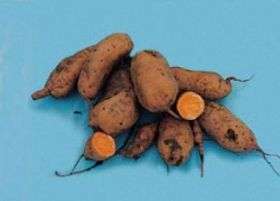
Sweetpotatoes, often misunderstood and underrated, are receiving new attention as a life-saving food crop in developing countries.
According to the International Potato Center (www.cipotato.org), more than 95 percent of the global sweetpotato crop is grown in developing countries, where it is the fifth most important food crop. Despite its name, the sweetpotato is not related to the potato. Potatoes are tubers (referring to their thickened stems) and members of the Solanaceae family, which also includes tomatoes, red peppers, and eggplant. Sweetpotatoes are classified as "storage roots" and belong to the morning-glory family.
Scientists believe that sweetpotatoes were domesticated more than 5,000 years ago and reportedly introduced into China in the late 16th century. Because of its hardy nature and broad adaptability, sweetpotato spread through Asia, Africa, and Latin America during the 17th and 18th centuries. It is now grown in more developing countries than any other root crop.
Sweetpotato has a long history as a lifesaving crop. When typhoons demolished thousands of rice fields, Japanese farmers turned to sweetpotato to sustain their country. Sweetpotato kept millions from starvation in famine-plagued China in the early 1960s, and in Uganda, where a virus ravaged cassava crops in the 1990s, the hardy hero came to the rescue, nourishing millions in rural communities.
Rich in carbohydrates and vitamin A, sweetpotatoes are nutrition superstars. Uses range from consumption of fresh roots or leaves to processing into animal feed, starch, flour, candy and alcohol. Because of its versatility and adaptability, sweetpotato ranks as the world’s seventh most important food crop (following wheat, rice, maize, potato, barley, and cassava). Globally, more than 133 million tons of the underrated, vitamin-packed root are produced each year.
Despite its storied history, sweetpotato has received relative little attention from crop improvement research. To bring attention to the issue, a recent study was published by the American Society for Horticultural Science (www.ashs.org). For the study, researchers conducted a survey of 36 scientists from 21 developing countries to solicit opinions on key constraints affecting the productivity of small sweetpotato producers.
Keith Fuglie, of the Resources and Rural Economics Division at the United States Department of Agriculture's Economic Research Service, led the study. He found consistent key constraints in all major sweetpotato producing areas. Survey respondents indicated that the priority needs in developing countries were: control of viruses, small-enterprise development for sweetpotato processing, improvement in availability and quality of sweetpotato planting material and improved cultivars exhibiting high and stable yield potential.
Some differences emerged, however, in priority needs of the two major centers of sweetpotato production—Sub-Saharan Africa and China. Additional priorities for Sub-Saharan Africa included improved control of the sweetpotato weevil and cultivars with high beta carotene content to address Vitamin A deficiency. For China, priorities included: conservation and characterization of genetic resources, prebreeding, cultivars with high starch yield and new product development. According to Fuglie, the different sets of priorities reflect differences in the role of sweetpotato in the rural economy and also different capacities of the agricultural research system in these regions of the world.
Fuglie noted that "these findings could help agricultural scientists working for national and international institutions establish their priorities for sweetpotato crop improvement research. Focusing research on the key productivity constraints facing sweetpotato farmers in a particular country or region will increase the likelihood of farmer adoption and potential impact of the technology resulting from that research."
Principal beneficiaries of the research study will be small-scale sweetpotato farmers in developing countries. Fuglie hopes that emerging technologies based on research will be available for sweetpotato farmers within 5 to 10 years.
Source: American Society for Horticultural Science


