New mini-sensor may have biomedical and security applications
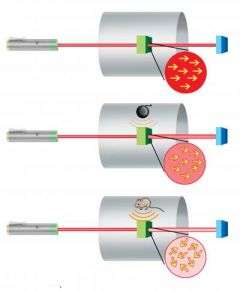
A tiny sensor that can detect magnetic field changes as small as 70 femtoteslas-equivalent to the brain waves of a person daydreaming-has been demonstrated at the National Institute of Standards and Technology (NIST). The sensor could be battery-operated and could reduce the costs of non-invasive biomagnetic measurements such as fetal heart monitoring. The device also may have applications such as homeland security screening for explosives.
Described in the November issue of Nature Photonics, the prototype device is almost 1000 times more sensitive than NIST's original chip-scale magnetometer demonstrated in 2004 and is based on a different operating principle. Its performance puts it within reach of matching the current gold standard for magnetic sensors, so-called superconducting quantum interference devices or SQUIDs. These devices can sense changes in the 3- to 40-femtotesla range but must be cooled to very low (cryogenic) temperatures, making them much larger, power hungry, and more expensive.
The NIST prototype consists of a single low-power (milliwatt) infrared laser and a rice-grain-sized container with dimensions of 3 by 2 by 1 millimeters. The container holds about 100 billion rubidium atoms in gas form. As the laser beam passes through the atomic vapor, scientists measure the transmitted optical power while varying the strength of a magnetic field applied perpendicular to the beam. The amount of laser light absorbed by the atoms varies predictably with the magnetic field, providing a reference scale for measuring the field. The stronger the magnetic field, the more light is absorbed.
"The small size and high performance of this sensor will open doors to applications that we could previously only dream about," project leader John Kitching says.
The new NIST mini-sensor could reduce the equipment size and costs associated with some non-invasive biomedical tests. (The body's electrical signals that make the heart contract or brain cells fire also simultaneously generate a magnetic field.) The NIST group and collaborators have used a modified version of the original sensor to detect magnetic signals from a mouse heart. The new sensor is already powerful enough for fetal heart monitoring; with further work, the sensitivity can likely be improved to a level in the 10 femtotesla range, sufficient for additional applications such as measuring brain activity, the designers say. A femtotesla is one quadrillionth (or a millionth of a billionth) of a tesla, the unit that defines the strength of a magnetic field. For comparison, the Earth's magnetic field is measured in microteslas, and a magnetic resonance imaging (MRI) system operates at several teslas.
To make a complete portable magnetometer, the laser and vapor cell would need to be packaged with miniature optics and a light detector. The vapor cell can be fabricated and assembled on semiconductor wafers using existing techniques for making microelectronics and microelectromechanical systems (MEMS). This design, adapted from a previously developed NIST chip-scale atomic clock, offers the potential for low-cost mass production.
As described in the new paper, NIST scientists demonstrated that the prototype mini-sensor produces a strong signal that changes rapidly with the strength of a magnetic field from the outside world. The device exhibits a consistent minimum level of electromagnetic static, or "white noise," which indicates a stable limit on its overall sensitivity. The authors also estimated that a well-designed compact magnetometer with present sensitivity could operate continuously for weeks on a single AA battery. Magnetometers need to be designed with applications in mind; smaller vapor cells require less power but are also less sensitive. Thus, an application for which low power is critical would benefit from a very small magnetometer, whereas a larger magnetometer would be more suitable for a different application requiring high sensitivity. The NIST work evaluates the tradeoffs between size, power and performance in a quantifiable way.
"This result suggests that millimeter-scale, low-power, inexpensive, femtotesla magnetometers are feasible ... Such an instrument would greatly expand the range of applications in which atomic magnetometers could be used," the paper states.
The NIST device could be used in a heart monitoring technique known as magnetocardiography (MCG), which is sensitive enough to measure fields of few picoteslas emitted by the fetal heart from small currents in heart muscle cells, providing complementary and perhaps better information than an electrocardiogram. With further improvements, the NIST sensor also might be used in magnetoencephalography (MEG), which measures the magnetic fields produced by electrical activity in the brain, helping to pinpoint tumors or determine function of various parts of the brain. The existing mini-sensor likely will be able to detect some brain activity, such as the signals from alpha waves, which are about 1 picotesla in magnitude at a distance of 1 centimeter from the skull surface, but not the fainter signals from the full range of brain function. (Signals of magnitude 1 picotesla are identifiable with a magnetometer sensitivity of 70 femtotesla per root Hertz.) MCG and MEG offer the advantage of not requiring contrast agents or injected tracers as do other medical procedures such as MRI or positron emission tomography (PET).
Potential NIST collaborators are interested in making a portable MEG helmet that could be worn by epileptics to record brain activity before and during seizures. The devices would be much smaller and lighter than the SQUID helmets currently used for such studies. Kitching said the NIST sensor also may have applications in MRI or in airport screening for explosives based on detection of nuclear quadrupole resonance in nitrogen compounds.
As a non-regulatory agency of the Commerce Department, NIST promotes U.S. innovation and industrial competitiveness by advancing measurement science, standards and technology in ways that enhance economic security and improve our quality of life.
Citations:
Vishal Shah, Svenja Knappe, Peter D.D. Schwindt, and John Kitching. Femtotesla Atomic Magnetometry with a Microfabricated Vapor Cell. Nature Photonics. 1 November 2007.
Brad Lindseth, Peter Schwindt, John Kitching, David Fischer, Vladimir Shusterman. 2007. Non-contact Measurement of Cardiac Electromagnetic Field in Mice Using an Ultra-small Atomic Magnetometer. Feasibility Study. Presented at Computers in Cardiology, Durham, NC, Sept 30-Oct. 3, 2007.
Source: NIST


