White Dwarf 'Sibling Rivalry' Explodes into Supernova
November 1, 2007 White Dwarf 'Sibling Rivalry' Explodes into Supernova

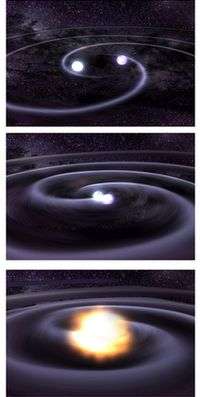
This artist´s conception shows two white dwarf stars spiraling in toward each other until they collide. A collision like this is believed to have spawned supernova 2006gz. Credit: NASA/Dana Berry, Sky Works Digital

Astronomers at the Harvard-Smithsonian Center for Astrophysics (CfA) have found that a supernova discovered last year was caused by two colliding white dwarf stars. The white dwarfs were siblings orbiting each other. They slowly spiraled inward until they merged, touching off a titanic explosion. CfA observations show the strongest evidence yet of what was, until now, a purely theoretical mechanism for creating a supernova.

"This finding shows that nature may be richer than we suspected, with more than one way to make a white dwarf explode," said Harvard graduate student and first author Malcolm Hicken.

The paper describing this discovery appeared in the November 1 issue of The Astrophysical Journal Letters.

Astronomers characterize an observed supernova based on whether its spectrum shows evidence of hydrogen (Type II) or not (Type I). In Type II, a massive, short-lived star undergoes core collapse and explodes. In the conventional picture for Type Ia, the most common supernovae lacking hydrogen, a white dwarf star collects gas from a companion star until it undergoes catastrophic nuclear fusion and blasts itself apart.

The new find, supernova 2006gz, was classified as a Type Ia due to the lack of hydrogen and other characteristics. However, an analysis combining CfA data with measurements from The Ohio State University suggested that SN 2006gz was unusual and deserved a closer look.

Most importantly, SN 2006gz showed the strongest spectral signature of unburned carbon ever seen. Merging white dwarfs are expected to have carbon outside their densest regions. The powerful explosion from the inside then should push off the outmost carbon-rich layers.

The spectrum of SN 2006gz also showed evidence for compressed layers of silicon. Silicon was created during the explosion and then compressed by a shock wave that rebounded from the surrounding layers of carbon and oxygen. Computer models for merging white dwarfs predict both the carbon and silicon spectral signatures.

Additionally, SN 2006gz was brighter than expected, indicating that its progenitor exceeded the 1.4 solar mass Chandrasekhar limit – the upper bound for a single white dwarf. Only one other potential example of a super-Chandrasekhar supernova has been seen: SN 2003fg. While observations of that event were suggestive, the data from SN 2006gz are much stronger.

"Our case is different. Although 2006gz is also extra bright, the chemistry we see, particularly unburned carbon, is well observed and very unusual," said Harvard astronomer Robert Kirshner, a member of the discovery team.

In addition to providing the first example of a new way to make supernovae, SN 2006gz holds implications for the field of cosmology. Type Ia supernovae typically have a narrow spread in brightness, which makes them useful as "standard candles" for calculating cosmic distances. It was the study of Type Ia supernovae that led to the discovery of dark energy, the mysterious force causing the expansion of the universe to accelerate.

If Type Ia supernovae are more varied than previously expected, then astronomers must be extra cautious when using them to study the cosmos.

"Supernova 2006gz stands out from normal Type Ia objects and wouldn’t be included in cosmology studies," commented Hicken. "But we have to be careful not to mistake a double white dwarf explosion for a single white dwarf blast. SN 2006gz was easy to recognize, but there may be less clear-cut cases."

Source: Harvard-Smithsonian Center for Astrophysics


print this article email this article download pdf blog this article bookmark this article     Stumble it Digg this share on Facebook retweet share on Reddit add to delicious
Rate this story - 4.7 /5 (23 votes)


November 1, 2007 all stories

Comments: 0

4.7 /5 (23 votes)
  • Stumble this up

  • Digg this

  • share this

  • hide
  • Related Stories

  • New type of supernova explosion reported; predicted by theoretical physicists at UCSB
    created Nov 05, 2009 | popularity not rated yet | comments 0
  • Rapid supernova could be new class of exploding star
    created Nov 05, 2009 | popularity not rated yet | comments 0
  • Review: Motorola's Droid is a serious smart phone
    created Nov 04, 2009 | popularity not rated yet | comments 0
  • Powerful pumpkins, super squash
    created Nov 04, 2009 | popularity not rated yet | comments 0
  • Sustainably grown garlic
    created Nov 03, 2009 | popularity not rated yet | comments 0


  • hide
  • Relevant PhysicsForums posts

  • The shape of our solar system's orbits.
    created Nov 07, 2009
  • Above or Below the Line of Nodes
    created Nov 07, 2009
  • Supernova vs. Nova?
    created Nov 07, 2009
  • Supernova's Gamma Rays and Comets
    created Nov 06, 2009
  • More from Physics Forums - General Astronomy

Other News

NASA satellites make a movie and get rainfall, wind info on Ida

NASA satellites make a movie and get rainfall, wind info on Ida (w/ Video)

Space & Earth / Earth Sciences

created 1hour ago | popularity not rated yet | comments 0

NASA satellites are amazing examples of technology. The TRMM satellite peers into tropical cyclones and can tell how much rain is falling per hour and where. QuikScat uses microwave technology to measure Ida's ...


L-R: Chiwetel Ejiofor, Amanda Peet and John Cusack at the premiere of "2012"

NASA on crusade to debunk 2012 apocalypse myths

Space & Earth / Space Exploration

created 54 minutes ago | popularity not rated yet | comments 0

The world is not coming to an end on December 21, 2012, the US space agency insisted Monday in a rare campaign to dispel widespread rumors fueled by the Internet and a new Hollywood movie.


NASA's GOES Project offers real-time hurricane alley movies

NASA's GOES Project offers real-time hurricane alley movies

Space & Earth / Earth Sciences

created 45 minutes ago | popularity not rated yet | comments 0

People love to get the big picture of hurricane alleys, and thanks to the GOES Project at NASA's Goddard Space Flight Center in Greenbelt, Md., they can now get real-time satellite animations of the eastern ...


Antarctica glacier retreat creates new carbon dioxide store

Antarctica glacier retreat creates new carbon dioxide store

Space & Earth / Earth Sciences

created 5 hours ago | popularity 5 / 5 (2) | comments 0

Large blooms of tiny marine plants called phytoplankton are flourishing in areas of open water left exposed by the recent and rapid melting of ice shelves and glaciers around the Antarctic Peninsula. This ...


NASA's TRMM Satellite sees most of Ida's heaviest rain stayed off coasts

NASA's TRMM Satellite sees most of Ida's heaviest rain stayed off coasts

Space & Earth / Earth Sciences

created 1hour ago | popularity not rated yet | comments 0

NASA and the Japanese Space Agency's Tropical Rainfall Measuring Mission (TRMM) satellite flew over Ida and captured her rainfall when she passed by Nicaragua, Honduras and Belize this weekend. TRMM data revealed ...