Students devise novel way to detect urinary catheter infections
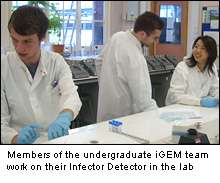
A biological sensor that catches infections on hospital catheters at an early stage has been developed by Biochemistry and Bioengineering students and researchers at Imperial College London.
The device, which aims to prevent painful urinary infections in elderly hospital patients, is Imperial's entry in this year's International Genetically Engineered Machines (iGEM) competition, held at MIT on 3 – 4 November 2007.
The sensing device consists of a genetically engineered device suspended in liquid that could be painted onto the end of a catheter outside the patient's body. This liquid contains a protein which seeks out and latches onto a small molecule called AHL, which is secreted by bacteria and found in these kinds of infections. When AHL is present and intercepted by these molecular devices, a second protein is activated, which glows green. This causes the liquid on the catheter to change colour, fluorescing a green colour, indicating the presence of an early-stage infection.
Professor Richard Kitney of Imperial's Department of Bioengineering, one of the academics supervising the project, explained the significance of their invention, saying: "Normally, in hospitals, doctors and nurses only find out that a patient has a urinary infection from their catheter when the patient's temperature rises and they become ill. By the time these symptoms are displayed, the infection has travelled up the catheter into the body, which is very serious if left untreated.
"Our device would mean that healthcare workers would get a clear early warning sign – in the form of a fluorescing green signal – that an infection was present on the catheter. This would allow them to perform basic disinfection, removing the bacteria from the catheter, before it could take hold in the patient."
The student team – consisting of 10 undergraduate students from the Departments of Life Sciences and Bioengineering – are flying out to MIT in Massachusetts this weekend to present their project to the iGEM judges, alongside student teams from 69 other universities from around the world. The iGEM competition was established in 2004 by MIT to promote student involvement in the emerging field of synthetic biology - an emerging science which merges engineering approaches with biology to use cells as manufacturing units.
Professor Paul Freemont from Imperial's Department of Life Sciences who is also supervising the iGEM team explained why getting undergraduate students involved in projects like this is so important: "Synthetic biology is a brand new type of science where we manipulate DNA to create biological devices based on engineering principles. It's an exciting field with countless possible applications, and MIT's iGEM competition ensures that some of the world's brightest young students get hands-on experience of devising some of these applications themselves."
James Chappell, one of the Imperial undergraduates on the team said: "The iGEM project has been an excellent experience. It has helped me build confidence and understanding in the field of biology and in addition has given me new insights into the methodology of engineering Biology. For the first time I have seen a project – our Infector Detector – develop from the initial brainstorming sessions to a functional synthetic machine. I have fully enjoyed my iGEM experience and I am looking forward to the jamboree at MIT for the opportunity to promote our project and learn of other iGEM projects."
Professor Freemont added: "Last year's team of Imperial undergraduates scooped second place in the competition, so we're hoping to go one better and win outright this year! I think our entry is very strong, as it shows how the principles of synthetic biology can be applied to a real-life problem in a healthcare environment."
Source: Imperial College London


