Engineers Teach Nature to 'Grow' Computer Components
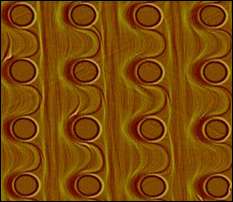
November 1, 2007 Engineers Teach Nature to 'Grow' Computer Components

Credit: Clark School of Engineering

Computers don't grow on trees, but with a little prodding from engineers, nature can produce computer components.

At the University of Maryland's A. James Clark School of Engineering, Ray Phaneuf, associate professor of materials science and engineering, has developed a template that nature can follow to produce "self-assembling" structures. The template causes atoms to be arranged in a defined pattern that can serve a variety of purposes - a semiconductor in a laptop, a component in a cell phone or a sensor in a wearable device.

The idea of self-assembly in nature has long been known - crystallization is one such process; the formation of shells into spirals is another. However, researchers have been limited to the designs that nature already knows how to make. Phaneuf's work introduces a man-made template that nature then follows, addressing a number of manufacturing difficulties.

While we understand how to make working nanoscale devices, making things out of a countable number of atoms takes a long time," Phaneuf said. "Industry needs to be able to mass-produce them on a practical time scale."

The template process can be used by device manufacturers to mass-produce tiny components rapidly and efficiently, reduce costs, shrink device sizes, and improve devices' functionality in ways previously not possible.

"The same template can be used thousands of times," Phaneuf said. "This results in enormous savings."

Phaneuf says his work is one step in a "cocktail" approach to computer assembly - an engineer's dream in which one could "mix-up" a computer the same way one mixes a drink.

"Imagine you shake up a cocktail and spill it onto a table," Phaneuf said. "The liquid will collect in pools in a manner designated by nature.

"Now imagine that first you coated the table with wax and scraped a pattern into it. Now when you spill the liquid onto the table, it collects in the pattern you scraped into the wax - it assumes the form you want it to take. When we apply this idea to manufacturing nanoscale computer components, collections of atoms become ordered, accessible, controllable and reproducible - characteristics crucial to their use in high-tech devices."

These devices could include those used in the growing field of quantum computing, which is believed to hold promise for tasks requiring massive computing power such as carrying out exceptionally difficult mathematical processes, Phaneuf said. An application of the templates might be self-assembly of coupled quantum dots to form "qubits," the building blocks of quantum computers. According to Phaneuf, templating could be used to make the manufacture of this highly complicated system more feasible: "Addressing individual qubits might be done optically, to get around the problem of trying to wire them all up."

Phaneuf's work focuses on silicon and gallium arsenide components. Silicon is the prevalent material for components in computers while gallium arsenide is used more often in cell phones.

The templates are created using photolithography (a process akin to photography, in which the template is chemically developed after being exposed to light) and etching, or by "nanoscraping," in which an atomic force microscope is used to selectively scrape the pattern into the template.

Source: University of Maryland


print this article email this article download pdf blog this article bookmark this article     Stumble it Digg this share on Facebook retweet share on Reddit add to delicious
Rate this story - 4.5 /5 (40 votes)


November 1, 2007 all stories

Comments: 0

4.5 /5 (40 votes)
  • Stumble this up

  • Digg this

  • share this

  • hide
  • Related Stories

  • Researchers 'notch' a victory toward new kind of cancer drug
    created Nov 11, 2009 | popularity not rated yet | comments 0
  • How RNA polymerase II gets the go-ahead for gene transcription
    created Oct 09, 2009 | popularity not rated yet | comments 0
  • Scientists Use DNA Scaffolding To Build Tiny Circuit Boards
    created Aug 18, 2009 | popularity not rated yet | comments 0
  • Nanopillars Promise Cheap, Efficient, Flexible Solar Cells
    created Jul 09, 2009 | popularity not rated yet | comments 0
  • Carb synthesis sheds light on promising tuberculosis drug target
    created Jun 22, 2009 | popularity not rated yet | comments 0


  • hide
  • Relevant PhysicsForums posts

  • Inductance and Magnetic Fields
    created 2 hours ago
  • Theory behind RMS speed
    created 2 hours ago
  • Basic question - flotation
    created 2 hours ago
  • Molecule size of water and oxygen
    created 3 hours ago
  • More from Physics Forums - General Physics

Other News

Nanowire Formation

Nanowires key to future transistors, electronics

Nanotechnology / Nanophysics

created 23 hours ago | popularity 4.8 / 5 (8) | comments 1

(PhysOrg.com) -- A new generation of ultrasmall transistors and more powerful computer chips using tiny structures called semiconducting nanowires are closer to reality after a key discovery by researchers ...


Water droplets direct self-assembly process in thin-film materials

Nanotechnology / Nanomaterials

created Nov 23, 2009 | popularity 5 / 5 (4) | comments 2

You can think of it as origami - very high-tech origami. Researchers at the University of Illinois have developed a technique for fabricating three-dimensional, single-crystalline silicon structures from thin films by coupling ...


Using superconducting probes to get a picture of what it's like inside CNTs

Nanotechnology / Nanophysics

created Nov 20, 2009 | popularity 4.4 / 5 (9) | comments 0

(PhysOrg.com) -- "Carbon nanotubes are exciting for fundamental physics, and for potential technological applications," Nadya Mason tells PhysOrg.com. "However, we are generally limited in the way that we can study them. ...


Peptides control crystal growth with 'switches, throttles and brakes'

Peptides control crystal growth with 'switches, throttles and brakes'

Nanotechnology / Bio & Medicine

created Nov 23, 2009 | popularity 4.8 / 5 (5) | comments 0

(PhysOrg.com) -- By producing some of the highest resolution images of peptides attaching to mineral surfaces, scientists have a deeper understanding how biomolecules manipulate the growth crystals. This research ...


Fast, easy, and highly sensitive arsenic detection with gold nanoparticles

Nanotechnology / Nanomaterials

created Nov 25, 2009 | popularity 5 / 5 (1) | comments 0

(PhysOrg.com) -- Mention of arsenic poisoning usually brings to mind underhanded murder. However, the danger of arsenic poisoning from contaminated drinking water is far greater. Low concentrations of arsenic are found in ...