New technique makes atomic-level microscopy 100 times faster
November 1st, 2007 New technique makes atomic-level microscopy 100 times faster

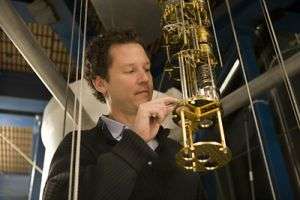
Cornell Professor Keith Schwab works on a low-temperature apparatus similar to that used in the paper reported in this weeks issue of Nature. Credit: CU

Using an existing technique in a novel way, Cornell physicist Keith Schwab and colleagues at Cornell and Boston University have made the scanning tunneling microscope (STM) -- which can image individual atoms on a surface -- at least 100 times faster.

The simple adaptation, based on a method of measurement currently used in nano-electronics, could also give STMs significant new capabilities -- including the ability to sense temperatures in spots as small as a single atom.

The finding is described in the Nov. 1 issue of the journal Nature.

The STM uses quantum tunneling, or the ability of electrons to "tunnel" across a barrier, to detect changes in the distance between a needlelike probe and a conducting surface. Researchers apply a tiny voltage to the sample and move the probe -- a simple platinum-iridium wire snipped to end in a point just one atom wide -- just a few angstroms (10ths of a nanometer) over the sample's surface. By measuring changes in current as electrons tunnel between the sample and the probe, they can reconstruct a map of the surface topology down to the atomic level.

Since its invention in the 1980s, the STM has enabled major discoveries in fields from semiconductor technology to nano-electronics.

But while current can change in a nanosecond, measurements with the STM are painfully slow. And the limiting factor is not in the signal itself: It's in the basic electronics involved in analyzing it. A theoretical STM could collect data as fast as electrons can tunnel -- at a rate of one gigahertz, or 1 billion cycles per second of bandwidth. But a typical STM is slowed down by the capacitance, or energy storage, in the cables that make up its readout circuitry -- to about one kilohertz (1,000 cycles per second) or less.

Researchers have tried a variety of complex remedies. But in the end, said Schwab, an associate professor of physics at Cornell, the solution was surprisingly simple. By adding an external source of radio frequency (RF) waves and sending a wave into the STM through a simple network, the researchers showed that it's possible to detect the resistance at the tunneling junction -- and hence the distance between the probe and sample surface -- based on the characteristics of the wave that reflects back to the source.

The technique, called reflectometry, uses the standard cables as paths for high-frequency waves, which aren't slowed down by the cables' capacitance.

"There are six orders of magnitude between the fundamental limit in frequency and where people are operating," said Schwab. With the RF adaptation, speeds increase by a factor of between 100 and 1,000. "Our hope is that we can produce more or less video images, as opposed to a scan that takes forever."

The setup also offers potential for atomic resolution thermometry -- precise measurements of temperature at any particular atom on a surface -- and for motion detection so sensitive it could measure movement of a distance 30,000 times smaller than the size of an atom.

"This STM will be used for a lot of good physics experiments," said Schwab. "Once you open up this new parameter, all this bandwidth, people will figure out ways to use it. I firmly believe 10 years from now there will be a lot of RF-STMs around, and people will do all kinds of great experiments with them."

Source: Cornell University


print this article email this article download pdf blog this article bookmark this article     Digg this Stumble it share on Facebook share on Reddit add to delicious save to Yahoo! bookmarks
4.5/5 after 23 votes


November 1st, 2007 all stories
Nanotechnology / Nanophysics

Comments: 0
Rank: 4.5/5 after 23 votes

  • Stumble this up

  • Digg this

  • Share it:
  • share on Facebook
  • share on MySpace
  • share on Slashdot
  • rss-newsfeed
  • share on Google
  • share on Reddit
  • add to delicious
  • save to Yahoo! bookmarks
  • share on Windows Live
  • Add to Mixx!
Rating: 4.5/5 after 23 votes

  • Related Stories

  • Imaging 'Gridlock' in High-temperature Superconductors
    created Mar 05, 2007 | popularity not rated yet | comments 0
  • Turning an axel mounted molecular wheel
    created Jan 23, 2007 | popularity not rated yet | comments 0
  • Atoms Precision Placement Helps Building Nanoscale Devices
    created Sep 10, 2004 | popularity not rated yet | comments 0
  • Scientists directly measure charge states of atoms using an atomic force microscope
    created Jun 23, 2009 | popularity not rated yet | comments 0
  • Our Sun: A Little Slow On the Uptake for Cycle 24
    created Apr 27, 2009 | popularity not rated yet | comments 0

Tags


  • Physicists Demonstrate Quantum Memory with Matter Qubits
    Physicists Demonstrate Quantum Memory with Matter Qubits
    Physics / General Physics
    created Jul 03, 2009 | popularity 4.4 / 5 (16) | comments 1
  • 'Holey' Nanosheets for Wastewater Dye Removal
    Nanotechnology / Nanomaterials
    created Jul 01, 2009 | popularity 5 / 5 (5) | comments 1
  • Jellyfish Robot Swims Like its Biological Counterpart
    Jellyfish Robot Swims Like its Biological Counterpart
    Electronics / Robotics
    created Jun 26, 2009 | popularity 4.4 / 5 (8) | comments 1
  • Could Maxwell's Demon Exist in Nanoscale Systems?
    Could Maxwell's Demon Exist in Nanoscale Systems?
    Physics / General Physics
    created Jun 24, 2009 | popularity 4.4 / 5 (18) | comments 29
  • Living Safely with Robots, Beyond Asimov's Laws
    Living Safely with Robots, Beyond Asimov's Laws
    Electronics / Robotics
    created Jun 22, 2009 | popularity 4.6 / 5 (52) | comments 40
  • Other News

    A 'quantum of sol' -- how nanotechnology could hold the key to a solar-powered future

    A 'quantum of sol' -- how nanotechnology could hold the key to a solar-powered future

    Nanotechnology / Nanomaterials

    created Jun 30, 2009 | popularity 3.7 / 5 (12) | comments 16

    (PhysOrg.com) -- A new generation of 'nano-structured' millimetre-sized solar cells that could convert the sun's energy to electricity more than twice as efficiently as current technology, is the subject of ...


    Australian researchers are set to begin human trials of a tiny nano-cell that acts as a "Trojan horse" against cancer

    Hi-tech 'Trojan horse' can kill cancer cells: researchers

    Nanotechnology / Bio & Medicine

    created Jun 29, 2009 | popularity 4.6 / 5 (11) | comments 7

    Australian researchers are set to begin human trials of a tiny nano-cell that acts as a "Trojan horse" against cancer cells, a breakthrough they say may curb the need for debilitating chemotherapy.


    Harnessing Nanoparticles To Track Cancer Cell Changes

    Nanotechnology / Bio & Medicine

    created Jul 03, 2009 | popularity not rated yet | comments 1

    The more dots there are, the more accurate a picture you get when you connect them. Cancer researchers adopting that philosophy have developed a new imaging technology that could give scientists the ability to simultaneously ...


    'Holey' Nanosheets for Wastewater Dye Removal

    Nanotechnology / Nanomaterials

    created Jul 01, 2009 | popularity 5 / 5 (5) | comments 1

    (PhysOrg.com) -- Researchers have discovered that extremely thin sheets of nickel oxide with hexagonally shaped holes can absorb hazardous dyes from wastewater nearly as well as the best traditional methods, but are recyclable. ...


    New statistical technique improves precision of nanotechnology data

    New statistical technique improves precision of nanotechnology data

    Nanotechnology / Nanophysics

    created Jul 01, 2009 | popularity 3 / 5 (2) | comments 0

    A new statistical analysis technique that identifies and removes systematic bias, noise and equipment-based artifacts from experimental data could lead to more precise and reliable measurement of nanomaterials ...