Device Created for 'Red Wine Headache'
November 1, 2007 Device Created for 'Red Wine Headache'

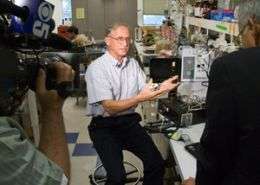
Mathies explaining his new technology to the press.

A device first developed by chemistry professor Rich Mathies to look for signs of life on Mars could help avoid the dreaded “red wine headache.”

Mathies described his new technology in an article and press release published by the journal Analytical Chemistry. The Associated Press (AP) interviewed Mathies and released their own version of the story that has been picked-up by over 200 newspapers, TV stations and other media outlets around the world.

In the year 2015, the European Space Agency’s ExoMars mission is scheduled to land a rover on Mars. The rover’s instrument package will test soil samples for telltale chemical markers of life using the Mars Organic Analyzer (MOA), a device that Mathies has been perfecting for over a decade.

In the meantime, working with his NASA-funded technology, Mathies has created a device that can detect amines, chemicals that can turn wine and other beverages and foods into ingredients for pounding headaches. The amines occur naturally in a wide variety of aged, pickled and fermented foods, including wine, chocolate, cheese, olives, nuts and cured meats.

Researchers have suspected several culprits for red wine headache, including the amines tyramine and histamine, although they have reached no definite conclusions. Still, many specialists warn headache sufferers away from foods rich in amines, which can also trigger sudden episodes of high blood pressure, heart palpitations and elevated adrenaline levels.

The prototype of the device — the size of a small briefcase — uses a drop of wine to determine amine levels in five minutes, Mathies said. A start-up company he co-founded is working to create a smaller device the size of a personal digital assistant that people could take to restaurants and test their favorite wines.

Mathies and colleagues found the highest amine levels in red wine and sake and the lowest in beer. The researchers suggest the device could be used to put amine levels on wine labels.

Says Mathies, “This is a great example of how technology developed for one purpose can have useful but unexpected spin-offs. Since I suffer from red wine headaches myself, when this device is commercialized, I’ll be the first customer.”

Source: UC Berkeley


print this article email this article download pdf blog this article bookmark this article     Stumble it Digg this share on Facebook retweet share on Reddit add to delicious
Rate this story - 4.1 /5 (11 votes)

Rank Filter

Move the slider to adjust rank threshold, so that you can hide some of the comments.


Display comments: newest first

  • wesgeorge - Nov 02, 2007
    • Rank: 2.5 / 5 (2)
    Good work. I am sick of getting headaches from crappy wine. I know that some wines are fine, others usually cheap blends lend themselves to histamine attacks. I'm all for labeling wines, but until that happens, I would be an early adopter of the digital amine tester device!
  • RRex - Nov 08, 2007
    • Rank: not rated yet
    I enjoyed reading about the wine headache devise. However, I believe it is better to make wine with low levels of histamines than to just measure them or to rely on some external device.

    The compounds described in the article are in the histamine family and are many of the same that are produced by our bodies to fight allergen in the environment. We used to assume that histamines were just automatically part of wine, particularly red wine. This is not the case. Histamines should not be in wine. We discovered that the yeast seem to be doing the same thing as our bodies do, produce histamines, to protect themselves from toxins in the juice during the fermentation. The toxins weaken the yeast and make the growing environment difficult. The elevated histamines, produced during the fermentation seem to be more reactive after the malo/lactic conversion, although I do not know the mechanism. I hypothesized that we could reduce histamines and therefore reduce "red wine headaches" by reducing toxins in the must or the precursors that caused the yeast to produce histamines. Happy yeast seem to produce less histamine.

    We introduced better culling in the vineyard and much better hand sorting at the winery. The bunches of grapes are metered onto a moveable sorting table where damaged bunches are removed. The selected bunches are then de-stemmed but not crushed, leaving mostly whole berries. The berries pass to a specially designed shaker table where the small unformed "shot" berries, early season unpolinated raisins and other bits and pieces are shaken out. From there the berries go to another moving belt table where the berries are sorted by hand to remove anything that appears decayed, damaged or infected with molds and mildews. Green jacks (stem parts) are removed and any mog (material other than grapes). As we say, we leave only the grapes you would feed to a baby. The process is slow and tedious but worth it in the end. We have neighbors who process thousands of tons per day during the harvest. With our methods we can do about 12 tons per day.

    We also carefully feed and monitor the yeast during fermentation to keep them thriving and happy. These steps have reduced the histamines in Deerfield wine and have virtually done away with the red wine headache. So far this study, its practice and results have been empirical and we don't know all the reasons for its success. We are beginning a data base at Deerfield to try to quantify the results. Up until recently histamine testing was expensive but now one of our local wine labs does histamine testing and with the end of the fermentations we with the start to test our wines and catalog the results. So far, we know that the process of clean winemaking results in headache free red wine.

    An alternative, particularly if you plan to go out wine tasting or to a wine tasting party, is to take an antihistamine tablet before drinking wine. This should greatly reduce the histamine induced headache affect.

November 1, 2007 all stories

Comments: 2

4.1 /5 (11 votes)
  • Stumble this up

  • Digg this

  • share this

  • hide
  • Related Stories


Other News

Tiny bubbles clean oil from water

Tiny bubbles clean oil from water

Chemistry / Materials Science

created 5 hours ago | popularity 4 / 5 (3) | comments 0

Small amounts of oil leave a fluorescent sheen on polluted water. Oil sheen is hard to remove, even when the water is aerated with ozone or filtered through sand. Now, a University of Utah engineer has developed ...


Tiny particles can deliver antioxidant enzyme to injured heart cells

Tiny particles can deliver antioxidant enzyme to injured heart cells

Chemistry / Polymers

created 2 hours ago | popularity 5 / 5 (1) | comments 0

Researchers at Emory University and the Georgia Institute of Technology have developed microscopic polymer beads that can deliver an antioxidant enzyme made naturally by the body into the heart.


H1N1 Virus Can Be Killed by Acidic Ozone Water

H1N1 Virus Can Be Killed by Acidic Ozone Water

Chemistry / Biochemistry

created Nov 09, 2009 | popularity 4.5 / 5 (37) | comments 14

(PhysOrg.com) -- Scientists have found that acidic ozone water can deactivate H1N1 viruses very effectively, offering a promising disinfectant for the millions of people trying to avoid the disease. Acidic ...


New evidence that dark chocolate helps ease emotional stress

New evidence that dark chocolate helps ease emotional stress

Chemistry / Biochemistry

created Nov 11, 2009 | popularity 4 / 5 (4) | comments 2

The "chocolate cure" for emotional stress is getting new support from a clinical trial published online in ACS' Journal of Proteome Research.


Energy-saving powder

Energy-saving powder: Converting methane to methanol

Chemistry / Other

created Nov 11, 2009 | popularity 3.2 / 5 (6) | comments 2

It is currently estimated that natural gas resources will be exhausted in 130 years; however, those reserves where extraction is cost-effective will only flow for another 60 years or so.