Does Titan's methane originate from underground?
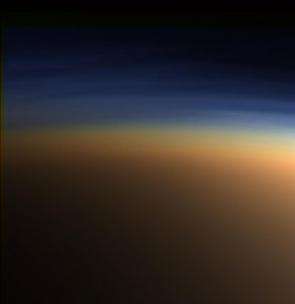
Data from ESA's Huygens probe have been used to validate a new model of the evolution of Titan, Saturn’s largest moon, showing that its methane supply may be locked away in a kind of methane-rich ice.
The presence of methane in Titan's atmosphere is one of the major enigmas that the NASA/ESA/ASI Cassini-Huygens mission is trying to solve.
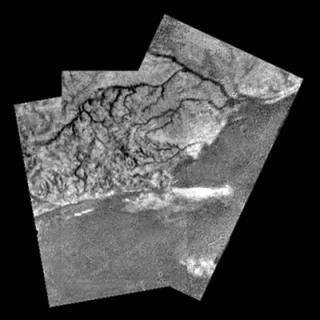
Titan was revealed last year to have spectacular landscapes apparently carved by liquids. The Cassini-Huygens mission also showed that there is not after all a lot of liquid methane remaining on the moon’s surface, and so it is not clear where the atmospheric methane gas comes from.
Using the Cassini-Huygens findings, a model of Titan's evolution, focusing on the source of Titan’s atmospheric methane, has been developed in a joint study by the University of Nantes, France, and the University of Arizona in Tucson, USA.
"This model is in agreement with the observations made so far by both the Huygens probe that landed on Titan on 14 January 2005 and the remote sensing instruments on board the Cassini spacecraft," said Gabriel Tobie, of the Laboratoire de Planetologie et Geodynamique de Nantes, and lead author of an article in Nature.
There is a difference between volcanism on Earth and ‘cryovolcanism’ on Titan. Volcanoes on Titan would involve ice melting and ice degassing, which is analogous to silicate volcanism on Earth, but with different materials.
Methane, playing a role on Titan similar to water on Earth, would have been released during three episodes: a first one following the accretion and differentiation period, a second episode about 2000 million years ago when convection started in the silicate core and a geologically recent one (last 500 million years ago) due to enhanced cooling of the moon by solid-state convection in the outer crust.
This means that Titan’s methane supply may be stored in a kind of methane-rich ice. The scientists suggest that the ice, called a ‘clathrate hydrate’, forms a crust above an ocean of liquid water mixed with ammonia.
"As methane is broken down by light-induced chemical reactions over a timescale of tens of millions of years, it can’t just be a remnant of the atmosphere present when Titan itself was formed, and it must be replenished quite regularly," said Tobie.
"According to our model, during the last outgassing episode, the dissociation of the methane clathrate and hence release of methane are induced by thermal anomalies within the icy crust, which are generated by crystallisation in the internal ocean," said Tobie.
"As this crystallisation started only relatively recently (500 to 1000 million years ago), we expect that the ammonia-water ocean is still present few tens of kilometres below the surface and that methane outgassing is still operating. Even though the outgassing rate is expected to decline now (it peaked about 500 million years ago), release of methane through cryovolcanic eruptions should still occur on Titan," explained Tobie.
"Parts of the clathrate crust might be warmed from time to time by ‘cryovolcanic’ activity on the moon, causing it to release its methane into the atmosphere. These outbursts could produce temporary flows of liquid methane on the surface, accounting for the river-like features seen on Titan’s surface.
"Cassini’s instruments, in particular its Visible and Infrared Mapping Spectrometer (VIMS), should detect an increasing number of cryovolcanic features and, if we are lucky, may eventually detect eruptions of methane," added Tobie.
If they are right, say the researchers, then Cassini and future missions to Titan should also be able to detect the existence of their possible subsurface liquid water-ammonia ocean.
Later in the mission, Cassini itself will make measurements that will confirm (or not) the presence of the internal water ocean, and also the existence of a rocky core.
The findings appear in the 2 March issue of Nature. The article ‘Episodic outgassing as the origin of atmospheric methane on Titan’ is by Gabriel Tobie (Lab. de Planetologie et Geodynamique, Universite de Nantes, France and LPL, University of Arizona, Tucson, USA), Jonathan I. Lunine (LPL, University of Arizona, Tucson, USA and INAF, Rome, Italy) and Christophe Sotin (Lab. de Planetologie et Geodynamique, Universite de Nantes, France).
Source: ESA


