Light-powered micro-machines to advance telecommunications
A new theory developed at MIT could lead to "smart" optical microchips that adapt to different wavelengths of light, potentially advancing telecommunications, spectroscopy and remote sensing.
Drawn by the promise of superior system performance, researchers have been exploring the concept of microchips that manipulate light instead of electricity. In their new theory, the MIT team has shown how such chips could feature tiny machines with moving parts powered and controlled by the very light they manipulate, giving rise to fundamentally new functionality.
"There are thousands of complex functions we could make happen by tinkering with this idea," said Peter Rakich, an MIT postdoctoral associate who invented the theoretical concept along with postdoc Milos Popovic. The work was described in the cover story of the November issue of Nature Photonics.
For example, such chips could one day be used to remotely adjust the amount of bandwidth available in an optical network, or to automatically process signals flowing through fiber-optic networks, without using any electrical power, Rakich said.
Coauthors on the paper were Marin Soljacic, assistant professor of physics; and Erich Ippen, the Elihu Thomson Professor of Electrical Engineering and professor of physics.
"The idea that opto-nanomechanical devices can be designed to self-adapt to all-optical control-i.e., by self-aligning their resonances to optical control frequencies and by permitting all-optical tuning and dimension control-is new and exciting," said Ippen.
Earlier this year an MIT team composed of many of the same researchers showed that photonic circuitry could be integrated on a silicon chip by polarizing all of the light to the same orientation. The current work shows how tiny mobile machines can be built on such chips, taking advantage of the substantial pressures exerted by photons as they strike the walls of a cavity.
In the macroscopic world, light waves do not exert significant forces, but in the unique world of the microscopic, coupled with ultrapure laser light, photons bouncing off the walls of a cavity can build up a measurable force called radiation pressure. This is similar to the pressure exerted by gas molecules trapped in an aerosol can.
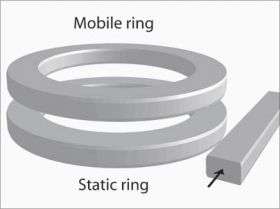
To take advantage of this radiation pressure, the researchers propose machines built from ring-shaped cavities only millionths of a meter in size located on the chip surface. When pressure on the cavity walls is high enough, the cavity is forced to move. This movement forms a critical part of an optical micromachine, which adjusts its configuration to respond to light in a predesigned way.
A unique application of this concept involves processing data that travels in fiber-optic networks. Today resonators employed in fiber-optic networks have to be synchronized with the incident light to ring at its frequency, in the same way an opera singer has to tune the pitch of her voice to make a wine glass ring.
Remarkably, a "smart" resonator based on the MIT concept could chase the frequency (color) of the laser light incident upon it. As the frequency of the laser beam changes, the frequency of the resonator will always follow it, no matter where it goes.
In other words, this new, unique resonator is like a wine glass that self-adjusts to the pitch of the singer's voice and follows it along throughout a song, Rakich said. He noted that physical systems that adapt to driving light and behave like these nanomachines do not exist elsewhere in nature.
By coupling the resonating cavities with nano-scale cantilevers, optical devices analogous to microelectromechanical systems (MEMS) devices can be created.
Although the researchers focused on ring-shaped cavities, their model could be applied to other structures as well.
"Our objective now is to develop a variety of light-powered micro- and nanomachines with unique capabilities enabled by this technology," explained Popovic. "But the first step will be to demonstrate the concept in practice."
Source: MIT


