'Phononic Computer' Could Process Information with Heat
November 2, 2007 By Lisa Zyga 'Phononic Computer' Could Process Information with Heat

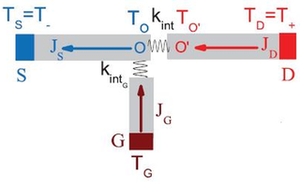
A thermal transistor controls heat flow. Heat passes between terminals S and D for the “on” state, and little or no heat passes between S and D for the “off” state. G is the control terminal. Image credit: Wang and Li.

Most computers today use electrons to carry information, while theoretical optical computers use photons. Recently, physicists from Singapore have proposed a third type of computer: a “phononic computer,” which would use heat, carried by phonons, to perform operations similar to its electronic counterpart.

“Heat is very abundant and very often it is regarded as useless and harmful for information processing,” Professor Baowen Li of the National University of Singapore told PhysOrg.com. “The merit of our paper is that we demonstrate that, in addition to the existing electrons and photons, the phonons can also perform a similar function. This provides an alternative way for information processing. Moreover, the heat can be harnessed to use.”

Li and co-author Lei Wang from the NUS have demonstrated how to make thermal logic gates for possible use in future phononic computers, with their results published in a recent issue of Physical Review Letters.

Logic gates, one of the basic elements of computers, perform an operation on one or more logic inputs to produce a single logic output. In electronic logic gates, the inputs and outputs are represented by different voltages. However, in a thermal logic gate, the inputs and outputs are represented by different temperatures.

The key element of the logic gate is the thermal transistor (which was invented by Li’s group last year), which works similar to how a field-effect transistor controls electric current. The thermal transistor is composed of two terminals that are weakly coupled, plus a third control terminal.

“Like all other theoretical modeling, we use heat bath to produce heat, which is a kind of random atomic or molecular motion,” Li explained. “To conduct heat, you don't need too much external power. Any temperature difference will lead to heat conduction.”

In the researchers’ model, heat is conducted by lattice vibration. When the vibration spectra of the two terminals are combined, their overlap determines the heat current. For example, when the two spectra overlap, the heat can easily travel between the terminals, representing the “on” state. When the vibration spectra do not overlap, very little heat (or no heat) passes through, representing the “off” state. The “negative differential thermal resistance” (NDTR) that occurs due to the match/mismatch of vibrational spectra of the terminals’ interface particles, makes the “on” and “off” states both stable, making the thermal logic operations possible.

“Like we explain in our Physical Review Letters article, all these logic gate functions can be achieved only when the system has the so-called negative or super response, by which we mean that the large temperature difference (change) will induce the small heat current,” Li said. “This is the so-called ‘negative differential thermal resistance.’” The NDTR phenomenon was also discovered by Li’s group in 2006.

The researchers demonstrate how combining thermal transistors can be used to build different thermal logic gates, such as a signal repeater. A signal repeater “digitizes” the heat input, so that when the temperature is higher or lower than a critical value, the output is either “on” or “off,” but not in between. By connecting a few thermal transistors in series, the researchers achieved a nearly ideal repeater. Besides signal repeaters, they also demonstrated a NOT gate, which reverses the input signal, and an AND/OR gate, made from the same thermal transistor model.

While the current model simply shows the feasibility of thermal logic gates, Wang and Li predict that an experimental realization of the devices in nanoscale systems may not be too far off. They point out that another thermal device, the solid-state thermal rectifier, was experimentally demonstrated in 2006, just a few years after the proposed theoretical model.

“One advantage of a phononic computer might be that we don't need to consume a lot of electricity,” Li said. “We may use the redundant heat produced by electronic devices or provided by Mother Nature to do useful work. Another advantage is that, one day, human beings can control and use heat wisely so that we may save a lot of energy—which is a big issue nowadays.”

More information: Wang, Lei, and Li, Baowen. “Thermal Logic Gates: Computation with Phonons.” Physical Review Letters 99, 177208 (2007).

Copyright 2007 PhysOrg.com.
All rights reserved. This material may not be published, broadcast, rewritten or redistributed in whole or part without the express written permission of PhysOrg.com.


print this article email this article download pdf blog this article bookmark this article     Stumble it Digg this share on Facebook retweet share on Reddit add to delicious
Rate this story - 4.2 /5 (74 votes)

Rank Filter

Move the slider to adjust rank threshold, so that you can hide some of the comments.


Display comments: newest first

  • earls - Nov 02, 2007
    • Rank: 3.3 / 5 (3)
    Hot.
  • atomsmith - Nov 02, 2007
    • Rank: 4 / 5 (1)
    Something about "us[ing] the redundant heat" doesn't sit well with me (thermodynamics, Feynman, and all that).

    I guess if we trap it in a reservoir and slowly leak it through the phononic circuit it makes sense, but chips these days usually try to get the heat out as quickly as possible.
  • Reaper6971 - Nov 02, 2007
    • Rank: 3 / 5 (1)
    Seems overly complicated w/ all the vibrating going on & temperature sensors.
  • saucerfreak2012 - Nov 02, 2007
    • Rank: 3 / 5 (1)
    %u201CLike we explain in our Physical Review Letters article, all these logic gate functions can be achieved only when the system has the so-called negative or super response, by which we mean that the large temperature difference (change) will induce the small heat current,%u201D

    Not very sensitive, but might be usefull as a material for constructing heat-sinks or heatpipes for chip cooling. Put those extra BTUs to work instead of offloading to the air with noisy fans.
  • weewilly - Nov 02, 2007
    • Rank: 3 / 5 (1)
    Super temperature conduction materials have to also be super quick to be able to transfer temperatures in speeds suitable for computer adaptations. Nice idea but I do not see it as a reliable and feasible methode as a CPU. My background is not in depth enough to see this as something that could be utilized for a computer. Who knows?
  • gopher65 - Nov 03, 2007
    • Rank: 4.5 / 5 (2)
    I'd suggest that instead of using this method for a stand alone computer, use it as part of an existing optical or electronic computer. Both setups generate substantial waste heat, and if you can use a portion of that heat to power a secondary CPU you can substantially increase the calculations/watt performance of a computer. I'd think that this would be especially useful when used with server clusters where performance per watt is extremely important.
  • Carlefeld - Nov 03, 2007
    • Rank: not rated yet
    Gopher65, you're a genius! I give you the :

    -- Carl Feld Award 2008 --
    !!!
    ;)

    Baowen Li, please read the comment above!

    Friendly yours,
    Carl Feld.
  • slash - Nov 14, 2007
    • Rank: not rated yet
    Just like electricity is based on *differences* in voltage causing the electrons to flow, phononic circuits will rely on differences in temperature.

    So no, you cannot just put a phononic computer inside a classical one - you have to connect it to the (cooler) outside first to make it work. Likely it will be just as difficult (or even more so) and possibly less efficient than just installing a standard cooling system.

    I do like the idea, but I wonder if the concept could ever compete with classical computers that have been successfully improved over decades.

November 2, 2007 all stories

Comments: 8

4.2 /5 (74 votes)
  • Stumble this up

  • Digg this

  • share this

  • hide
  • Related Stories

  • Scientists Propose Thermal Memory to Store Data
    created Jan 07, 2009 | popularity not rated yet | comments 0
  • IBM Cools 3-D Chips with Water
    created Jun 05, 2008 | popularity not rated yet | comments 0
  • HP Advances Flexibility, Efficiency of Blades Across the Data Center
    created Nov 12, 2007 | popularity not rated yet | comments 0
  • Good vibrations in nanotube research
    created Oct 15, 2007 | popularity not rated yet | comments 0
  • CELSIUS V830 workstation with AMD64 technology
    created Aug 30, 2005 | popularity not rated yet | comments 0


  • hide
  • Relevant PhysicsForums posts

  • Young's Double Slit - Fringe Width
    created 1hour ago
  • Pressure exerted by a liquid is different to gas?
    created 2 hours ago
  • Work
    created 5 hours ago
  • I need some help with this project (optics and lens design)
    created 6 hours ago
  • black hole gravity
    created 7 hours ago
  • Photoelectric effect
    created 9 hours ago
  • More from Physics Forums - General Physics

Other News

The LHC tunnel

Peckish bird briefly downs big atom smasher

Physics / General Physics

created 5 hours ago | popularity 3.4 / 5 (7) | comments 9

A peckish bird briefly knocked out part of the world's biggest atom smasher by causing a chain reaction with a piece of bread, the European Organisation for Nuclear Research (CERN) said Monday.


Ginzburg helped develop the Soviet Union's hydrogen bomb in the late 1940s and early 1950s

Russian bomb physicist Ginzburg dead at 93

Physics / General Physics

created 6 hours ago | popularity 5 / 5 (2) | comments 0

Nobel Physics prize winner Vitaly Ginzburg, who helped develop the Soviet hydrogen bomb, has died at the age of 93, the Russian Academy of Sciences said Monday.


Stars Fueled by Dark Matter Could Hold Secrets to the Universe

Stars Fueled by Dark Matter Could Hold Secrets to the Universe

Physics / General Physics

created Nov 03, 2009 | popularity 4.5 / 5 (51) | comments 43

(PhysOrg.com) -- The first stars in the universe may have been very different from the stars we see today, yet they may hold clues to understanding some of the mysterious features of the universe. These "dark ...


Second Law of Thermodynamics May Explain Economic Evolution

Second Law of Thermodynamics May Explain Economic Evolution

Physics / General Physics

created Nov 02, 2009 | popularity 4.3 / 5 (31) | comments 28

(PhysOrg.com) -- Terms such as the "invisible hand," laissez-faire policy, and free-market principles suggest that economic growth and decline in capitalist societies seem to be somehow self-regulated. Now, ...


High-performance plasmas may make reliable, efficient fusion power a reality

High-performance plasmas may make reliable, efficient fusion power a reality

Physics / Plasma Physics

created Nov 02, 2009 | popularity 4.7 / 5 (40) | comments 36

In the quest to produce nuclear fusion energy, researchers from the DIII-D National Fusion Facility have recently confirmed long-standing theoretical predictions that performance, efficiency and reliability ...