MIT's 'robocar' named a finalist in DARPA Urban Challenge
November 2, 2007
MIT's 'robocar' named a finalist in DARPA Urban Challenge

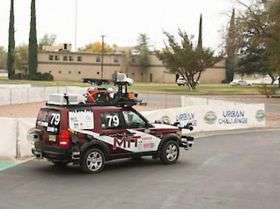
MIT's 'robocar' negotiated a course without a driver to advance to the finals of the DARPA Urban Challenge. Photo / Jason Dorfman, CSAIL

Team MIT has made it to the finals of the DARPA Urban Challenge, a competition for cars and trucks that run without human help. The qualification was announced Thursday, Nov. 1, by DARPA, the Defense Advanced Research Projects Agency, who is sponsoring the competition with the goal of developing vehicles that can operate on their own in battle and keep humans out of harm's way.

The announcement means the MIT vehicle--a self-piloted Land Rover LR3 dubbed "robocar"--and its team of student and faculty developers will compete in the finals Saturday in Victorville, Calif. DARPA plans to recognize the top three finishers Sunday with awards of $2 million, $1 million, and $500,000.

"Our team is absolutely thrilled to be invited to participate in the race," said team leader John Leonard, professor of mechanical and ocean engineering at MIT. "My co-PI's Jon How, Seth Teller, David Barrett and I would like to extend our heartfelt thanks to our students and staff, who have done a phenomenal job in creating a highly innovative autonomous vehicle in just 18 months. We also thank our sponsors who helped us to make it this far, and our families who made tremendous sacrifices in supporting us to undertake this project. We look forward to the challenge of trying to finish the 60 mile race course on Saturday."

The semifinals, which were held from Oct. 26-31, evaluated some three dozen robotic vehicles on their ability to operate in traffic without human intervention while obeying California traffic laws. The vehicles had to operate simulated military supply missions, at the same time performing routine operations such as negotiating left turns and roadblocks.

The MIT vehicle uses multiple laser range scanners, high-rate video cameras and automotive radar units to perform autonomous planning and motion control.

In addition to Leonard, key members of the MIT team include Professor Jonathan How and Associate Professor Emilio Frazzoli of the MIT Department of Aeronautics and Astronautics, Professor Seth Teller of the MIT Department of Electrical Engineering and Computer Science and Associate Professor David Barrett of Olin College. The team also includes engineers from the C.S. Draper Laboratory and a team of undergraduates from Olin College.

This is the first year MIT has competed in the DARPA Urban Challenge.

Source: MIT


Rank 4 /5 (5 votes)
Tags

Relevant PhysicsForums posts
  • How to calculate total compressibility in liquid porous solid system
    created6 hours ago
  • Need help reading 3-D
    createdFeb 11, 2012
  • A way to send and receive wireless data
    createdFeb 11, 2012
  • Calling function with no input argument
    createdFeb 10, 2012
  • Force free body diagram problem on gym equipment
    createdFeb 10, 2012
  • Empirical data regarding shower heads and water
    createdFeb 10, 2012
  • More from Physics Forums - General Engineering

More news stories

Google might launch Drive for cloud storage soon

(PhysOrg.com) -- Google's next big move, according to the Wall Street Journal, is a cloud storage service called Drive. Hardly first to the plate, Google is simply catching up to introducing its cloud reposi ...

Technology / Internet

created 14 hours ago | popularity 4.8 / 5 (5) | comments 5 | with audio podcast report

Iran blocks email, restricts net access: reports

Iran has further restricted access to the Internet and blocked popular email services for the past few days, in a move a top lawmaker said could "cost the regime dearly," media reports said on Sunday.

Technology / Internet

created 7 hours ago | popularity 5 / 5 (2) | comments 3

Love a click away in Indonesia's Twitter Republic

He was a geeky kid from Yogyakarta, she a glamorous city girl in Jakarta. In a country with one of the world's most vibrant social networking scenes they fell in love on Twitter.

Technology / Internet

created 15 hours ago | popularity 4 / 5 (1) | comments 0

Walney offshore wind farm is world's biggest (for now)

(PhysOrg.com) -- The Walney wind farm on the Irish Sea--characterized by high tides, waves and windy weather--officially opened this week. The farm is treated in the press as a very big deal as the Walney ...

Technology / Energy & Green Tech

created Feb 11, 2012 | popularity 4.1 / 5 (14) | comments 52 | with audio podcast weblog

Navy to begin tests on electromagnetic railgun prototype launcher

The Office of Naval Research (ONR)'s Electromagnetic (EM) Railgun program will take an important step forward in the coming weeks when the first industry railgun prototype launcher is tested at a facility ...

Technology / Engineering

created Feb 06, 2012 | popularity 4.5 / 5 (19) | comments 94 | with audio podcast


Scientists discover molecular secrets of 2,000-year-old Chinese herbal remedy

For roughly two thousand years, Chinese herbalists have treated Malaria using a root extract, commonly known as Chang Shan, from a type of hydrangea that grows in Tibet and Nepal. More recent studies suggest that halofuginone, ...

New method to examine batteries -- MRI from the inside

There is an ever-increasing need for advanced batteries for portable electronics, such as phones, cameras, and music players, but also to power electric vehicles and to facilitate the distribution and storage of energy derived ...

A mitosis mystery solved: How chromosomes align perfectly in a dividing cell

Although the process of mitotic cell division has been studied intensely for more than 50 years, Whitehead Institute researchers have only now solved the mystery of how cells correctly align their chromosomes during symmetric ...

Overeating may double risk of memory loss

New research suggests that consuming between 2,100 and 6,000 calories per day may double the risk of memory loss, or mild cognitive impairment (MCI), among people age 70 and older. The study was released today and will be ...

Lab study raises questions over nano-particle impact

Tests involving chickens have raised questions about the impact on health from engineered nano-particles, the ultra-fine grains commonly used in drugs and processed foods, scientists said on Sunday.

Starve a virus, feed a cure? Findings show how some cells protect themselves against HIV

A protein that protects some of our immune cells from the most common and virulent form of HIV works by starving the virus of the molecular building blocks that it needs to replicate, according to research published online ...