Researchers study how people think about what is and isn't risky
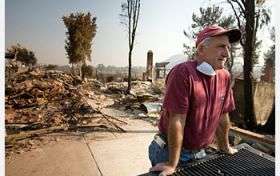
Why do people live in places like southern California where homes intermingle with wooded areas and the risk of wildfire is so great? Leading social scientists have a surprising answer: because the emotional benefits interfere with their ability to assess the risks.
Recent fire activity in the state of California supports this unusual theory offered by researchers funded by the National Science Foundation (NSF). According to the U.S. Forest Service, October wildfires destroyed 2,000 homes, forced the evacuation of more than 1 million residents and resulted in seven fatalities.
"It's likely that people who live near heavily wooded areas in California focus on things they love about their location, like environmental beauty or proximity to the ocean, and simultaneously discount the risk of wildfire," said Jacqueline Meszaros, program director for decision, risk and management sciences at NSF.
Researchers found people link perceived risk and perceived benefit to emotional evaluations of a potential hazard. If people like an activity, they judge the risks as low. If people dislike an activity, they judge the risks as high. For example, people buy houses or cars they like and find emotionally attractive, then downplay risks associated with the purchase.
This may explain why people sometimes make seemingly irrational, high-risk decisions, such as settling along the coastline where there is greater vulnerability to earthquakes and hurricanes.
"One of the exciting things in the current generation of research is that emotional components of risk decisions are beginning to be understood in addition to other more established components," said Meszaros. "Turns out that emotions explain a fair amount of what surprises us about people and risks."
People also make decisions about risk based on how they feel about available information concerning a hazard. Interestingly, there was a great deal of information available about California wildfires before the events of October. A July 2007 study on California housing and wildland fires by researchers at the U.S. Forest Service, the U.S. Geological Survey and two U.S. Universities warned of possible problems.
The study found California has a large number of homes in or near highly wooded areas, has a high number of human-caused fires and has some of the most severe fire weather in the country. It also found most Californians live at lower elevations dominated by chaparral surveillances susceptible to frequent, high-intensity, crown fires.
"It's hard to say whether people knew of these findings, and if the findings figured into decisions about living in the area," said Meszaros. "But even if they had read the facts, we have a number of findings that suggest facts alone often are not enough to change peoples' perceptions of risks. People need to relate to those facts at an emotional level for risk judgments to be affected."
Providing "vivid information" about fire risks that engages emotional functions, not just rational ones, people theoretically would judge the risk of living near thickly wooded areas as higher. This could reduce serious public policy problems that result from emotional biases in risk perception and decision making.
Using the theory for certain types of risk communication might be important for city planners, who are considering allowing people to build in an area where there is a known risk. But not much is known yet about the dangers of presenting people with highly vivid information.
More is known about the conditions that lead people to discount vivid information and distrust the sender. For example, studies of fear appeals--such as certain anti-smoking advertising--suggests that some vivid messages can lead to undesirable responses. Certain fear messages may actually have led to more kids smoking.
Meszaros said scientists cannot forecast how many Californians are likely to rebuild in the same locations. She said scientists need better social and economic asset databases to test theories about things like disaster resilience, vulnerability and resettlement.
Source: NSF


