New nanotech process could increase computer memory
March 2nd, 2006 New nanotech process could increase computer memory

A team of scientists from the Department of Physics at the Universitat Autònoma de Barcelona, in collaboration with colleagues from the Argonne National Laboratory (USA) and the Spintec laboratory (Grenoble, France), has for the first time produced microscopic magnetic states, known as “displaced vortex states”, that will allow an increase in the size of MRAMs (which are not deleted when the computer is switched off). The research has been published in Physical Review Letters and Applied Physics Letters.

In the near future we will turn our computers on and they will be ready to work almost instantaneously; no longer will we have to wait a while for the operating system and certain programs to load into the RAM. At the moment, SRAM and DRAM do not allow this, as they are quick, but they are deleted when the computer is switched off (that is, they are “volatile”); Flash memories, which we use for digital cameras, are not deleted, but they are slow; MRAM, which is still being developed, is fast and non-volatile, but has a relatively low storage capacity. A team of scientists from the UAB Department of Physics, in collaboration with colleagues from the Argonne National Laboratory (USA) and the Spintec laboratory (Grenoble, France), have discovered a magnetic phenomenon that could be useful in the quest for the ideal type of memory: an MRAM with large storage capacity.

The “displaced vortex states”, first observed by UAB researchers, are small circular movements of just a few thousandths of a millimetre that form in the tiny zones where the data is stored. The information on hard drives has normally been saved by orientating these zones in specific directions. The zones pointing upwards, for example, codify a 1, and those pointing downwards a 0. The smaller and more compact these zones are, the greater the capacity of the hard drive. But if they are too close together, the magnetic field created by one can affect the neighbouring zone and wipe the data. However, if the field is saved in a whirlpool form, in “vortex state”, it does not leave the tiny zone to which it is confined and does not affect the neighbouring data, thus making it possible for a much larger hard drive capacity.

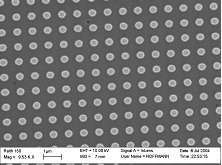
The scientists have achieved these “vortex states” on small, circular structures that are smaller than a micrometre (a thousandth of a millimetre) and combine layers of material with opposing magnetic properties: a layer of ferromagnetic material and a layer of antiferromagnetic material. What makes the configuration of the magnets observed by the UAB scientists new is that the vortex states are “displaced”, that is, once the magnetic field is no longer applied, the eye of the whirpool moves off-centre with regard to the circular structure on which it formed. This seemingly insignificant detail is the key to applying the technique to increasing the capacity not only of hard drives but also Magnetic Random Access Memories (MRAMs) that are fast, non-volatile, but until now with small storage capacity.

“The phenomenon observed could also be applied to other fields, such as improving the read heads of hard drives”, according to Jordi Sort, a UAB-ICREA physicist and the coordinator of the research. “But the reason that motivated us is even more fundamental: this is a very peculiar physical state that can be observed only in extremely small magnetic structures.”

Josep Nogués (ICREA researcher) and Maria Dolors Baró, of the UAB Department of Physics, also took part in the research, which was recently published in Physical Review Letters and Applied Physics Letters.

Source: Universitat Autònoma de Barcelona


print this article email this article download pdf blog this article bookmark this article     Digg this Stumble it share on Facebook share on Reddit add to delicious save to Yahoo! bookmarks
4.2/5 after 31 votes


March 2nd, 2006 all stories
Nanotechnology /

Comments: 0
Rank: 4.2/5 after 31 votes

  • Stumble this up

  • Digg this

  • Share it:
  • share on Facebook
  • share on MySpace
  • share on Slashdot
  • rss-newsfeed
  • share on Google
  • share on Reddit
  • add to delicious
  • save to Yahoo! bookmarks
  • share on Windows Live
  • Add to Mixx!
Rating: 4.2/5 after 31 votes

  • Related Stories

  • Scientists to study diamond-based quantum information processing, communication
    created Apr 15, 2009 | popularity not rated yet | comments 0
  • Nuclear fusion-fission hybrid could contribute to carbon-free energy future
    created Jan 27, 2009 | popularity not rated yet | comments 0
  • Electrons discover their individuality
    created Sep 01, 2008 | popularity not rated yet | comments 0
  • Superfluid-superconductor relationship is detailed
    created Aug 02, 2008 | popularity not rated yet | comments 0
  • Researchers Move Closer To New Class of Memory
    created Apr 11, 2008 | popularity not rated yet | comments 0

Tags


  • Physicists Demonstrate Quantum Memory with Matter Qubits
    Physicists Demonstrate Quantum Memory with Matter Qubits
    Physics / General Physics
    created Jul 03, 2009 | popularity 4.4 / 5 (17) | comments 1
  • 'Holey' Nanosheets for Wastewater Dye Removal
    Nanotechnology / Nanomaterials
    created Jul 01, 2009 | popularity 5 / 5 (5) | comments 1
  • Jellyfish Robot Swims Like its Biological Counterpart
    Jellyfish Robot Swims Like its Biological Counterpart
    Electronics / Robotics
    created Jun 26, 2009 | popularity 4.4 / 5 (8) | comments 1
  • Could Maxwell's Demon Exist in Nanoscale Systems?
    Could Maxwell's Demon Exist in Nanoscale Systems?
    Physics / General Physics
    created Jun 24, 2009 | popularity 4.4 / 5 (18) | comments 29
  • Living Safely with Robots, Beyond Asimov's Laws
    Living Safely with Robots, Beyond Asimov's Laws
    Electronics / Robotics
    created Jun 22, 2009 | popularity 4.6 / 5 (52) | comments 40
  • Other News

    A 'quantum of sol' -- how nanotechnology could hold the key to a solar-powered future

    A 'quantum of sol' -- how nanotechnology could hold the key to a solar-powered future

    Nanotechnology / Nanomaterials

    created Jun 30, 2009 | popularity 3.9 / 5 (14) | comments 16

    (PhysOrg.com) -- A new generation of 'nano-structured' millimetre-sized solar cells that could convert the sun's energy to electricity more than twice as efficiently as current technology, is the subject of ...


    Australian researchers are set to begin human trials of a tiny nano-cell that acts as a "Trojan horse" against cancer

    Hi-tech 'Trojan horse' can kill cancer cells: researchers

    Nanotechnology / Bio & Medicine

    created Jun 29, 2009 | popularity 4.6 / 5 (11) | comments 7

    Australian researchers are set to begin human trials of a tiny nano-cell that acts as a "Trojan horse" against cancer cells, a breakthrough they say may curb the need for debilitating chemotherapy.


    'Holey' Nanosheets for Wastewater Dye Removal

    Nanotechnology / Nanomaterials

    created Jul 01, 2009 | popularity 5 / 5 (5) | comments 1

    (PhysOrg.com) -- Researchers have discovered that extremely thin sheets of nickel oxide with hexagonally shaped holes can absorb hazardous dyes from wastewater nearly as well as the best traditional methods, but are recyclable. ...


    Harnessing Nanoparticles To Track Cancer Cell Changes

    Nanotechnology / Bio & Medicine

    created Jul 03, 2009 | popularity not rated yet | comments 1

    The more dots there are, the more accurate a picture you get when you connect them. Cancer researchers adopting that philosophy have developed a new imaging technology that could give scientists the ability to simultaneously ...


    Computer-Guided Nanoparticle Therapy Destroys Tumors

    Nanotechnology / Bio & Medicine

    created Jun 29, 2009 | popularity 5 / 5 (11) | comments 0

    Gold nanoshells are among the most promising new nanoscale therapeutics being developed to kill tumors, acting as antennas that turn light energy into heat that cooks cancer to death. Now, a multi-institutional research team ...