Government plan to revive 'Dead Zone' in Gulf of Mexico could backfire
The potential revision to the government’s approach for rejuvenating a huge “Dead Zone” in the Gulf of Mexico is potentially dangerous and should be reconsidered, scientists in Michigan are reporting in a study scheduled for the Dec. 1 issue of ACS’ Environmental Science & Technology.
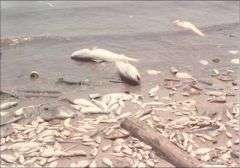
In the study, Donald Scavia and Kristina A. Donnelly point out that the Gulf of Mexico has one of the largest hypoxic, or oxygen-depleted, areas in the world. Fish and plants in this 6,000 square mile “Dead Zone” have been devastated, leaving the waters incapable of sustaining many types of aquatic life.
In response, an intergovernmental task force gave the U. S. Congress and the President a so-called Hypoxia Action Plan in 2001, which aimed to reduce the size of the Dead Zone. That original plan called for reducing nitrogen loads to the Gulf, but recent assessments are considering phosphorous as the limiting factor in controlling the algae blooms that deplete oxygen from the Gulf water, and focusing on reducing sewage discharges and other inputs of phosphorous.
The new study concluded that pollution control efforts must continue to focus on nitrogen even if phosphorus controls are added. It found that a phosphorus-only approach is potentially dangerous.
Using mathematical model estimates and real-world data from other hypoxia reduction experiences in North Carolina and Hong Kong waters, the researchers suggest that a phosphorous-only approach could possibly enlarge the Dead Zone, extending it into the western portion of the Gulf. “The prudent approach would be to address both nitrogen and phosphorous,” the researchers said.
Source: ACS


