Sticky Tape Inspired by Insect Feet

November 5th, 2007 By Lisa Zyga Sticky Tape Inspired by Insect Feet

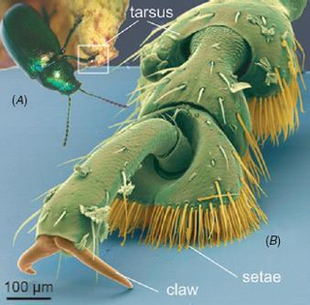
(A) Chrysomelid beetle with (B) a close-up of the tarsus with a hairy adhesive system (colored scanning electron microscope image). Credit: Stanislav Gorb, et al.

Scientists have designed an extremely sticky patterned adhesive, which is twice as sticky as flat tapes used for similar purposes. The new glue-free adhesive can also stick to dusty surfaces better, can be washed with soap and water, and can be reused multiple times.

The researchers call the material “insect tape” because its adhesive properties come from a pattern of microstructures that are inspired by insect feet. The team, composed of evolutionary biomaterials researchers from the Max Planck Institute (MPI) in Stuttgart, Germany, and biologically inspired robotics researchers from Case Western Reserve in Cleveland, US, analyzed more than 300 different species of insects to determine the optimal properties for a man-made adhesive.

“This tape provides the highest stickiness among other tapes with reversible adhesion and remains sticky for the highest number of repetitions (several thousands of adhesion cycles),” co-author Stanislav Gorb of the MPI told PhysOrg.com. “After getting dirty, it can be washed with soapy water, and the initial stickiness will be recovered.”

The way that insects walk on walls and ceilings has intrigued scientists since the 19th century (and likely well before). Today researchers know that many of the million known insect species have independently evolved two types of attachment structures: smooth pads (e.g. grasshoppers) and hairy surfaces (e.g. coleopterans, such as beetles).

The researchers focused on insects with hairy surfaces, which often consist of dense hairs and setae ranging in length from a few micrometers to several millimeters. The scientists found that a hierarchical design of hairs optimizes contact formation, and a high density of small structures can produce a larger contact area, resulting in better overall adhesion. The tape is resistant to dust contamination due to gaps in the microstructures where dust particles can sink, as well as the adaptability of the tape’s contact surface. Further, mushroom-shaped tips, like those that appear on some insects’ setae, enable the adhesive to adapt to uneven surfaces and irregularities, including cracks.

“The adhesive strength of insects, spiders, and geckos on smooth glass is in the range of 100 kPa [kilopascals, a measure of pressure],” Gorb said. “Our material demonstrates about 60 kPa. We are not that far from them.”

Because of the fibers’ flexibility, the tape can be used repeatedly. During pull-off, the elastic fibers elongate up to several micrometers to break the bond between the tape and substrate. After hundreds of cycles, the adhesion decreases; however, washing the tape with a soap solution and water enables the tape to completely recover its adhesive properties.

The researchers experimented with the insect tape on a glass-wall-climbing robot called Mini-WhegsTM, which uses spokes with feet to climb over large obstacles. When the patterned surface of the insect tape was applied to its feet, the 120-gram (4.2-ounce), radio-controlled robot could successfully climb glass walls.

Besides robots, the tape could have applications in manipulating smooth surfaces such as optical lenses and CDs, as well as for adhering objects to or protecting sensitive glass surfaces. For further research, the scientists suggest that changing the shape of the surface contact features could optimize the tape for specific applications.

“It will be not as strong and as cheap as ScotchTM tape, but it will be reasonably cheap to use in everyday life,” Gorb said. “We believe that the tape will not replace existing tapes but find its applications in certain technological niches. Right now, most of applications are coming from high-tech companies, such as robotics and optical technologies.”

More information: Gorb, Stanislav N., Sinha, Mitali, Peressadko, Andrei, Daltorio, Kathryn A., and Quinn, Roger D. “Insects did it first: a micropatterned adhesive tape for robotic applications.” Bioinspiration & Biomimetics 2, (2007) S117-S125.

Copyright 2007 PhysOrg.com.
All rights reserved. This material may not be published, broadcast, rewritten or redistributed in whole or part without the express written permission of PhysOrg.com.


print this article email this article download pdf blog this article bookmark this article     Digg this Stumble it share on Facebook share on Reddit add to delicious save to Yahoo! bookmarks
4.5/5 after 62 votes

Rank Filter

Move the slider to adjust rank threshold, so that you can hide some of the comments.


Display comments: newest first

  • fredrick - Nov 05, 2007
    • Rank: not rated yet
    so you couldn't get your own news story, then?
  • johnaramas - Nov 06, 2007
    • Rank: not rated yet
    Now if they can only create a post-it that will successfully stick to my dusty computer monitor!

    John
    http://www.gigatribe.com
  • BrianH - Jan 26, 2008
    • Rank: not rated yet
    I am hereby claiming copyright on the promotional motto, "Tape it and Stick it!"
    :)


November 5th, 2007 all stories
Physics / Condensed Matter

Comments: 3
Rank: 4.5/5 after 62 votes

  • Stumble this up

  • Digg this

  • Share it:
  • share on Facebook
  • share on MySpace
  • share on Slashdot
  • rss-newsfeed
  • share on Google
  • share on Reddit
  • add to delicious
  • save to Yahoo! bookmarks
  • share on Windows Live
  • Add to Mixx!
Rating: 4.5/5 after 62 votes

  • Related Stories

  • Researchers develop technique for quick detection of Salmonella
    created Feb 02, 2009 | popularity not rated yet | comments 0
  • Gaps in Adhesion
    created Nov 17, 2008 | popularity not rated yet | comments 0
  • Study shows quantum dots can penetrate skin through minor abrasions
    created Jul 02, 2008 | popularity not rated yet | comments 0
  • Team explains 'the wallpaper problem'
    created Mar 30, 2008 | popularity not rated yet | comments 0
  • Scientists create gecko-inspired bandage
    created Feb 18, 2008 | popularity not rated yet | comments 0

Tags


  • Physicists Demonstrate Quantum Memory with Matter Qubits
    Physicists Demonstrate Quantum Memory with Matter Qubits
    Physics / General Physics
    created Jul 03, 2009 | popularity 4.4 / 5 (13) | comments 1
  • 'Holey' Nanosheets for Wastewater Dye Removal
    Nanotechnology / Nanomaterials
    created Jul 01, 2009 | popularity 5 / 5 (5) | comments 1
  • Jellyfish Robot Swims Like its Biological Counterpart
    Jellyfish Robot Swims Like its Biological Counterpart
    Electronics / Robotics
    created Jun 26, 2009 | popularity 4.4 / 5 (7) | comments 1
  • Could Maxwell's Demon Exist in Nanoscale Systems?
    Could Maxwell's Demon Exist in Nanoscale Systems?
    Physics / General Physics
    created Jun 24, 2009 | popularity 4.4 / 5 (18) | comments 29
  • Living Safely with Robots, Beyond Asimov's Laws
    Living Safely with Robots, Beyond Asimov's Laws
    Electronics / Robotics
    created Jun 22, 2009 | popularity 4.6 / 5 (51) | comments 39
  • Other News

    Physicists Demonstrate Quantum Memory with Matter Qubits

    Physicists Demonstrate Quantum Memory with Matter Qubits

    Physics / General Physics

    created Jul 03, 2009 | popularity 4.4 / 5 (13) | comments 1

    (PhysOrg.com) -- For the first time, scientists have successfully operated a quantum gate between two remote particles of matter, marking an important step toward the development of a quantum computer. In ...


    Scientists create first electronic quantum processor

    Scientists create first electronic quantum processor

    Physics / General Physics

    created Jun 28, 2009 | popularity 4.8 / 5 (49) | comments 38

    A team led by Yale University researchers has created the first rudimentary solid-state quantum processor, taking another step toward the ultimate dream of building a quantum computer.


    Fermilab's CDF observes Omega-sub-b baryon

    Fermilab's CDF observes Omega-sub-b baryon

    Physics / General Physics

    created Jun 29, 2009 | popularity 4.6 / 5 (13) | comments 7

    (PhysOrg.com) -- At a recent physics seminar at the Department of Energy’s Fermi National Accelerator Laboratory, Fermilab physicist Pat Lukens of the CDF experiment announced the observation of a new particle, ...


    New insights, and a new angle, on high-temperature superconductivity

    New insights, and a new angle, on high-temperature superconductivity

    Physics / Superconductivity

    created Jun 29, 2009 | popularity 4.8 / 5 (12) | comments 6

    (PhysOrg.com) -- A Princeton-led research team has revealed surprising information about how electron behavior influences the conduction of electricity in a class of high-temperature superconductors. An increased ...


    The art of invisibility and the perfect cat's eye

    The art of invisibility and the perfect cat's eye

    Physics / Optics & Photonics

    created Jun 30, 2009 | popularity 3.9 / 5 (7) | comments 6

    (PhysOrg.com) -- In recent years scientists have explored the impossible by developing invisibility or 'cloaking' devices, but can the same technology also help make things more visible?