Washington University Antarctic team to install seismographs
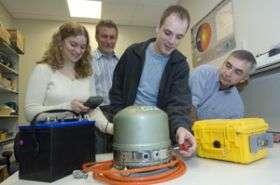
A team of seismologists from Washington University in St. Louis, like members of the starship Enterprise, will “boldly go where no man has gone before” after Thanksgiving this year.
The team, led by Douglas A. Wiens, Ph.D., Washington University Professor of Earth and Planetary Sciences in Arts & Sciences, will go to remote regions of Antarctica to place seismographs in both east and west Antarctica, to learn about the earth beneath the ice, and glean information about glaciers, mountains and ice streams. The location of their field camp, called AGAP-South, has never been visited by humans before, and the entire region of Antarctica has only been traversed by a Russian team 50 years ago and by a Chinese team last year.
Up until this November, no woman has been in these parts of Antarctica either, but Wiens’ graduate student, Moira Pyle, will hold the distinction of being the first woman to set foot there.
The projects, funded by the National Science Foundation (NSF), are Washington University’s contribution to a celebration of International Polar Year (IPY), 125 years after the first IPY (1882), 75 years after IPY 2 (1932), and 50 years after the first International Geophysical Year. The research period for the celebration is actually two years, March 1, 2007 through March 31, 2009.
Wiens and the group will install 10 seismographs each in the east and west parts of Antarctica, and an additional 20 instruments next year. Members of the group will spend between one to two months in Antarctica.
What they’ll do on their ‘summer vacation’
It will be summer in Antarctica, with temperatures maxing out at -30 Fahrenheit. The researchers will stay in a heated tent at their base camp, 400 miles from the nearest civilization, South Pole base, and about 3000 miles from New Zealand. They will wear sturdy boots, snow pants and parkas and cover their faces with masks, as the potential for frostbite to exposed skin is very high.
While two of the five will stay at base camp to prepare for the next day, three will be transported as far as 300 miles away to install the seismographs.
The vehicle will be a stout aircraft made in the fifties called a Twin Otter duel prop, sometimes referred to as a Dehaviland-6. There are, of course, no runways on ice, so the aircraft is equipped with skis. They will have a Canadian pilot who will have access to a spreadsheet denoting various caches of fuel throughout the continent. The barrels weighing up to 300 pounds or more are spread throughout the Antarctic. The effects of the ice and sun will tell the researchers ‘they’re not in Missouri anymore.’
“The surface of the Antarctic looks essentially like a snow-covered western Kansas, but mountains lurk beneath two miles of ice, “said Wiens, who has researched the Antarctic since the 1990s and put in the largest array of seismographs – 43 – ever in the early part of this century. “You see nothing but a vast flat sea of white under constant sunshine. It’s really eerie out there.
“In terms of the east, we have no idea what’s beneath the ice. No one has even taken any rock samples. It’s thought that when the Earth’s climate started to cool millions of years ago, the first glaciers in the world formed in these mountains. But we really don’t know if the mountains were there at the time the glaciers formed.”
Analysis of seismic waves could reveal how old the mountains are and their relationship to the formation of glaciers.
“One of the things we should be able to determine is what’s causing the elevation of the mountains,” he said. “It’s probably either due to a thick crust or hot temperatures in the mantle. If it’s hot temperatures in the mantle, the mantle can’t stay hot for billions of years, so that would tell us that it’s due to fairly recent activity. But if it’s thick crust, we can speculate that it was formed a long time ago.”
Global warming effect?
In west Antarctica, global warming is a concern. Wiens said that simulations show that the ice sheet in west Antarctica could fall apart if the Earth warms up, flooding coastal cities around the world.
Ice streams that are like rivers of ice as much as 80 miles wide are a study focus. Wiens said studies of these features over the past 40 years show some ice streams speeding up, others slowing down. Seismographs can detect sudden motion of the ice streams to help understand what controls their motion. Also, the rate of motion of the ice streams is related to the conditions of the rocks beneath. “We need to know how hot the mantle is. If it’s really hot, the ice will flow easier. If it’s really cold, it won’t flow at all.” said Wiens.
Since this work is part of the International Polar Year, the Washington University group will not be the only researchers working on these projects. There will be Chinese, French, Japanese and Italian seismologists, as well as other Americans, from Ohio State University (OSU), Columbia University, and Pennsylvania State University, among others.
A collaboration with Ohio State University combines the seismic data with global positioning system (GPS) data, in one coordinated project called Polenet.
“Their data complement ours in understanding how the loss of ice is related to uplift of the land,” said Wiens.
Rounding out the research team are graduate students Michael Barkledge, and David Heeszel, the only one who is a newbie to Antarctica, and Antarctica veteran Patrick Shore, a lecturer and computer specialist in Earth and Planetary Sciences. He has accompanied Wiens on many different seismic expeditions.
One important thing Wiens will stress to the group is sleep.
“You have to be careful that you keep sleeping,” he said. “When you first get there, and it’s light all the time, you get jazzed up and want to keep working. Your body doesn’t really tell you to sleep. You get tired, but your eyes are telling you the sun is still out.”
Source: Washington University in St. Louis


