Record 5th planet found around nearby star
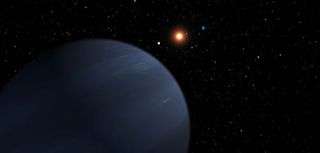
A team of American astronomers announced today (Tuesday, Nov. 6) the discovery of a record-breaking fifth planet around the nearby star 55 Cancri, making it the only star aside from the sun known to have five planets.
The discovery comes after 19 years of observations of 55 Cancri and represents a milestone for the California and Carnegie Planet Search team, which this year celebrates the 20th anniversary of its first attempts to find extrasolar planets by analyzing the wobbles they cause in their host star.
The team's long history of measurements - more than 300 for 55 Cancri alone - made the discovery of a five-planet system possible, said UC Berkeley astronomy professor Geoffrey Marcy, who with Paul Butler, now at the Carnegie Institution of Washington, began observations of many nearby stars at the University of California Lick Observatory in 1987.
The unique 55 Cancri system, located 41 light-years away in the direction of the constellation Cancer, is notable also because its clutch of four inner planets and one giant outer planet resembles our own solar system, though without an Earth or Mars.
"This system is interesting because there's a giant planet at 6 AU and four smaller planets inward of 0.8 AU, with a huge remaining gap in between, right where we would expect to find an Earth-sized planet," Marcy said.
An AU, or astronomical unit, is the average distance between the Earth and the sun, about 93 million miles.
According to lead author Debra Fischer, assistant professor of astronomy at San Francisco State University, the fifth planet is within the star's habitable zone in which water could exist as a liquid. Though the planet is a giant ball of gas, liquid water could exist on the surface of a moon or on other, rocky planets that may yet be found within the zone. "Right now, we are looking at a gap between the 260-day orbit of the new planet and the 14-year orbit of another gas giant, and if you had to bet, you'd bet that there is more orbiting stuff there."
Fischer noted that what occupies this gap has to be another planet around the size of Neptune or smaller, because anything larger would have destabilized the orbits of the other planets. All of the planets around 55 Cancri are in stable, nearly circular obits, like the eight planets in our solar system. Jupiter is located at 5.2 AU from the sun, while Mercury and Venus are closer than 0.72 AU. Earth and Mars are in the gap at 1 AU and 1.5 AU.
"We haven't found a twin of our solar system, because the four planets close to the star are all the size of Neptune or bigger," Marcy said, but he added that he's optimistic that continued observations will reveal a rocky planet within five years.
The new discovery, using data from the Lick Observatory and the W. M. Keck Observatory in Hawaii, has been accepted for publication in the Astrophysical Journal. The authors are Fischer, Marcy and their colleagues at the Carnegie Institution, San Francisco State University, UC Santa Cruz, Tennessee State University and UC Berkeley.
Fischer and Marcy also discussed their findings today during a media teleconference hosted by NASA.
"This work marks an exciting next step in the search for worlds like our own," said Michael Briley, an astronomer at the National Science Foundation. "To go from the first detections of planets around sun-like stars to finding a full-fledged solar system with a planet in a habitable zone in just 12 years is an amazing accomplishment and a testament to the years of hard work put in by these investigators."
In 1996, when Marcy and Butler found a Jupiter-sized planet orbiting close to 55 Cancri and circling every 14.6 days, it was only the fourth known star with an exoplanet. The second planet discovered in 2002 around the star turned out to circle in a more distant orbit, like our own Jupiter does, although the planet was four times the weight of Jupiter. The third, also discovered in 2002, was smaller, about half the size of Saturn, and was orbiting near the star with an orbit of 44 days, slightly farther than the first planet. The fourth planet, found in 2004, was so close to the star as to be hellishly hot - a Neptune-sized planet (14 times Earth's mass) with a 2.8 day period discovered in collaboration with a team led by Barbara McArthur of the University of Texas.
Although astronomers have found nearly 250 exoplanets, only one other star, mu Ara in the southern sky, is known to have four planets.
The newly-found fifth planet around 55 Cancri is also large - around half the size of Saturn, or at least 45 times the mass of Earth - and orbiting at about 0.785 AU in 260.8 days. Because the star 55 Cancri is older and dimmer than our sun, the habitable zone - the region in which planetary temperatures can be favorable for liquid water - is closer to the star than is our sun's habitable zone, and includes the new planet.
Finding multiple planets around a star is difficult because each planet produces its own stellar wobble. Marcy compares detecting the wobble within wobbles that are caused by one of several planets to picking out a single musical note from many played simultaneously. While the ear can do that, it took Marcy more than 10 months to convince himself that a fifth wobble was buried in the data.
The Doppler technique used by the search team sees this wobble as a change in the speed with which a star moves toward or away from us. The search team can detect velocities as small as 1 meter per second, which is walking speed.
55 Cancri has produced "a rat's nest of radial velocity data," Fischer said. "We probably still don't have all the planets. We are pulling out one thread at a time, disentangling all these orbits, and it has taken a lot more data and time than we predicted. I think it's amazing what we have been able to do with the system."
Source: University of California - Berkeley


