When animals evolve on islands, size doesn't matter
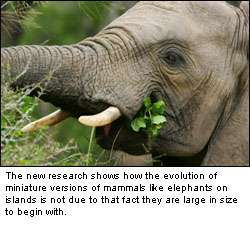
A theory explaining the evolution of giant rodents, miniature elephants, and even miniature humans on islands has been called into questions by new research published today in Proceedings of the Royal Society B: Biological Sciences.
The new study refutes the ‘island rule’ which says that in island environments small mammals such as rodents tend to evolve to be larger, and large mammals such as elephants tend to evolve to be smaller, with the original size of the species being the key determining factor in these changes.
The new research findings suggest that the tendency to either evolve larger or smaller on islands varies from one group of species to another, irrespective of original size. The research team, from Imperial College London, suspect instead that a number of external factors, including the physical environment of the particular island, the availability of prey, the presence of predators and the presence of competing species all play a role in determining the size evolution of island mammals.
Dr Shai Meiri from the NERC Centre for Population Biology at Imperial College London, lead author on the paper, explains: “If the island rule was correct, then most large mammals living on islands would be smaller than their continental relatives, and most small island mammals would be larger those living on continents. Our large dataset of mammal body sizes shows that this isn’t the case: there is evidence that most mammal groups show no tendency to consistently either grow larger or smaller, in contradiction to the island rule.”
Dr Meiri, who carried out the work with Professor Andy Purvis and Natalie Cooper from the College’s Department of Life Sciences, added: “The island rule suggests that the smallest mammals such as mice will exhibit the most evolutionary growth on islands, whilst the largest mammals like elephants will dwarf the most, with all mammals in between on a sliding-scale.
“Our analyses showed this isn’t the case, and the relationship between mammal size and evolutionary size change on islands is not that straightforward. Crucially, when we examined size change in light of the evolutionary relationship between different species, there was no connection between an evolution towards large size and greater degree of dwarfism on islands, or between evolution towards small size and island gigantism.”
The research team concluded that although there does appear to be a weak correlation between the size of a mammal and how its size then evolves in an island habitat, this reflects some groups’ specific tendencies towards gigantism or dwarfism, and not the general course of evolution. “The course of size evolution is dependent on a complex interplay of many other factors, that have led to the evolution of fascinating miniature and giant species of mammals on islands,” concludes Dr Meiri.
Source: Imperial College London


