Energy From Hot Rocks
November 8, 2007 Energy From Hot Rocks

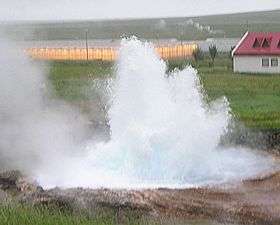
Two UC Davis geologists are studying the underground chemistry that creates this geyser found on an Icelandic farm. (Robert Zierenberg/UC Davis photo)

Two UC Davis geologists are taking part in the Iceland Deep Drilling Project, an international effort to learn more about the potential of geothermal energy, or extracting heat from rocks.

Professors Peter Schiffman and Robert Zierenberg are working with Wilfred Elders, professor emeritus at UC Riverside, Dennis Bird at Stanford University and Mark Reed at the University of Oregon to study the chemistry that occurs at high pressures and temperatures two miles below Iceland.

"We hope to understand the process of heat transfer when water reacts with hot volcanic rocks and how that changes the chemistry of fluids circulating at depth," Zierenberg said. "We know very little about materials under these conditions."

The university team, funded by the National Science Foundation, will drill up to 4 kilometers, or 2.5 miles, into the rock. It will be one of three boreholes sunk as part of the Iceland Deep Drilling Project, which is supported largely by Icelandic power companies.

The island nation generates more than half of its electrical power from geothermal energy. Hot water and steam from boreholes can be used to run turbines for electricity or directly to heat homes and businesses. Iceland meets the rest of its electricity needs from hydroelectric power, and imports fossil fuels only for transportation.

The U.S. has lots of potential for geothermal energy generation, Zierenberg said. There are several plants in California, including the Geysers region in the north and at Mammoth Lakes. Although its share of energy generation in the state is small, the Geysers is the largest geothermal field in the world, Zierenberg said. There are also numerous abandoned oil and gas boreholes around the country -- including in the Central Valley -- that could potentially access hot water that could be used for space heating.

That would, however, require something of a cultural change. In Iceland, geothermal heating is used at a community level: hot water is pumped up and circulated around a town or neighborhood. Americans are more accustomed to individual power delivery, Zierenberg said.

The team expects to begin drilling in the summer of 2008.

Source: UC Davis


print this article email this article download pdf blog this article bookmark this article     Stumble it Digg this share on Facebook retweet share on Reddit add to delicious
Rate this story - 4.2 /5 (16 votes)


November 8, 2007 all stories

Comments: 0

4.2 /5 (16 votes)
  • Stumble this up

  • Digg this

  • share this

  • hide
  • Related Stories

  • New funding will stimulate alternative energy research
    created Nov 16, 2009 | popularity not rated yet | comments 0
  • Researchers to study hidden lakes beneath West Antarctic ice sheet
    created Oct 21, 2009 | popularity not rated yet | comments 0
  • Imagine Peace Tower lights in Second Life
    created Oct 11, 2009 | popularity not rated yet | comments 0
  • Making geothermal more productive
    created Sep 08, 2009 | popularity not rated yet | comments 0
  • How a Solar-Hydrogen Economy Could Supply the World's Energy Needs
    created Aug 24, 2009 | popularity not rated yet | comments 0


  • hide
  • Relevant PhysicsForums posts

  • Climate Science Update
    created 6 hours ago
  • The IPCC and the term "most"
    created Nov 23, 2009
  • Is global warming a fact?
    created Nov 23, 2009
  • Random variability of wind patterns
    created Nov 23, 2009
  • More from Physics Forums - Earth

Other News

The Energy Sources of Ultraluminous Galaxies

The Energy Sources of Ultraluminous Galaxies

Space & Earth / Astronomy

created 4 hours ago | popularity 4.5 / 5 (2) | comments 0

(PhysOrg.com) -- Ultraluminous infrared galaxies ((ULIRGs) are galaxies whose luminosity exceeds that of a trillion suns; for comparison, the Milky Way galaxy has a typical (and much more modest) luminosity ...


Fermi Telescope Peers Deep into Microquasar

Fermi Telescope Peers Deep into Microquasar (w/ Video)

Space & Earth / Astronomy

created 3 hours ago | popularity 4.5 / 5 (2) | comments 0

(PhysOrg.com) -- NASA's Fermi Gamma-ray Space Telescope has made the first unambiguous detection of high-energy gamma-rays from an enigmatic binary system known as Cygnus X-3. The system pairs a hot, massive ...


Space shuttle Atlantis, 7 astronauts back on Earth (AP)

Space shuttle Atlantis, 7 astronauts back on Earth

Space & Earth / Space Exploration

created 4 hours ago | popularity not rated yet | comments 0

(AP) -- Space shuttle Atlantis and its seven astronauts returned to Earth with a smooth touchdown Friday to end an 11-day flight that resupplied the International Space Station.


Herschel takes a peek at the ingredients of the galaxies

Herschel takes a peek at the ingredients of the galaxies

Space & Earth / Astronomy

created 2 hours ago | popularity not rated yet | comments 0

(PhysOrg.com) -- The European Space Agency has today released spectacular new observations from the Herschel Space Observatory, including the UK-led SPIRE instrument. Spectrometers on board all three Hershel ...


China is set to launch its second moon orbiter next October, state media have reported

China to launch second lunar probe: state media

Space & Earth / Space Exploration

created 9 hours ago | popularity 5 / 5 (3) | comments 0

China will launch its second moon orbiter next October, state media reported Friday, as it powers ahead with a space programme that has sparked concerns abroad.