Researchers identify natural herbicide that controls weeds around some common lawn grasses
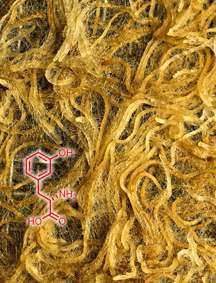
Certain varieties of common fescue lawn grass come equipped with their own natural broad-spectrum herbicide that inhibits the growth of weeds and other plants around them.
Cornell researchers have identified the herbicide as an amino acid called meta-tyrosine, or m-tyrosine, that these lawn grasses exude from their roots in large amounts. This amino acid is a close relative of para-tyrosine (p-tyrosine), one of the 20 common amino acids that form proteins.
Reporting on the discovery in the current issue of the Proceedings of the National Academies of Science, Frank Schroeder, the paper's senior author and an assistant scientist at the Boyce Thompson Institute for Plant Research on Cornell's campus, said, "We at first didn't believe m-tyrosine had anything to do with the observed herbicidal activity, but then we tested it and found it to be extremely toxic to plants but not toxic to fungi, mammals or bacteria."
Co-author Cecile Bertin, Ph.D. '05, research director for PharmAfrican, a Montreal-based bio-pharmaceuticals company, made the initial discovery that fescue grasses inhibit plants from growing around them.
While m-tyrosine itself is too water soluble to be applied directly as a herbicide, this research may lead to development of new varieties of fescue grasses that suppress weeds more effectively, which could reduce the need for synthetic herbicides, said Schroeder. By increasing our understanding of basic plant biology, the discovery of m-tyrosine's herbicidal properties could also help researchers discover more sustainable ways to control weeds or completely new herbicides, Schroeder added.
He and his colleagues are now conducting experiments to understand how m-tyrosine works as a plant killer. Plants depend on the production of large amounts of another common amino acid, phenylalanine, which is essential for the biosynthesis of wood, cell walls and lignin.
"Phenylalanine, m-tyrosine and p-tyrosine are structurally all very similar," said Schroeder. "Because of this similarity, we think that m-tyrosine might simulate high concentrations of phenylalanine, which would normally provide negative feedback for phenylalanine biosynthesis" and, thereby, suppress plant growth.
Schroeder and colleagues are also trying to understand why fescue grasses do not succumb to the toxin themselves. They found that when phenylalanine was added to plants dying from m-tyrosine exposure, they recovered. As a result, the researchers suspect that these fescue varieties may overproduce phenylalanine to save themselves from their own toxin.
People have not recognized how effective some fescue varieties are at suppressing weeds because m-tyrosine production appears to be highly dependent on environmental conditions, Schroeder said, which is another area that the researchers are currently investigating.
Source: Cornell University


