Rosetta closes in on Earth -- a second time
November 8, 2007 Rosetta closes in on Earth -- a second time

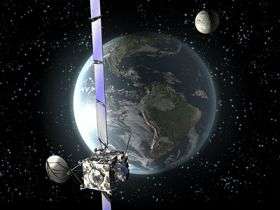
This is an artist’s rendition of Rosetta’s closest approach to Earth during its second swing-by of our planet on 13 November this year. The image shows the fly-by configuration as seen from above. Credit: ESA

ESA’s comet chaser, Rosetta, is on its way to its second close encounter with Earth on 13 November. The spacecraft’s operators are leaving no stones unturned to make sure Earth’s gravity gives it the exact boost it needs en route to its destination.

This month’s Earth swing-by is Rosetta’s third major step on its 10-year journey to 67/P Churyumov-Gerasimenko. The trajectory correction manoeuvre successfully performed last month prepared ESA’s Comet Chaser for the upcoming encounter. The spacecraft is now right on track to gain the right amount of energy from Earth’s gravity and save fuel later on.

Closest approach will take place on 13 November 2007 at 21:57 CET, at which time Rosetta will speed past at 45 000 km/h (about 12.5 km/s) relative to Earth. At this time, Rosetta will be 5301km above the Pacific Ocean, south-west of Chile, at 63° 46’ South and 74° 35’ West.

Why swing by Earth?

Swing-bys make use of the gravitational attraction of planets to modify a spacecraft’s trajectory and to gain the orbital energy needed to reach the final target.

The first Earth swing-by took place on 4 March 2005. On 25 February 2007 Rosetta made its closest approach to Mars, to use its gravity. The swing-by this month will be followed by the third and last swing-by, using Earth’s gravity, on 13 November 2009.

While the gravity-assist manoeuvre at Mars was needed to slow the spacecraft down and head back towards the inner solar system, the second Earth swing by will help Rosetta gain enough energy to reach the outer Solar System through the asteroid belt and observe asteroid Steins, one of its scientific targets. Rosetta will then head back to Earth for the last planned swing-by in November 2009.

The increased energy from this Earth swing-by will help Rosetta cross the asteroid belt for a second time, observe Lutetia (its second target asteroid) and finally rendezvous with comet 67/P Churyumov-Gerasimenko. The rendezvous will take place about 4 astronomical units or 600 million km from the Sun, in 2014.

Intense activity coming up...

During this Earth swing-by, the highest priority will be given to spacecraft operations, as the manoeuvre is critical for the success of the overall mission. In addition, during the incoming and outgoing tracks of the swing-by, Rosetta will be under unfavourable solar illumination and thus temperature conditions. This is why only very limited slots will be available for the instruments to be used safely.

Despite this, a few experiments both on the orbiter and the Philae lander will be activated for calibration, scientific measurements and imaging. The observations are scheduled during and around the time of closest approach, from 7 Nov, 01:00 CET, to 20 Nov, 15:00 CET.

Rosetta will first point to Earth to make observations of the atmosphere and the magnetosphere, including a search for shooting stars from space. It will image urban regions in Asia, Africa and Europe and then point to the Moon and obtain spectra of the illuminated Moon. Flying away after closest approach, Rosetta will image the Earth-Moon system from a distance.

Rosetta will be controlled from ESA’s Spacecraft Operations Centre (ESOC) in Darmstadt, Germany.

Source: European Space Agency


print this article email this article download pdf blog this article bookmark this article     Stumble it Digg this share on Facebook retweet share on Reddit add to delicious
Rate this story - 4.2 /5 (6 votes)


November 8, 2007 all stories

Comments: 0

4.2 /5 (6 votes)
  • Stumble this up

  • Digg this

  • share this

  • hide
  • Related Stories

  • Rosetta bound for outer Solar System after final Earth swingby (w/ Video)
    created Nov 13, 2009 | popularity not rated yet | comments 0
  • First view of Earth as Rosetta approaches home
    created Nov 12, 2009 | popularity not rated yet | comments 0
  • Rosetta spacecraft may help unravel cosmic mystery (w/ Video)
    created Nov 12, 2009 | popularity not rated yet | comments 0
  • Rosetta approach on schedule
    created Nov 06, 2009 | popularity not rated yet | comments 0
  • Rosetta's final Earth boost
    created Nov 04, 2009 | popularity not rated yet | comments 0


  • hide
  • Relevant PhysicsForums posts

  • Black hole confusion
    created Nov 14, 2009
  • Moon tied to Earth
    created Nov 13, 2009
  • Water on the Moon!
    created Nov 13, 2009
  • Is it possible for a single super-massive black hole...
    created Nov 13, 2009
  • More from Physics Forums - General Astronomy

Other News

MIT scientists pinpoint origin of dissolved arsenic in Bangladesh drinking water

Scientists pinpoint origin of dissolved arsenic in Bangladesh drinking water

Space & Earth / Environment

created 2 minutes ago | popularity not rated yet | comments 0

Researchers in MIT's Department of Civil and Environmental Engineering believe they have pinpointed a pathway by which arsenic may be contaminating the drinking water in Bangladesh, a phenomenon that has puzzled ...


Warmer means windier on world's biggest lake

Space & Earth / Earth Sciences

created 1minute ago | popularity not rated yet | comments 0

Rising water temperatures are kicking up more powerful winds on Lake Superior, with consequences for currents, biological cycles, pollution and more on the world's largest lake and its smaller brethren.


Hawaii's famed white sandy beaches are shrinking (AP)

Hawaii's famed white sandy beaches are shrinking

Space & Earth / Environment

created 5 hours ago | popularity 5 / 5 (1) | comments 1

(AP) -- Jenn Boneza remembers when the white sandy beach near the boat ramp in her hometown was wide enough for people to build sand castles.


Wu Chang Gong temple in Taiwan was partially levelled by a powerful earthquake ten years ago

Taiwan to boost quake warning system

Space & Earth / Earth Sciences

created 6 hours ago | popularity not rated yet | comments 0

Taiwan plans to build its first undersea seismic station, designed to improve the island's early warning system and save valuable seconds when earthquakes strike, officials said.


Commuters wait on the platform shrouded by fog in London

Climate change not man-made, say majority of Britons: poll

Space & Earth / Environment

created 5 hours ago | popularity 3 / 5 (4) | comments 3

Less than half of Britons believes that human activity is to blame for global warming, according to a poll carried out for The Times newspaper and published on Saturday.