Bug-Zapper: A Dose of Radiation May Help Knock Out Malaria
November 8, 2007 Bug-Zapper: A Dose of Radiation May Help Knock Out Malaria

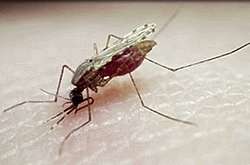
Credit: Sinclair Stammers/Peter Billingsley

How are physicists helping an effort to eradicate malaria, the mosquito-borne disease that kills more than one million people every year? Researchers at the National Institute of Standards and Technology used their expertise in radiation science to help a young company create weakened, harmless versions of the malaria-causing parasite. These parasites, in turn, are being used to create a new type of vaccine that shows promise of being more effective than current malaria vaccines.

The new vaccine is a departure from previous approaches, which have usually depended on proteins derived from only part of the parasite Plasmodium falciparum, the most dangerous species of parasite that causes malaria.

Using vaccines based on whole living parasites had been on scientists’ minds for several decades, after they discovered that volunteers built up high levels of protection to malaria after being exposed to mosquitoes containing live, radiation-weakened parasites. But manufacturing technology only recently has been developed to the point where it is possible to efficiently extract weakened parasites from their mosquito carriers in order to make a vaccine.

With their knowledge of measuring radiation doses for industrial processes such as medical equipment sterilization, NIST researchers have been lending their expertise for several years to Maryland-based biotech firm Sanaria Inc., which is creating the new vaccine. In the manufacturing process, live mosquitoes containing the parasite are exposed to gamma rays. To ensure that the parasites are sufficiently weakened for the vaccine, yet remain alive, they must be exposed to a radiation dose of at least 150 gray, but not much more. Coincidentally, this is also the dose used to delay sprouting in potatoes and onions.

One critical design issue is ensuring a relatively uniform radiation dose regardless of where the mosquito is in the chamber. Using radiation-sensitive test materials inside the chamber as well as sophisticated measuring equipment, NIST researchers mapped out the radiation dose at different parts of the chamber.

They initially found there was a variation in dose within the chamber, but by suggesting that the manufacturer change the position of the chamber relative to the radiation source they were able to significantly reduce this variation in dose. This not only increases the speed of the process, but more importantly improves the quality of the process. To be safe for human trials all mosquitoes in the chamber must get their minimum dose of 150 gray.

The vaccine is currently being manufactured for the anticipated human clinical trials. NIST researchers will continue to be active in the manufacturing process by doing regularly scheduled quality-assurance tests that ensure the desired dose is being delivered to the mosquitoes.

Source: NIST


print this article email this article download pdf blog this article bookmark this article     Stumble it Digg this share on Facebook retweet share on Reddit add to delicious
Rate this story - 4.3 /5 (7 votes)


November 8, 2007 all stories

Comments: 0

4.3 /5 (7 votes)
  • Stumble this up

  • Digg this

  • share this

  • hide
  • Related Stories

  • News from a space phantom
    created Oct 20, 2005 | popularity not rated yet | comments 0
  • Buying Time Through 'Hibernation on Demand'
    created Apr 22, 2005 | popularity not rated yet | comments 0
  • Unindicated CT series result in unnecessary radiation exposure for patients
    created 22 hours ago | popularity not rated yet | comments 0
  • Acute heart attack patients receiving high ionizing radiation dose
    created Nov 16, 2009 | popularity not rated yet | comments 0
  • Patient research to benefit from cutting edge heart scanner
    created Nov 13, 2009 | popularity not rated yet | comments 0


  • hide
  • Relevant PhysicsForums posts

  • Interesting optics Problem
    created 2 hours ago
  • What is a guage?
    created 3 hours ago
  • Optics Q!!!: Diffraction Pattern from a Ronchi Ruling
    created 3 hours ago
  • Pressure of helium
    created 7 hours ago
  • More from Physics Forums - General Physics

Other News

First Pump-Probe Experiment at LCLS Completed

First Pump-Probe Experiment at Linac Coherent Light Source Completed

Physics / General Physics

created 12 hours ago | popularity 5 / 5 (7) | comments 0

(PhysOrg.com) -- The first experiment using the Linac Coherent Light Source to illuminate molecules via a "pump-probe" technique has been completed by an international team of more than 30 scientists from ...


Scientists demonstrate multibeam, multi-functional lasers

Scientists demonstrate multibeam, multi-functional lasers

Physics / General Physics

created 17 hours ago | popularity 5 / 5 (5) | comments 0

An international team of applied scientists from Harvard, Hamamatsu Photonics, and ETH Zürich have demonstrated compact, multibeam, and multi-wavelength lasers emitting in the invisible part of the light spectrum ...


LHC sets new world record

Large Hadron Collider sets new power world record

Physics / General Physics

created Nov 30, 2009 | popularity 4.8 / 5 (16) | comments 10

(PhysOrg.com) -- CERN's Large Hadron Collider has today become the world's highest energy particle accelerator, having accelerated its twin beams of protons to an energy of 1.18 TeV in the early hours of the ...


Superconductor magnet heat shield being developed

Superconductor magnet spacecraft heat shield being developed

Physics / General Physics

created Nov 26, 2009 | popularity 4.8 / 5 (40) | comments 28

(PhysOrg.com) -- European space agencies and an aerospace giant are developing a new re-entry heat shield that will use superconductor magnets to generate a magnetic field strong enough to deflect the superhot ...


Scientists react as they stand in front of a screen at CERN

First atoms reported smashed in Large Hadron Collider (Update)

Physics / General Physics

created Nov 23, 2009 | popularity 4.6 / 5 (37) | comments 29

Two circulating beams on Monday produced the first particle collisions in the world's biggest atom smasher, the Large Hadron Collider (LHC), three days after its restart, scientists announced.