Smile, protons, you're on camera
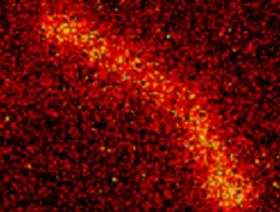
Radioactivity, discovered more than 100 years ago and studied by physicists ever since, would seem to be a relatively closed subject in science. However, since the 1960s, the pursuit of at least one open question about how nuclei spontaneously eject various particles has continued to nag experimentalists, largely because of an inability to make precise measurements of fleeting, exotic nuclei.
In a paper published this week in Physical Review Letters, an international collaboration of researchers, led by Marek Pfutzner, a physicist from Warsaw University in Poland, takes several steps toward an answer. The scientists describe a first-ever success in peering closely at radioactive decay of a rare iron isotope at the ragged edge of the known nuclear map. The tools used to achieve this result include a novel combination of advanced physics equipment and imaging technology that is found in most off-the-shelf digital cameras.
"We have proved in a direct and clear way that this extremely neutron-deficient nucleus disintegrates by the simultaneous emission of two protons," write the authors.
Pfutzner and his collaborators set out to better understand an exotic form of radioactivity -- two-proton emissions from iron-45, a nucleus with 26 protons and 19 neutrons. The stable form of iron that is most abundant on Earth has 26 protons and 30 neutrons. One possibility was that the iron-45 isotope might occasionally release an energetically linked two-proton pair, known as a diproton. Other possibilities were that the protons, whether emitted in quick succession or simultaneously, were unlinked.
The research was performed at Michigan State University's National Superconducting Cyclotron Laboratory (NSCL), but the key device was a detector built by Pfutzner and his Warsaw University colleagues. Though nicknamed "the cannon" because of its vague resemblance to some sort of space age military device, the detector didn't shoot anything but rather was the target for the beam of rare isotopes produced at the NSCL Coupled Cyclotron Facility.
The detector included a front-end gas chamber that accepted and then slowed rare isotopes traveling at half the speed of light. The back-end imaging system, built around a high-end digital camera with standard charge-coupled device, or CCD, technology, recorded ghostly images of trajectories of emitted protons from the decaying iron-45 nuclei shot into the cannon's mouth.
Analysis of these images ruled out the theorized diproton emission and indicated that the observed correlations between emitted protons were best described by a form of nuclear transformation known as three-body decay. A theory of this process had previously been described by Leonid Grigorenko, a physicist at the Joint Institute for Nuclear Research in Dubna, Russia and a coauthor of the paper.
"There is amazing agreement between the experiment and Grigorenko's theory, which takes into account the complex interplay between emitted pairs of protons and the daughter nucleus," said Robert Grzywacz, a physicist at the University of Tennessee and Oak Ridge National Laboratory and a coauthor of the paper.
Besides shedding light on a novel form of radioactive decay, the technique also could lead to additional discoveries about fleeting, rare isotopes studied at accelerator facilities such as NSCL and Oak Ridge National Laboratory. These isotopes may hold the key to understanding processes inside neutron stars and determining the limits of nuclear existence.
The experiment itself also harkens back to the early days of experimental nuclear physics in which visual information served as the raw data. Before the days of cameras, this information was usually captured by scientists hunched over a microscope counting, for example, tiny flashes as alpha particles struck a zinc sulfide screen under the lens.
"It's perhaps the first time in modern nuclear physics that fundamentally new information about radioactive decay was captured in a picture taken by a digital camera," said Andreas Stolz, NSCL assistant professor and a coauthor on the paper. "Usually, in nuclear physics experiments you have digitized data and several channels of information from electronics equipment, but never images."
Source: Michigan State University


