Nanocaps help scientists control magnetism reversal
March 3, 2006 feature
Nanocaps help scientists control magnetism reversal, fig 1

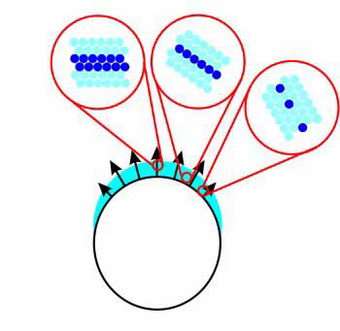
Figure 1: In this model of a multilayer cap on top of a nanosphere, the turquoise layer on the sphere shows different thickness levels, and the black arrows represent the radial symmetric anisotropy orientation across the cap. The radial orientation – as opposed to a parallel orientation in flat films – is caused by the different thickness levels, and is what alters the nanoparticle’s magnetic reversal properties. Image source: T.C. Ulbrich, et al.

By fabricating curved “nanocaps” to study nanoscale magnetism, scientists have discovered how to partly control magnetism reversal, which could improve applications such as data storage, recording media and biomedical technology.

A link between the magnetic and geometric properties of nanoparticles has a significant effect on the magnetization reversal mechanism of these nanoparticles, report T.C. Ulbrich et al. in a recent report in Physical Review Letters. Using a new nanomaterial, which consists of a spherical particle covered with a thin film, the scientists studied how the thickness of the ferromagnetic film affects magnetization reversal. Ferromagnetic materials, which react to external magnetic fields to spontaneously form permanent magnets, can last for millions of years or until a different magnetic field is applied.
Nanocaps help scientists control magnetism reversal, fig 2

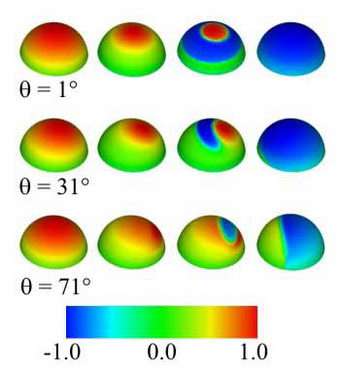
Figure 2: These sequences (which are micromagnetic simulations) show how the magnetization of these 310 nm caps changes depending on the angle of the direction of the applied magnetic field (1º, 31º or 71º). As the applied magnetic field is increased (from left to right), the magnetization of the caps changes differently depending on the angle, which is due to the curvature/different thickness levels. Image source: T.C. Ulbrich, et al.

These new, curved multilayer films differ from previously studied materials, most of which were flat with constant thickness. By depositing thin layers (some less than one nanometer) of ferromagnetic cobalt and palladium on spherical nanoparticles, the scientists formed these films in the shape of caps. Analyzing different thickness levels across the sphere, the team could distinguish different degrees of thickness, discovering that this topological change altered the fundamental nanoscale magnetism of the individual particles.

In this case, the scientists applied a reverse magnetic field to the already magnetized nanocaps, and then analyzed how the magnetization reversal evolved in individual caps. In regions where the film is thick, the nanomaterial demonstrates radial magnetic anisotropy, which means the material’s magnetism is directionally dependent and ferromagnetic (Figure 1). Where the film is thinner, the material’s ferromagnetic properties and the magnetic anisotropy vanish.

“The evaporation of multilayer films on spherical particles leads to an anisotropy distribution in the caps,” said Ulbrich. “In contrast to a flat film, where the anisotropy is parallel throughout the film, here, the anisotropy points radially outward, leading to the altered magnetic reversal properties.”

Previous theories used to describe flat film layers don’t describe the magnetism reversal for the different cases of curved film.

“To investigate the physical origin of this remarkable behavior in detail, micromagnetic simulations were performed, enabling us to distinguish the [different] influences,” wrote the researchers (Figure 2).

Nanocaps help scientists control magnetism reversal, fig 3

Figure 3: This image, taken with a magnetic force microscope, distinguishes oppositely charged magnetic multilayers on nanospheres. Image source: T.C. Ulbrich, et al.

In addition to investigating the topographic assembly of the nanoparticles, the physicists also looked at the morphology to determine the film structure. Using a scanning tunneling microscope, the team discovered that the film had a grainy nanostructure, which also played a role in affecting the film’s magnetic anisotropy. Images from an atomic force microscope and a magnetic force microscope (Figure 3) showed that individual nanoparticles flipped after exposure to a reversed magnetic field.

Because the scientists have control over the film curvature – and subsequently over anisotropies and magnetic properties – the discovery has opened up doors to the possibilities of tailoring magnetism reversal for new nanoscale applications.

“Using these ‘tilted’ caps, we can combine easy writability and high thermal stability, which might lead to a higher storage density in magnetic recording applications,” said Ulbrich.

Citation: Ulbrich, T.C., Makarov, D., Hu, G., Guhr, I.L., Suess, D., Schrefl, T.and Albrecht, M. Magnetization Reversal in a Novel Gradient Nanomaterial. Physical Review Letters. 96, 077202 (2006).

By Lisa Zyga, Copyright 2006 PhysOrg.com

4.3 /5 (76 votes)  

Rank 4.3 /5 (76 votes)
Tags

Relevant PhysicsForums posts

More news stories

'Dark plasmons' transmit energy

Microscopic channels of gold nanoparticles have the ability to transmit electromagnetic energy that starts as light and propagates via "dark plasmons," according to researchers at Rice University.

Nanotechnology / Nanophysics

created 14 hours ago | popularity 5 / 5 (5) | comments 0 | with audio podcast

Nanotube therapy takes aim at breast cancer stem cells

Wake Forest Baptist Medical Center researchers have again proven that injecting multiwalled carbon nanotubes (MWCNTs) into tumors and heating them with a quick, 30-second laser treatment can kill them.

Nanotechnology / Bio & Medicine

created 19 hours ago | popularity 5 / 5 (1) | comments 0 | with audio podcast

New kind of solar cell could capture significantly more energy than current cells

New solar cells could increase the maximum efficiency of solar panels by over 25%, according to scientists from the University of Cambridge.

Nanotechnology / Nanophysics

created Feb 08, 2012 | popularity 4.5 / 5 (11) | comments 14 | with audio podcast

New technology platform for molecule-based electronics

Researchers at the Nano-Science Center at the University of Copenhagen have developed a new nano-technology platform for the development of molecule-based electronic components using the wonder material graphene. At the same ...

Nanotechnology / Nanomaterials

created 21 hours ago | popularity 5 / 5 (2) | comments 0

Nanoshell whispering galleries improve thin solar panels

Visitors to Statuary Hall in the U.S. Capitol Building may have experienced a curious acoustic feature that allows a person to whisper softly at one side of the cavernous, half-domed room and for another on ...

Nanotechnology / Nanomaterials

created Feb 07, 2012 | popularity 4.3 / 5 (6) | comments 6 | with audio podcast


New error-correcting codes guarantee the fastest possible rate of data transmission

Error-correcting codes are one of the triumphs of the digital age. They’re a way of encoding information so that it can be transmitted across a communication channel — such as an optical fiber o ...

High school students test best with 7 hours' rest

(Medical Xpress) -- Whether or not you know any high school students that actually get nine hours of sleep each night, that’s what federal guidelines currently prescribe.

Soccer -- the link between managers and captains

Soccer managers regard their captains as an extension of themselves, according to new research from Northumbria University, which could explain why Fabio Capello quit as England manager following the FA row ...

Using economic evaluations for drug reimbursement decisions - what have we achieved?

Researchers at the University of York perform evaluations of the clinical and cost-effectiveness of drugs for the National Institute for Health and Clinical Excellence (NICE).

Increasing healthy food options makes economic sense

If there is an obvious truth one can learn from perusing the various dining options on Lehigh’s sprawling Asa Packer campus—from the University Center and Rathbone Hall to the sorority and fraternity houses on “the ...

Humans may have helped the decline of African rainforests 3000 years ago

(PhysOrg.com) -- Large areas of rainforests in Central Africa mysteriously disappeared over three thousand years ago, to be replaced by savannas. The prevailing theory has been that the cause was a change ...