Physics provides new insights on cataract formation
Using the tools and techniques of soft condensed matter physics, a research team in Switzerland has demonstrated that a finely tuned balance of attractions between proteins keeps the lens of the eye transparent, and that even a small change in this balance can cause proteins to aggregate and de-mix. This leads to cataract formation, the world’s leading cause of blindness.
This work could shed light on other protein aggregation diseases (such as Alzheimer’s disease), and may one day lead to methods for stabilizing protein interactions and thus preventing these problematic aggregations from occurring.
The eye lens is made up of densely packed crystallin proteins, arranged in such a way that light in the visible wavelength range can pass through. But for a variety of reasons including UV radiation exposure and age, the proteins sometimes change their behavior and clump together.
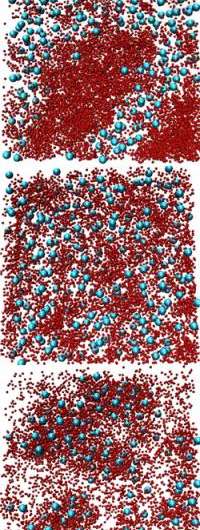
As a result, light is scattered once it enters the lens, resulting in cloudy vision or blindness. There is currently no known way to reverse the protein aggregation process once it has begun. Nearly 5 million people every year undergo cataract surgery in which their lenses are removed and replaced with artificial ones.
Previous research has shown that the interactions between the three major crystallin proteins that make up the concentrated eye lens protein solution are key to cataract formation. A team of scientists from the University of Fribourg, EPFL and the Rochester Institute of Technology (USA) studied the interactions between two of these proteins, at concentrations similar to those found in the eye lens, using a combination of neutron scattering experiments and molecular dynamics computer simulations. They found that a finely tuned combination of attraction and repulsion between the two proteins resulted in an arrangement that was transparent to visible light. “By combining experiments and simulations it became possible to quantify that there had to be a weak attraction between the proteins in order for the eye lens to be transparent,” explains EPFL postdoctoral researcher Giuseppe Foffi, a member of the Institut Romand de Recherche Numerique en Physique des Materiaux (IRRMA). “Our results indicate that cataracts may form if this balance of attractions is disrupted, and this opens a new direction for research into cataract formation.”
“Lots of studies have been done on individual proteins in the lens,” adds University of Fribourg physicist and lead author Anna Stradner, “But none on their mixtures at concentrations typically found in the eye. We modeled these proteins as colloidal particles, and found there was a very narrow window in which the protein solution remained stable, and this was a necessary condition for lens transparency.”
In addition to unveiling important new information about the interactions of the proteins in the eye lens, this benchmark study provides a framework for further study into the molecular properties and interactions of proteins. The results suggest that these properties could perhaps be manipulated to prevent aggregation or reverse the aggregation process once it has begun.
The results are reported in the November 9 issue of Physical Review Letters. The neutron scattering experiments were done at the Paul Scherrer Institute in Villigen, Switzerland, and the research was supported by grants from the Swiss National Science Foundation, the Marie Curie Network and the National Institutes of Health (USA).
Source: Ecole Polytechnique Fédérale de Lausanne


