A galaxy for science and research
November 9, 2007 A galaxy for science and research

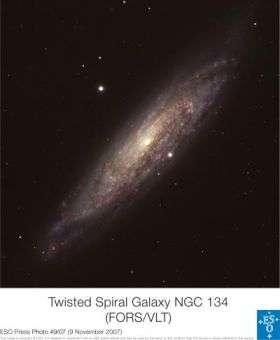
Image obtained with ESO's Very Large Telescope of the spiral galaxy observed by the European Commissioner for Science and Research, Janez Potocnik, when at Paranal. NGC 134 is a barred spiral with its spiral arms loosely wrapped around a bright, bar-shaped central region. The red features lounging along its spiral arms are glowing clouds of hot gas in which stars are forming, so-called HII regions. The galaxy also shows prominent dark lanes of dust across the disc, obscuring part of the galaxy's starlight. The image is a colour composite based on data obtained in the B, V, R, and H-? filters with the FORS2 instrument attached to Antu, UT1 of the VLT. During his stay on Paranal, the Commissioner, together with the observatory staff, prepared the observations of this Galaxy. At night, Janez Poto?nik initiated these observations, and checked the quality of the images as they appeared on the control screens. Because the high-sensitivity detectors used on the VLT measure only the intensity of the light reaching their pixels, the colour information is acquired by taking a sequence of images through different colored filters. Consequently, the commissioner could not immediately see the attached image, but only black-and-white version of it. The final colour processing was done by Haennes Heyer and Henri Boffin, with input from Yuri Beletsky (all ESO). Credit: VLT/ESO

During his visit to ESO's Very Large Telescope at Paranal, the European Commissioner for Science and Research, Janez Potocnik, participated in an observing sequence and took images of a beautiful spiral galaxy.

The visit took place on 27 October and the Commissioner observed with one of the FORS instruments on Antu, the first 8.2-m Unit Telescope of the VLT.

"Two hours bus ride from the nearest town, Antofagasta, in the middle of nowhere and at 2 600 m altitude, rises a state of the art astronomical observatory at which scientists from across Europe venture to exploit some of the most advanced technologies and sophisticated techniques available within astronomy. One of the facilities is the VLT, the Very Large Telescope, with which, together with the other telescopes, scientists can study objects at the far edge of the Universe," wrote Potocnik on his blog.

Known until now as a simple number in a catalogue, NGC 134, the 'Island in the Universe' that was observed by the Commissioner is replete with remarkable attributes, and the VLT has clapped its eyes on them. Just like our own Galaxy, NGC 134 is a barred spiral with its spiral arms loosely wrapped around a bright, bar-shaped central region.

One feature that stands out is its warped disc. While a galaxy's disc is often pictured as a flat structure of gas and stars surrounding the galaxy's centre, a warped disc is a structure that, when viewed sideways, resembles a bent record album left out too long in the burning Sun.

Warps are actually not atypical. More than half of the spiral galaxies do show warps one way or another, and our own Milky Way also has a small warp.

Many theories exist to explain warps. One possibility is that warps are the aftermath of interactions or collisions between galaxies. These can also produce tails of material being pulled out from the galaxy. The VLT image reveals that NGC 134 also appears to have a tail of gas stripped from the top edge of the disc.

So did NGC 134 have a striking encounter with another galaxy in the past? Or is some other galaxy out there exerting a gravitational pull on it? This is a riddle astronomers need to solve.

The superb VLT image also shows that the galaxy has its fair share of ionised hydrogen regions (HII regions) lounging along its spiral arms. Seen in the image as red features, these are glowing clouds of hot gas in which stars are forming. The galaxy also shows prominent dark lanes of dust across the disc, obscuring part of the galaxy's starlight.

Studying galaxies like NGC 134 is an excellent way to learn more about our own Galaxy.

NGC 134 was discovered by Sir John Herschel at the Cape of Good Hope and is located in the Sculptor southern constellation. The galaxy is located about 60 million light-years away - when the light that was captured by the VLT originally left the galaxy, a dramatic episode of mass extinction had led to the disappearance of dinosaurs on Earth, paving the way for the appearance of mammals and later specifically of humans, who have built unique high-tech installations in the Atacama desert to satisfy their curiosity about the workings of the Universe. Still, NGC 134 is not very far away, by cosmological standards. It is the dominant member of a small group of galaxies that belongs to the Virgo or Local Supercluster and is one of the 200 brightest galaxies in our skies.

Source: ESO


print this article email this article download pdf blog this article bookmark this article     Stumble it Digg this share on Facebook retweet share on Reddit add to delicious
Rate this story - 4.1 /5 (8 votes)


November 9, 2007 all stories

Comments: 0

4.1 /5 (8 votes)
  • Stumble this up

  • Digg this

  • share this

  • hide
  • Related Stories

  • Maps Unveil the Source of Starburst Galaxy's Winds
    created Nov 18, 2009 | popularity not rated yet | comments 0
  • NGC 4710 galaxy: Baffling boxy bulge (w/ Video)
    created Nov 18, 2009 | popularity not rated yet | comments 0
  • Mysterious X-rays from a Nearby Galaxy
    created Nov 13, 2009 | popularity not rated yet | comments 0
  • Swift, XMM-Newton satellites tune into a middleweight black hole
    created Nov 10, 2009 | popularity not rated yet | comments 0
  • Rapid supernova could be new class of exploding star
    created Nov 05, 2009 | popularity not rated yet | comments 0


  • hide
  • Relevant PhysicsForums posts

  • Are there green, purple and pink stars?
    created 2 hours ago
  • Sideral question
    created Nov 21, 2009
  • Doppler shifted blackbody spectrum
    created Nov 21, 2009
  • Earth v. Moon
    created Nov 21, 2009
  • More from Physics Forums - General Astronomy

Other News

The shore of Deception Island in Antarctica, in 2008

Antarctic ice loss vaster, faster than thought: study

Space & Earth / Earth Sciences

created 6 hours ago | popularity 2.9 / 5 (10) | comments 7

The East Antarctic icesheet, once seen as largely unaffected by global warming, has lost billions of tonnes of ice since 2006 and could boost sea levels in the future, according to a new study.


Astronaut's baby daughter born as he circles Earth (AP)

Astronaut's baby daughter born as he circles Earth

Space & Earth / Space Exploration

created 6 hours ago | popularity 5 / 5 (1) | comments 0

(AP) -- Astronaut Randolph Bresnik jubilantly welcomed his new daughter into the world Sunday as he floated 220 miles above it.


Denmark: 65 world leaders for UN climate summit (AP)

Denmark: 65 world leaders for UN climate summit

Space & Earth / Environment

created 6 hours ago | popularity 1 / 5 (2) | comments 2

(AP) -- Sixty-five world leaders have said they will attend the Copenhagen climate summit in December, and several more have responded positively to invitations, Danish officials said Sunday.


Commuters wait on the platform shrouded by fog in London

Climate change not man-made, say majority of Britons: poll

Space & Earth / Environment

created Nov 15, 2009 | popularity 3.4 / 5 (16) | comments 46

Less than half of Britons believes that human activity is to blame for global warming, according to a poll carried out for The Times newspaper and published on Saturday.


Mysteriously warm times in Antarctica

Mysteriously warm times in Antarctica

Space & Earth / Earth Sciences

created Nov 18, 2009 | popularity 4.2 / 5 (21) | comments 31

(PhysOrg.com) -- A new study of Antarctica's past climate reveals that temperatures during the warm periods between ice ages (interglacials) may have been higher than previously thought. The latest analysis ...