NASA Unveils New Antenna Network in White Sands, N.M.
November 9, 2007 NASA Unveils New Antenna Network in White Sands, N.M.

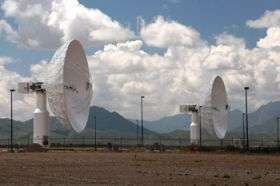
Two of the new 18-meter Ka band dishes installed at the White Sands Test Facility in New Mexico. Credit: NASA

Engineers from NASA’s Goddard Space Flight Center in Greenbelt, Md., showcased the new 18-meter Ka Band Antenna Network, the first such system in agency history, during a ribbon-cutting ceremony at the White Sands Test Facility in New Mexico on November 8.

“Ka band” refers to a section within the microwave portion of the electromagnetic spectrum. Much like how listeners can’t pick up FM waves on AM radios and vice-versa, Ka band signals require special equipment to receive them.

The three new dishes help meet the growing demand for ground stations to handle high volumes of science data generated by today’s new satellites. The Ka band system allows satellites to transmit more data to the ground than ever before, in the area of 45 terabytes a month. That’s about the equivalent of 1,152 fully loaded 40-gigabyte iPods!

The dishes are 18.2 meters in diameter, and they need to be able to rotate quickly to acquire satellite signals. To make the dishes lighter they are largely held together with glue, rather than bolts and other fasteners. But this is no ordinary wood glue.

The network makes use of a two-part epoxy developed at NASA’s Jet Propulsion Laboratory in Pasadena, Calif. Tests have shown the glue and the dishes will last for decades, according to Raymond Pages, chief of Goddard’s Ground System Development Office.

The first missions to use the network will be the Solar Dynamics Observatory (SDO) and the Lunar Reconnaissance Orbiter (LRO). SDO will study solar variations that affect life on Earth. LRO will focus on selecting landing sites, identifying lunar resources and studying how the moon’s environment will affect humans. Both probes are slated for launch in late 2008.

“The design, development, and delivery of three 18-meter Ka band antenna systems in just over two years is a major accomplishment for Goddard and NASA,” Pages said. “People will be munching on data [from these missions] for years to come.”

Once SDO and LRO conclude, the antenna network will be available for other missions.

White Sands was chosen as the location for the new antennas because of the existing infrastructure available there, making it a cost-effective option. Weather was also a factor in the decision, because data must be able to reach the antennas with as little weather interference as possible for optimum quality.

Datron Advanced Technologies in Simi Valley, Calif., built the antennas. Honeywell Technology Solutions Inc. in Columbia, Md., built and assembled the ground station. The Cospal Composites Srl in Ambivere, Italy, manufactured the primary reflectors. Honeywell, Datron and Goddard helped to design the antennas. Goddard manages the White Sands Complex for NASA.

The total development cost of the new antenna system was $20 million.

Source: NASA


print this article email this article download pdf blog this article bookmark this article     Stumble it Digg this share on Facebook retweet share on Reddit add to delicious
Rate this story - 4.3 /5 (8 votes)


November 9, 2007 all stories

Comments: 0

4.3 /5 (8 votes)
  • Stumble this up

  • Digg this

  • share this

  • hide
  • Related Stories

  • Budget cuts may ax powerful telescopes
    created Nov 06, 2006 | popularity not rated yet | comments 0
  • Data from Space: Adaptive Array Network Could Improve Access to NASA's Earth Observing Satellites
    created May 23, 2005 | popularity not rated yet | comments 0
  • New Celestial Map Gives Directions for GPS
    created Oct 29, 2009 | popularity not rated yet | comments 0
  • Galileo's Jupiter Journey Began Two Decades Ago
    created Oct 19, 2009 | popularity not rated yet | comments 0
  • Bumpy road for satellite TV in cars
    created Oct 14, 2009 | popularity not rated yet | comments 0


  • hide
  • Relevant PhysicsForums posts

  • Gravity on Mars
    created 4 hours ago
  • Question about the orbit between Mars and Earth
    created 12 hours ago
  • SIMBAD/NED help
    created 15 hours ago
  • Black hole confusion
    created Nov 14, 2009
  • More from Physics Forums - General Astronomy

Other News

Ancient high-altitude trees grow faster as temperatures rise

Space & Earth / Earth Sciences

created 45 minutes ago | popularity 5 / 5 (2) | comments 0

PIC=32536:left]Increasing temperatures at high altitudes are fueling the post-1950 growth spurt seen in bristlecone pines, the world's oldest trees, according to new research.


Taking a Bite of Antarctic Ice

Taking a Bite of Antarctic Ice

Space & Earth / Space Exploration

created 8 minutes ago | popularity not rated yet | comments 0

Scientists with NASA’s IceBite project are heading this week for University Valley, a hanging valley perched more than 1600 feet (more than 1 mile) above sea level in Antarctica’s McMurdo Dry Valleys. Their ...


Terra satellite spots Tropical Cyclone Anja, the first of the southern season

Terra satellite spots Tropical Cyclone Anja, the first of the southern season

Space & Earth / Earth Sciences

created 1hour ago | popularity not rated yet | comments 0

NASA's Terra satellite captured a stunning image of Anja, the first tropical cyclone of the southern Hemisphere cyclone season. When Anja formed on Saturday, November 14, in the Southern Indian Ocean, about ...


New climate treaty could put species at risk

Space & Earth / Environment

created 35 minutes ago | popularity not rated yet | comments 0

Plans to be discussed at the forthcoming UN climate conference in Copenhagen to cut deforestation in developing countries could save some species from extinction but inadvertently increase the risk to others, scientists believe.


Volatile gas could turn Rwandan lake into a freshwater time bomb

Space & Earth / Earth Sciences

created 1hour ago | popularity 5 / 5 (1) | comments 0

A dangerous level of carbon dioxide and methane gas haunts Lake Kivu, the freshwater lake system bordering Rwanda and the Republic of Congo.