Part-time pulsar yields new insight into inner workings of cosmic clocks
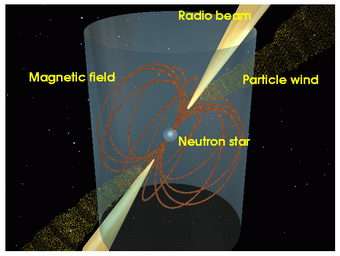
Astronomers using the 76-m Lovell radio telescope at the University of Manchester's Jodrell Bank Observatory have discovered a very strange pulsar that helps explain how pulsars act as 'cosmic clocks' and confirms theories put forward 37 years ago to explain the way in which pulsars emit their regular beams of radio waves - considered to be one of the hardest problems in astrophysics.
Their research, now published in Science Express, reveals a pulsar that is only 'on' for part of the time. The strange pulsar is spinning about its own axis and slows down 50% faster when it is 'on' compared to when it is 'off'.
Pulsars are dense, highly magnetized neutron stars that are born in a violent explosion marking the death of massive stars. They act like cosmic lighthouses as they project a rotating beam of radio waves across the galaxy. Dr. Michael Kramer explains, "Pulsars are a physicist's dream come true. They are made of the most extreme matter that we know of in the Universe, and their highly stable rotation makes them super-precise cosmic clocks. But, embarrassingly, we do not know how these clocks work. This discovery goes a long way towards solving this problem."
The research team, led by Dr. Michael Kramer, found a pulsar that is only periodically active. It appears as a normal pulsar for about a week and then "switches off" for about one month before emitting pulses again. The pulsar, called PSR B1931+24, is unique in this behaviour and affords astronomers an opportunity to compare its quiet and active phases. As it is quiet the majority of the time, it is difficult to detect, suggesting that there may be many other similar objects that have, so far, escaped detection.
Prof. Andrew Lyne points out that, "After the discovery of pulsars, theoreticians proposed that strong electric fields rip particles out of the neutron star surface into a surrounding magnetised cloud of plasma called the magnetosphere. But, for nearly 40 years, there had been no way to test whether our basic understanding was correct."
The University of Manchester astronomers were delighted when they found that this pulsar slows down more rapidly when the pulsar is on than when it is off. Dr. Christine Jordan points out the importance of this discovery, "We can clearly see that something hits the brakes when the pulsar is on."
This breaking mechanism must be related to the radio emission and the processes creating it and the additional slow-down can be explained by a wind of particles leaving the pulsar's magnetosphere and carrying away rotational energy. "Such a braking effect of the pulsar wind was expected but now, finally, we have observational evidence for it" adds Dr Duncan Lorimer.
The amount of braking can be related to the number of charges leaving the pulsar magnetosphere. Dr. Michael Kramer explains their surprise when it was found that the resulting number was within 2% of the theoretical predictions. "We were really shocked when we saw these numbers on our screens. Given the pulsar's complexity, we never really expected the magnetospheric theory to work so well."
Prof. Andrew Lyne summarized the result: "It is amazing that, after almost 40 years, we have not only found a new, unusual, pulsar phenomenon but also a very unexpected way to confirm some fundamental theories about the nature of pulsars."
Source: PPARC


