Scientists discover biological mechanism for enhanced carbon consumption in the ocean
November 12, 2007
Scientists discover biological mechanism for enhanced carbon consumption in the ocean

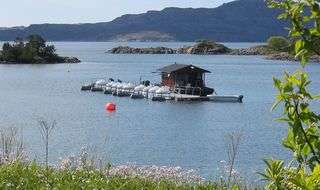
Experiments for the future: Mesocosms in the Raunefjord, Norway.

The world oceans are by far the largest sink of anthropogenic CO2 on our planet. Until now, they have swallowed almost half of the CO2 emitted through the burning of fossil fuels. However, can the oceans continue to alleviate the steady rise in atmospheric CO2 in the future?

Current models for the development of the global climate system do not incorporate the reaction of marine organisms nor the processes that they influence.

Professor Ulf Riebesell, marine biologist at IFM-GEOMAR in Kiel and the first author of the study, gives insight into the motivation for the research: “We need to learn a lot more about the biology of the oceans, because the organisms play a decisive role in the carbon cycle. How do they affect the chemical balance and what are their responses to the enormous environmental changes we are currently experiencing?” The Nature publication provides new insights into these effects and their dimension.

To investigate the biological processes and their potential changes with time, the scientists made use of an unusual experimental set up in the Raunefjord in Norway. Here, a series of nine mesocosms, enclosures manufactured from a specialized synthetic material and measuring 10 meters in depth, were used to isolate 27 cubic meters of natural fjord water.

In the experimental design, Ulf Riebesell and his team maintained three enclosures at current CO2 conditions as a control, while they infused CO2 in the remaining mesocosms to simulate predicted concentrations for the year 2100 and the year 2150. The critters in the mesocosms responded quickly to the extra serving of CO2. The higher the concentration of dissolved carbon dioxide, the faster the microalgae incorporated the greenhouse gas via photosynthesis. Can CO2 act as a fertilizer in the ocean?

The scientists measured an increased uptake of up to 39% compared to current rates. Ulf Riebesell describes the reaction of his team: “We expected the organisms to show distinct reactions to changing CO2 conditions. What really surprised us, however, was the dimension of this effect. Basically, we can now say that the biology in the oceans is significantly affecting the global climate system.” In the final step of the experiment, the scientists wanted to find out what happens with the rapidly proliferating biomass. Again the experiments in the Raunefjord provided insights: the extra CO2 bound in organic matter sank to depth after the peak of the algal bloom.

The CO2 fertilization of marine plankton can have a positive effect on climate change in the future. The greenhouse gas consumed by plankton and removed from the surface ocean when the dying cells sink to depth makes way for the uptake of more CO2. In a way, the tiny organisms act as a biological conveyer belt for the transport of carbon dioxide out of the surface and into the deep ocean. What appears to be a blessing for the atmospheric greenhouse effect may prove to be a curse for deep ocean ecosystems. Decomposition of the increased biomass will consume more oxygen, a major problem for marine animals that occupy deep habitats. Another consequence of the biological conveyer belt is the accelerated rate of ocean acidification in the deep ocean due to more rapid transport of CO2 to depth. The authors also expect direct affects on marine organisms based on previous observations. Planktonic crustaceans that were fed with CO2-enriched microalgae displayed slower growth rates and were less proliferous.

Ulf Riebesell remarks on the consequences of the study: „Our results probably represent only the tip of the iceberg. I am certain that scientists will discover further biological feedback mechanisms in the near future. It is essential not only to identify and to understand these mechanisms, but also to quantify their effect on the global climate system, now and in the future. “

The experiments in Bergen were conducted in the framework of the research program CARBOOCEAN, funded by the European Union.

Citation: Enhanced biological carbon consumption in a high CO2 ocean, http://dx.doi.org/ … /nature06267

Source: IFM-GEOMAR

4.5 /5 (19 votes)  

Filter


Move the slider to adjust rank threshold, so that you can hide some of the comments.


Display comments: newest first

Argiod
Nov 13, 2007

Rank: not rated yet
We're in a colossal garage, the door is closed, the engine is running, and we are fast running out of breathable air. No longer have we blue skies, but only an oily looking haze on the horizon, burning eyes and bronchitis, or COPD, or lung cancer...

Oh, wait, I'm not in Los Angeles any more... I can breathe again; at least for a while yet...
Rank 4.5 /5 (19 votes)
Tags

Relevant PhysicsForums posts
  • Do some geologists actually act a lot like Randy Marsh?
    createdFeb 11, 2012
  • Discrepancy between oxygen and carbon-dioxide levels
    createdFeb 09, 2012
  • where gems are found in the world
    createdFeb 09, 2012
  • Wind Waves in Reservoir ~ Wind run-up and Wind set-up
    createdFeb 08, 2012
  • Balance of oxygen in the atmosphere
    createdFeb 01, 2012
  • The case for a methanol-based economy
    createdJan 30, 2012
  • More from Physics Forums - Earth

More news stories

Salvage workers begin pumping fuel from Italian shipwreck

Salvage workers Sunday began pumping fuel from the shipwrecked Italian cruise liner Costa Concordia, a day ahead of schedule, officials said.

Space & Earth / Environment

created 32 minutes ago | popularity not rated yet | comments 0

Latin America mining boom clashes with conservation

Latin America is experiencing a mining boom as prices rise fuelled by a hike in global demand, but the region is also being hit by a wave of violent protests, strikes and rallies by environmentalists.

Space & Earth / Environment

created 8 hours ago | popularity 5 / 5 (1) | comments 0

Political leaders play key role in how worried Americans are by climate change: study

More than extreme weather events and the work of scientists, it is national political leaders who influence how much Americans worry about the threat of climate change, new research finds.

Space & Earth / Environment

created Feb 06, 2012 | popularity 5 / 5 (6) | comments 73

NASA budget will axe Mars deal with Europe: scientists

US President Barack Obama's budget proposal to be submitted next week for 2013 will cut NASA's budget by 20 percent and eliminate a major partnership with Europe on Mars exploration, scientists said Thursday.

Space & Earth / Space Exploration

created Feb 10, 2012 | popularity 5 / 5 (3) | comments 55

Humans may have helped the decline of African rainforests 3000 years ago

(PhysOrg.com) -- Large areas of rainforests in Central Africa mysteriously disappeared over three thousand years ago, to be replaced by savannas. The prevailing theory has been that the cause was a change ...

Space & Earth / Environment

created Feb 10, 2012 | popularity 4.1 / 5 (14) | comments 20 | with audio podcast report


Scientists discover molecular secrets of 2,000-year-old Chinese herbal remedy

For roughly two thousand years, Chinese herbalists have treated Malaria using a root extract, commonly known as Chang Shan, from a type of hydrangea that grows in Tibet and Nepal. More recent studies suggest that halofuginone, ...

New method to examine batteries -- MRI from the inside

There is an ever-increasing need for advanced batteries for portable electronics, such as phones, cameras, and music players, but also to power electric vehicles and to facilitate the distribution and storage of energy derived ...

A mitosis mystery solved: How chromosomes align perfectly in a dividing cell

Although the process of mitotic cell division has been studied intensely for more than 50 years, Whitehead Institute researchers have only now solved the mystery of how cells correctly align their chromosomes during symmetric ...

Starve a virus, feed a cure? Findings show how some cells protect themselves against HIV

A protein that protects some of our immune cells from the most common and virulent form of HIV works by starving the virus of the molecular building blocks that it needs to replicate, according to research published online ...

Researchers find extensive RNA editing in human transcriptome

In a new study published online in Nature Biotechnology, researchers from BGI, the world's largest genomics organization, reported the evidence of extensive RNA editing in a human cell line by analysis of RNA-seq data, demons ...

The proteins ensuring genome protection

Researchers from the University of Geneva (UNIGE), Switzerland, have discovered the crucial role of two proteins in developing a cell 'anti-enzyme shield'. This protection system, which operates at the level of molecular ...