Breakthrough toward industrial-scale production of nanodevices
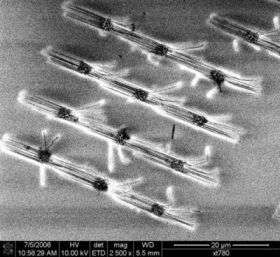
Scientists in Maryland are reporting an important advance toward the long-sought goal of industrial-scale fabrication of nanowire-based devices like ultra-sensitive sensors, light emitting diodes, and transistors for inexpensive, high-performance electronics products. The study is scheduled for the current issue of ACS’ Chemistry of Materials.
In the report, Babak Nikoobakht points out that existing state-of-the-art assembly methods for nanowire-based devices require complicated, multi-step treatments, painstaking alignments steps, and other processing for nanowires , which are thousands of times smaller than the diameter of a human hair.
The goal is to electrically address the coordinates of millions of nanowires on a surface in order to produce the components of electronic circuits. The study describes a new method in which zinc oxide nanowires are grown in the exact positions where nanodevices later will be fabricated, in a way that involves a minimum number of fabrication steps and is suitable for industrial-scale applications.
“This method, due to its scalability and ease of device fabrication, goes beyond the current state-of-the-art assembly of nanowire-based devices,” the report states. “It is believed to be an attractive approach for mass fabrication of nanowire-based transistors and sensors and is expected to impact nanotechnology in fabrication of nonconventional nanodevices.”
Source: ACS


