Octopus and kin inspire new camouflage strategies for military applications

November 12, 2007

Researchers are studying the remarkable shape- and color-changing abilities of the octopus and its close relatives in an effort to understand one of nature’s most remarkable feats of camouflage and self-preservation.

Eventually, such knowledge could lead to new and improved camouflage strategies for military applications, according to an article scheduled for the Nov. 12 issue of Chemical & Engineering News, ACS’ weekly newsmagazine.
Octopus and kin inspire new camouflage strategies for military applications

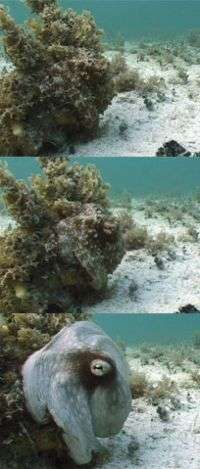
Octopus emerges from concealment. Credit: Roger Hanlon, Marine Biological Laboratory, Woods Hole, Mass

In the article, C&EN associate editor Bethany Halford points out that cephalopods, which include octopus, squid, and cuttlefish, are experts in the art of camouflage and renowned for their ability to make themselves look like fish, rocks, coral and other objects in an effort to hide from predators.

By studying the various layers of skin of these creatures, particularly the chemicals in these layers that are behind their color transitions, scientists hope to develop similar camouflage strategies.

In the article, Halford describes the specialized skin cells involved in the creatures’ color transformations, including the leucophore layer, which serves as a veritable base coat, another layer with chromatophores that are filled with pigments, and yet another layer sporting iridophores that reflect light in curious ways.

Link: http://pubs.acs.org/cen/science/85/8546sci2.html

Source: ACS


print this article email this article download pdf blog this article bookmark this article     Stumble it Digg this share on Facebook retweet share on Reddit add to delicious
Rate this story - 4.2 /5 (5 votes)


November 12, 2007 all stories

Comments: 0

4.2 /5 (5 votes)
  • Stumble this up

  • Digg this

  • share this

  • hide
  • Related Stories


Other News

Synthetic protein mimics structure, function of metalloprotein in nature

Synthetic protein mimics structure, function of metalloprotein in nature

Chemistry / Biochemistry

created 21 minutes ago | popularity not rated yet | comments 0

Scientists have designed a synthetic protein that is both a structural model and a functional model of a native protein, nitric-oxide reductase.


Entropy alone creates complex crystals from simple shapes, study shows

Entropy alone creates complex crystals from simple shapes, study shows

Chemistry / Materials Science

created 21 hours ago | popularity 4.9 / 5 (20) | comments 2

(PhysOrg.com) -- In a study that elevates the role of entropy in creating order, research led by the University of Michigan shows that certain pyramid shapes can spontaneously organize into complex quasicrystals.


Older dental fillings contain form of mercury unlikely to be toxic

Older dental fillings contain form of mercury unlikely to be toxic

Chemistry / Biochemistry

created 22 hours ago | popularity not rated yet | comments 0

A new study on the surface chemistry of silver-colored, mercury-based dental fillings suggests that the surface forms of mercury may be less toxic than previously thought. It appears online in ACS' journal ...


Roasting Does More than Enhance Flavor in Peanuts

Roasting Does More than Enhance Flavor in Peanuts

Chemistry / Other

created 19 hours ago | popularity 5 / 5 (1) | comments 1

(PhysOrg.com) -- Agricultural Research Service (ARS) scientists have shown that increasing roast color intensity steadily ramps up the antioxidant capacities of peanuts, peanut flour and peanut skins.


Drug industry embraces new business strategies after tough year

Drug industry embraces new business strategies after tough year

Chemistry / Other

created 19 hours ago | popularity not rated yet | comments 0

As they pop the champagne corks to celebrate New Year's Eve, drug industry executives will likely be glad to put 2009 behind them. That's because pharmaceutical companies who make top-selling drugs for heart ...