Scorpion Toxin Makes Fungus Deadly to Insect Pests
November 12, 2007
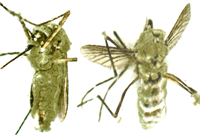
Fungus injected with deadly scorpion toxin can kill mosquitoes quickly.
University of Maryland entomology professor Raymond St. Leger has discovered how to use scorpion genes to create a hypervirulent fungus that can kill specific insect pests, including mosquitoes that carry malaria and a beetle that destroys coffee crops, but does not contaminate the environment as chemical pesticides do.
In the November issue of the journal Nature Biotechnology, St. Leger and Chengshu Wang, a colleague from the Chinese Academy of Sciences, describe how they were able to bioengineer a new version of the fungus Metarhizium anisopliae to inject specific insects with the scorpion toxin Androctonus australis insect neurotoxin (AaIT ), and kill them within a few days.
"Scorpions have toxins that are superbly adapted to killing insects," says St. Leger. "A scorpion kills by stabbing its prey, so we were looking for a way to get the toxin into the insect without the scorpion.
"Fungi are really good at that because they are naturally infective. They land on the insect's outer surface, insert little tubes called hyphae, and grow within the insect. You could almost see them as tiny hypodermic needles. If you can get the fungus to insert a toxin into the insect, you can kill the insect very quickly. This is what we did."
Speeding up the Process
The naturally occurring M. anisopliae fungus and other strains like it are already being used to control agricultural pests and mosquitoes, but their effectiveness has been limited in comparison to chemical pesticides. Unlike chemical pesticides, these altered fungi can be used to target specific insects and do not pose a threat to the environment.
In Australia, the fungus is sprayed from airplanes to target locusts and grasshoppers that decimate food crops. In Africa, the spores of the M. anisopliae fungus are put on sheets and hung inside houses to kill mosquitoes. "The problem is it takes quite a few fungal spores to kill the mosquito, and it is slow," says St. Leger. "It reduces the number of mosquito bites that people get, but it doesn't keep people from getting malaria or dengue. We're trying to get a supercharged, hypervirulent fungus that will take out the mosquitoes quickly."
St. Leger also is looking at the possibility of using the enhanced fungus to attack the coffee berry borer, an invasive beetle that causes severe damage to organic coffee crops in Colombia and other parts of Latin America. After oil, coffee is the largest legally traded commodity in the world, so the industry is eager to develop biopesticides that will protect the crop.
Synthetic Gene
To produce the insect-killing fungus, St. Leger created a synthetic scorpion gene which he inserted into the M. anisopliae fungus. "You can't just take out the scorpion gene and put it into the fungus. You have to turn that piece of DNA into something that the M. anisopliae can use properly," he explains.
He also had to create what he calls an "on/off switch" in front of the gene so the fungus will produce the scorpion toxin only when it is in the blood of the insect. "The fungus will never produce it under any other circumstances."
St. Leger tested the infectivity of the transgenic fungus against mosquitoes, caterpillars and the coffee borer beetle. It was nine times more virulent than the wild M. anisopliae in killing mosquitoes, 22 times more virulent to caterpillars, and 30 times more virulent to the coffee borer beetle.
St. Leger believes this supercharged, pathogenic fungus has great potential to become a cost effective biopesticide that can kill using far fewer spores than the wild M. anisopliae fungus. He is currently using a range of genes, including scorpion toxins, to create additional biocontrol agents that are also highly specific to important pest species.
Source: University of Maryland
-
Genetically modified fungus could fight malaria
Apr 07, 2011 |
5 / 5 (2) |
0
-
Transgenic fungi can combat malaria, other bug-borne diseases: study
Feb 24, 2011 |
5 / 5 (1) |
0
-
New studies show promise for biological control methods against insects
Feb 01, 2012 |
3.5 / 5 (2) |
0
-
Decoding corn defenses for improved pest resistance
Jan 06, 2012 |
not rated yet |
0
-
Special delivery: Nematode-infected insect cadavers
Nov 22, 2011 |
not rated yet |
0
-
Engineers build first sub-10-nm carbon nanotube transistor
Feb 01, 2012 |
4.9 / 5 (31) |
30
-
Something old, something new: Evolution and the structural divergence of duplicate genes
Jan 31, 2012 |
4.6 / 5 (7) |
1
-
The hidden nanoworld of ice crystals: Revealing the dynamic behavior of quasi-liquid layers
Jan 30, 2012 |
5 / 5 (3) |
1
-
Stock market network reveals investor clustering
Jan 27, 2012 |
3.9 / 5 (23) |
8
-
Of microchemistry and molecules: Electronic microfluidic device synthesizes biocompatible probes
Jan 26, 2012 |
5 / 5 (1) |
0
More news stories
The power of estrogen -- male snakes attract other males
A new study has shown that boosting the estrogen levels of male garter snakes causes them to secrete the same pheromones that females use to attract suitors, and turned the males into just about the sexiest ...
12 hours ago |
4.8 / 5 (5) |
1
|
Grass to gas: Researchers' genome map speeds biofuel development
Researchers at the University of Georgia have taken a major step in the ongoing effort to find sources of cleaner, renewable energy by mapping the genomes of two originator cells of Miscanthus x giganteus, a large perenn ...
9 hours ago |
3.8 / 5 (5) |
0
|
Experts reveal how plants don't get sunburn
(PhysOrg.com) -- Experts at the University of Glasgow have discovered how plants survive the harmful rays of the sun.
12 hours ago |
4.7 / 5 (3) |
0
|
Miami battling invasion of giant African snails
No one knows how they got there. But an invasion of African giant snails has southern Florida in a panic over potential crop damage, disease and general yuckiness surrounding the slimy gastropods.
16 hours ago |
4 / 5 (1) |
4
Protein libraries in a snap
(PhysOrg.com) -- A Rice University undergraduate will depart with not only a degree but also a possible patent for his invention of an efficient way to create protein libraries, an important component of biomolecular ...
16 hours ago |
4.8 / 5 (4) |
0
|
Google users warned of threat to smartphone wallets
Users of Google smartphone wallets were being warned on Friday that there is a way to crack pass codes intended to thwart thieves from going on illicit shopping sprees.
Anonymous knocks CIA website offline (Update)
The website of the Central Intelligence Agency was inaccessible on Friday after the hacker group Anonymous claimed to have knocked it offline.
Complex wiring of the nervous system may rely on a just a handful of genes and proteins
Researchers at the Salk Institute have discovered a startling feature of early brain development that helps to explain how complex neuron wiring patterns are programmed using just a handful of critical genes. ...
New error-correcting codes guarantee the fastest possible rate of data transmission
Error-correcting codes are one of the triumphs of the digital age. Theyre a way of encoding information so that it can be transmitted across a communication channel such as an optical fiber o ...
Humans may have helped the decline of African rainforests 3000 years ago
(PhysOrg.com) -- Large areas of rainforests in Central Africa mysteriously disappeared over three thousand years ago, to be replaced by savannas. The prevailing theory has been that the cause was a change ...
New power source discovered
(PhysOrg.com) -- Researchers at the Massachusetts Institute of Technology (MIT) and RMIT University have made a breakthrough in energy storage and power generation.
Nov 19, 2007
Rank: not rated yet
I have some questions regadring Scorpion Toxin Makes Fungus Deadly to Insect Pests.
It is very nice work
As for as biosafety issues, please told me that if the system in on/off basis and on only when fungys enterd into insect blood. my question is that if in human or in animal if we have any injure and their is wound with blood and it come contact with said fungus, then what is result?
2. Is it possible to find out genes for snek toxin with will help to make antiysnak bitting medicine.
Nov 20, 2007
Rank: not rated yet
Sep 29, 2008
Rank: not rated yet
And all genetic research. Not that this will stop anybody but with evolutionary pressures there can easily be unforeseen consequences.
And since the consequences are going to be unforeseen there can be no stopping the problem whatever it is from happening.