Brown root rot -- a potentially serious forage crop disease -- is found throughout the Northeast
November 12, 2007 Brown root rot -- a potentially serious forage crop disease -- is found throughout the Northeast

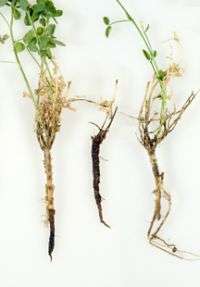
Alfalfa roots with various degrees of brown root rot.

Cornell plant pathologists have detected brown root rot -- a potentially serious forage crop disease -- in the northeastern United States. It is widespread in New York, Vermont and New Hampshire and has been detected in Pennsylvania and Maine.

The findings are published in the October issue of the journal Plant Disease.

Brown root rot (Phoma sclerotioides) affects dairy farmers, as it attacks forage crops alfalfa and clover.

"It's pervasive. These were arbitrarily chosen fields, and it is present in a majority of alfalfa fields tested in the Northeast," said Gary Bergstrom, Cornell professor of plant pathology. "At this point, we have not identified effective controls for it," he added, explaining that scientists are exploring disease-resistant varieties that are adapted to the Northeast.

Brown root rot was detected in eight of 10 fields sampled in New York state, six of seven fields sampled in Vermont and five of six fields sampled in New Hampshire.

The disease's lesions begin as reddish-brown to dark brown areas of external discoloration. As the lesions progress into the internal plant tissues, they can take on corky texture, with a dark border separating the healthy and diseased tissue. Lesions that do not immediately kill the plant can vary in appearance, making it difficult to identify the disease without laboratory analysis.

"It was found in a high percentage of plants in many fields, and most lesions had advanced to the internal tissues of roots and crowns," says Bergstrom. "This suggests that it may be a serious factor in the health and persistence of alfalfa in the region."

Spatial patterns within fields suggest the pathogen was not recently introduced in the Northeast, says Michael Wunsch, Cornell graduate student in plant pathology and the lead author of this research. In North America, brown root rot has been a problem in Alaska and in Alberta, Saskatchewan, Manitoba and the Yukon Territory of Canada. In eastern North America, it had been reported only in Nova Scotia. The disease was first observed in the contiguous United States in 1996 in Wyoming and then subsequently in Idaho, Montana, Minnesota and Wisconsin.

Other authors of the study are Robert Schindelbeck, research support specialist, and Harold van Es, professor, both of crop and soil sciences.

New York farmers with questions about brown root rot in their fields should contact Cornell Cooperative Extension field crops educators for their county. Outside of New York, farmers should contact their local cooperative extension offices.

Source: Cornell University


print this article email this article download pdf blog this article bookmark this article     Stumble it Digg this share on Facebook retweet share on Reddit add to delicious
Rate this story - 4 /5 (1 vote)

Rank Filter

Move the slider to adjust rank threshold, so that you can hide some of the comments.


Display comments: newest first

  • Argiod - Nov 13, 2007
    • Rank: not rated yet
    Mother Nature's way of telling us there are way too many humans?

November 12, 2007 all stories

Comments: 1

4 /5 (1 vote)
  • Stumble this up

  • Digg this

  • share this

  • hide
  • Related Stories

  • Plant reflections may be key to early detection of treatment needs
    created Feb 04, 2008 | popularity not rated yet | comments 0
  • Fungus is world's largest living organism
    created Jun 11, 2007 | popularity not rated yet | comments 0
  • Physical scientists will apply laws of physics in cancer fight
    created Oct 26, 2009 | popularity not rated yet | comments 0
  • From ecological Soviet-era ruin, a sea is reborn
    created Oct 25, 2009 | popularity not rated yet | comments 0
  • Squeezing More Crop Out of Each Drop of Water
    created Oct 09, 2009 | popularity not rated yet | comments 0


Other News

15,000 reasons to worry about invasive species

Biology / Ecology

created 1hour ago | popularity not rated yet | comments 0

A day at the beach in Wisconsin's North Woods didn't used to go like this. Candy Dailey spent a Fourth of July holiday splashing with grandkids on the sandy shore of Lake Metonga when she felt a nasty sting on her foot.


Scientists visualize how bacteria talk to one another

Scientists visualize how bacteria talk to one another

Biology / Cell & Microbiology

created 19 hours ago | popularity 4.9 / 5 (9) | comments 1

Using imaging mass spectrometry, researchers at the University of California, San Diego have developed tools that will enable scientists to visualize how different cell populations of cells communicate. Their ...


Laser etching safe alternative for labeling grapefruit

Laser etching safe alternative for labeling grapefruit

Biology / Other

created Nov 03, 2009 | popularity 4.4 / 5 (14) | comments 8

Laser labeling of fruit and vegetables is a new, patented technology in which a low-energy carbon dioxide laser beam is used to label, or "etch" information on produce, thereby eliminating the need for common ...


Caught in the act: Butterfly mate preference shows how 1 species can become 2

Caught in the act: Scientists find butterflies splitting into two species

Biology / Plants & Animals

created Nov 05, 2009 | popularity 4.5 / 5 (8) | comments 5

(PhysOrg.com) -- Breaking up may actually not be hard to do, say scientists who've found a population of tropical butterflies that may be on its way to a split into two distinct species.


Wolves, moose and biodiversity: An unexpected connection

Wolves, moose and biodiversity: An unexpected connection

Biology / Ecology

created Nov 02, 2009 | popularity 4.9 / 5 (7) | comments 4

Moose eat plants; wolves kill moose. What difference does this classic predator-prey interaction make to biodiversity?