Probing Question: Are Asteroids a Threat to Earth?
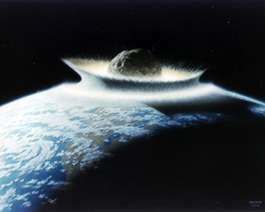
November 12, 2007 Artist's concept of a catastrophic asteroid impact

Artist's concept of a catastrophic asteroid impact. Credit: NASA

Hollywood thrillers such as Deep Impact helped to jump-start America's interest in knowing what our "deflection strategy" would be if a giant asteroid was on a potentially catastrophic collision course with Earth.

Chris Palma, senior lecturer in astronomy and astrophysics at Penn State, says that such events are statistically highly probable. "Throughout Earth's history, we have been bombarded by comets and asteroids from space," Palma notes. "Impacts happened more frequently in the past, but they will happen again. It is just a matter of when."

Explains Palma, a law was passed two years ago requiring NASA to "to both survey for near Earth objects and come up with a plan to divert those objects." Yet, some experts have criticized both NASA and the United States government for not doing enough to prevent potential impacts with Earth.

The so-called Tunguska event in 1908, believed to have been the only large-scale meteorite hit within recorded human history, reportedly flattened over 830 square miles of Siberia, with an explosion a thousand times more powerful than the atomic bomb dropped on Hiroshima. While it is staggering to imagine such damage in a heavily populated area, Palma cautions that "we have no experience with these scenarios and can't do more than estimate the number of lives that will be lost and the amount of damage to the infrastructure in the impact region."

Programs have been set into place to help predict and monitor threats posed by meteorite and asteroid impacts, such as NASA's Near Earth Object Program and University of Arizona's SpaceWatch group. However, Palma's impression is that the majority of similarly focused programs are spearheaded by "individual researchers."

What would happen if an asteroid was detected heading toward Earth? A number of different ideas have been proposed, says Palma, including "sending a very massive unmanned spacecraft towards the asteroid and using the ship's gravitational pull to nudge the asteroid off course." Adds Palma, the idea isn't to physically push it, but rather to use the spacecraft's strong gravitational pull to cause the asteroid to move into a different orbit without directly impacting the asteroid."

Would such a dramatic, heroic endeavor succeed? "My guess," says Palma," is that this particular model is a good theoretical starting point, but not one that is necessarily going to be feasible if applied."

Is enough being done to prepare for potential threats? As with so much else, it all depends on who you ask, though all agree that the stakes are high. After all, the most popular explanation for dinosaur extinction is the widespread after-effects of a giant asteroid impact.

Regarding our current state of deflection readiness, Palma says, "I think it is a bit of a stretch to say that NASA is doing nothing about this, but at the same time, I think you can argue that they should be doing more."

Source: by Josh Ambrose, Research Penn State


print this article email this article download pdf blog this article bookmark this article     Stumble it Digg this share on Facebook retweet share on Reddit add to delicious
Rate this story - 3.6 /5 (30 votes)


November 12, 2007 all stories

Comments: 0

3.6 /5 (30 votes)
  • Stumble this up

  • Digg this

  • share this

  • hide
  • Related Stories

  • Near Earth Objects - what lies ahead?
    created Nov 28, 2005 | popularity not rated yet | comments 0
  • Nanometric butterfly wings created
    created Oct 08, 2009 | popularity not rated yet | comments 0
  • Age-old kids' query in a text message: Wuz4dina?
    created Sep 22, 2009 | popularity not rated yet | comments 0
  • Astronomers unveil an amazing, interactive, 360-degree panoramic view of the entire night sky
    created Sep 14, 2009 | popularity not rated yet | comments 0
  • Huge telescope opens in Spain's Canary Islands
    created Jul 24, 2009 | popularity not rated yet | comments 0


  • hide
  • Relevant PhysicsForums posts

  • The shape of our solar system's orbits.
    created Nov 07, 2009
  • Above or Below the Line of Nodes
    created Nov 07, 2009
  • Supernova vs. Nova?
    created Nov 07, 2009
  • Supernova's Gamma Rays and Comets
    created Nov 06, 2009
  • More from Physics Forums - General Astronomy

Other News

Antarctica glacier retreat creates new carbon dioxide store

Antarctica glacier retreat creates new carbon dioxide store

Space & Earth / Earth Sciences

created 6 hours ago | popularity 4.3 / 5 (3) | comments 0

Large blooms of tiny marine plants called phytoplankton are flourishing in areas of open water left exposed by the recent and rapid melting of ice shelves and glaciers around the Antarctic Peninsula. This ...


L-R: Chiwetel Ejiofor, Amanda Peet and John Cusack at the premiere of "2012"

NASA on crusade to debunk 2012 apocalypse myths

Space & Earth / Space Exploration

created 2 hours ago | popularity not rated yet | comments 0

The world is not coming to an end on December 21, 2012, the US space agency insisted Monday in a rare campaign to dispel widespread rumors fueled by the Internet and a new Hollywood movie.


NASA satellites make a movie and get rainfall, wind info on Ida

NASA satellites make a movie and get rainfall, wind info on Ida (w/ Video)

Space & Earth / Earth Sciences

created 2 hours ago | popularity not rated yet | comments 0

NASA satellites are amazing examples of technology. The TRMM satellite peers into tropical cyclones and can tell how much rain is falling per hour and where. QuikScat uses microwave technology to measure Ida's ...


NASA's TRMM Satellite sees most of Ida's heaviest rain stayed off coasts

NASA's TRMM Satellite sees most of Ida's heaviest rain stayed off coasts

Space & Earth / Earth Sciences

created 3 hours ago | popularity not rated yet | comments 0

NASA and the Japanese Space Agency's Tropical Rainfall Measuring Mission (TRMM) satellite flew over Ida and captured her rainfall when she passed by Nicaragua, Honduras and Belize this weekend. TRMM data revealed ...


NASA's GOES Project offers real-time hurricane alley movies

NASA's GOES Project offers real-time hurricane alley movies

Space & Earth / Earth Sciences

created 1hour ago | popularity not rated yet | comments 0

People love to get the big picture of hurricane alleys, and thanks to the GOES Project at NASA's Goddard Space Flight Center in Greenbelt, Md., they can now get real-time satellite animations of the eastern ...