Brain2Robot
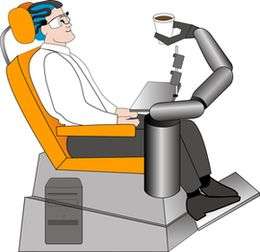
People who suffer from paralysis are confronted with many situations in which they need a helping hand.
In the Brain2Robot project, an international team of researchers has developed a robot control system that works on the basis of electroencephalograph (EEG) signals. This new idea could enable patients with severe motor disabilities to regain some of their lost autonomy.
The patient controls the robot arm with their thoughts: If they think about wanting to move their right hand, the robot arm is activated. If they imagine themselves moving their left hand, the robot arm will, for instance, lift up a cup of coffee.
But how can thoughts be translated into instructions for the robot? The solution is based on a concept known as a brain-computer interface (BCI). Researchers at the Fraunhofer Institute for Computer Architecture and Software Technology FIRST and the Charité hospital in Berlin have been working on this type of interface for almost seven years. For the input, they use a perfectly normal electroencephalogram (EEG), just like the ones used in everyday clinical practice.
Electrodes attached to the patient’s scalp measure the brain’s electrical signals, which are amplified and transmitted to a computer. Highly efficient algorithms analyze these signals using a self-learning technique.
The software is capable of detecting changes in brain activity that take place even before a movement is carried out. It can recognize and distinguish between the patterns of signals that correspond to an intention to raise the left or right hand, and extract them from the pulses being fired by millions of other neurons in the brain. These neural signal patterns are then converted into control instructions for the computer.
“The aim of the project is to help people with severe motor disabilities to carry out everyday tasks. The advantage of our technology is that it is capable of translating an intended action directly into instructions for the computer,” says team leader Florin Popescu.
The Brain2Robot project has been granted around 1.3 million euros in research funding under the EU’s sixth Framework Programme (FP6). Its focus lies on developing medical applications, in particular control systems for prosthetics, personal robots and wheelchairs. The researchers have also developed a “thought-controlled typewriter”, a communication device that enables severely paralyzed patients to pick out letters of the alphabet and write texts.
The robot arm could be ready for commercialization in just a few years’ time. BCI technology has potential uses in a great many applications: It could be used, for instance, for playing video games, or as part of safety systems for automobiles providing driver monitoring and driver assistance functions.
The development team will be presenting their robot arm at Medica 2007 in Düsseldorf from November 14 to 17 (Hall 3, Stand F92).
Source: Fraunhofer-Gesellschaft


