IBM's Blue Gene Pulls Away from the Pack
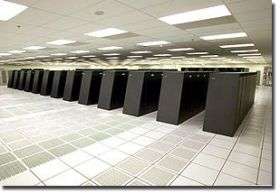
IBM’s Blue Gene/L supercomputer sprinted to a new world record as it continued its four-year domination of the official TOP500 Supercomputer Sites list. The world’s fastest computer at Lawrence Livermore National Laboratory in California is now nearly three times faster than the rest of the pack.
Livermore’s Blue Gene/L was expanded this summer to deliver a sustained performance of 478 trillion calculations per second (478 “teraflops”).
The No. 2 computer in the world – and Europe’s fastest – is the new first-time installation of Blue Gene/P, a sister machine to Blue Gene/L, located at the research consortium Jülich in Germany. Jülich’s Blue Gene/P clocks in at 167 teraflops.
IBM systems dominate the TOP500 rankings with a total of 232 on the list, the most of any vendor. The vast majority of IBM’s speediest systems – 183 -- are cluster configurations built with commodity microprocessors – another TOP500 record. IBM leads the industry in building the most powerful supercomputers from these PC server chips. The company also outpaces its rivals among the Top 10, with four IBM systems – all Blue Genes -- and 38 supercomputers among the Top 100. IBM’s 232 systems account for 45 percent of the combined computational power of the list.
Breaking the Petaflop Barrier
Leading the industry, IBM is closing in on a computing milestone known as a “petaflop” – the ability to process 1,000 trillion calculations every second. Petaflop computers promise exponential breakthroughs in science and engineering by providing predictive and highly detailed simulations. Earthquake simulations, for example, could show building-by-building movements of entire regions along the San Andreas fault, improving future designs of earthquake-resistant structures.
IBM has several supercomputer platforms underway that will lead the world into the “petascale” era. Blue Gene/P, introduced this June and purpose built to operate at a petaflop and beyond, will be targeted initially at scientific and research markets, but its expanded memory and SMP nodes makes it attractive for a broader range of applications. Also next year, supercomputers based on IBM’s latest generation of POWER processor will begin to hit the market for commercial and technical tasks such as weather forecasting, climate modeling, energy exploration, and auto and aerospace engineering.
Move Over for ‘Roadrunner’ in 2008
Rounding out IBM’s petaflop portfolio will be a computer nicknamed “Roadrunner,” a hybrid design that blends thousands of PC-type processors from AMD, and the Cell Broadband Engine, the graphics processor at the heart of the Sony Playstation 3. Roadrunner, planned to be delivered to the U.S. Department of Energy’s Los Alamos National Laboratory in summer 2008, will be capable of speeds exceeding a petaflop. By combining the two styles of microprocessors, Roadrunner will slash typical power consumption to offer a highly energy-efficient operating environment.
IBM’s petascale hardware initiatives are matched with corresponding investments in software, including application support and development tools, to increase productivity, ease of use and commercial viability. For instance, IBM will expand Blue Gene application support next year with a new open-source developers’ program with Argonne National Laboratory in Illinois, the first site in the U.S. to field a Blue Gene/P next year.
Based on IBM's POWER Architecture, the IBM System Blue Gene Solution is optimized for bandwidth, scalability and the ability to handle large amounts of data while consuming a fraction of the power and floor space required by today's fastest systems. A variety of industries are using Blue Gene systems to advance their research capabilities for life sciences, financial modeling, hydrodynamics, quantum chemistry, molecular dynamics, astronomy and space research and climate modeling.
The "TOP500 Supercomputer Sites" is compiled and published by supercomputing experts Jack Dongarra from the University of Tennessee, Erich Strohmaier and Horst Simon of NERSC/Lawrence Berkeley National Laboratory and Hans Meuer of the University of Mannheim (Germany). The entire list can be viewed at www.top500.org .
Source: IBM


