Clean, carbon-neutral hydrogen on the horizon
November 12, 2007 Microbial Electrolysis Cell

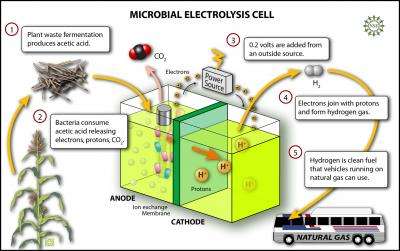
This illustration shows how the new electrolysis cell functions. Credit: Zina Deretsky, National Science Foundation

Hydrogen as an everyday, environmentally friendly fuel source may be closer than we think, according to Penn State researchers.

"The energy focus is currently on ethanol as a fuel, but economical ethanol from cellulose is 10 years down the road," says Bruce E. Logan, the Kappe professor of environmental engineering. "First you need to break cellulose down to sugars and then bacteria can convert them to ethanol."

Logan and Shaoan Cheng, research associate, suggest a method based on microbial fuel cells to convert cellulose and other biodegradable organic materials directly into hydrogen in today's (Nov. 12) issue of the Proceedings of the National Academy of Sciences online.

The researchers used naturally occurring bacteria in a microbial electrolysis cell with acetic acid – the acid found in vinegar. Acetic acid is also the predominant acid produced by fermentation of glucose or cellulose. The anode was granulated graphite, the cathode was carbon with a platinum catalyst, and they used an off-the-shelf anion exchange membrane. The bacteria consume the acetic acid and release electrons and protons creating up to 0.3 volts. When more than 0.2 volts are added from an outside source, hydrogen gas bubbles up from the liquid.

"This process produces 288 percent more energy in hydrogen than the electrical energy that is added to the process," says Logan.

Water hydrolysis, a standard method for producing hydrogen, is only 50 to 70 percent efficient. Even if the microbial electrolysis cell process is set up to bleed off some of the hydrogen to produce the added energy boost needed to sustain hydrogen production, the process still creates 144 percent more available energy than the electrical energy used to produce it.

For those who think that a hydrogen economy is far in the future, Logan suggests that hydrogen produced from cellulose and other renewable organic materials could be blended with natural gas for use in natural gas vehicles.

"We drive a lot of vehicles on natural gas already. Natural gas is essentially methane," says Logan. "Methane burns fairly cleanly, but if we add hydrogen, it burns even more cleanly and works fine in existing natural gas combustion vehicles."

The range of efficiencies of hydrogen production based on electrical energy and energy in a variety of organic substances is between 63 and 82 percent. Both lactic acid and acetic acid achieve 82 percent, while unpretreated cellulose is 63 percent efficient. Glucose is 64 percent efficient.

Another potential use for microbial-electrolysis-cell produced hydrogen is in fertilizer manufacture. Currently fertilizer is produced in large factories and trucked to farms. With microbial electrolysis cells, very large farms or farm cooperatives could produce hydrogen from wood chips and then through a common process, use the nitrogen in the air to produce ammonia or nitric acid. Both of these are used directly as fertilizer or the ammonia could be used to make ammonium nitrate, sulfate or phosphate.

Source: Penn State


print this article email this article download pdf blog this article bookmark this article     Stumble it Digg this share on Facebook retweet share on Reddit add to delicious
Rate this story - 4.7 /5 (68 votes)

Rank Filter

Move the slider to adjust rank threshold, so that you can hide some of the comments.


Display comments: newest first

  • earls - Nov 12, 2007
    • Rank: 1.3 / 5 (4)
    Cool research, but I'm looking for something a little more one-step.
  • irjsi - Nov 12, 2007
    • Rank: 1.8 / 5 (4)
    Mr. Earl,
    Get the show on the Road! . . . "something a little more one step" . . . consigns the various methods of H2 extraction to the laboratory for decades more!
    I've been hearing 'H2 is just around the corner' since 1980!
    An engineer acquaintance did not mention 'water', as an abundant source of H2: "H2 source is Natural Gas!"; an expensive transformation of one 'readily usable fuel' to industrial H2.
    I think the H2 from Natural Gas requires additional 'scrubbing' for purity, even as an industrial gas.
    A kite was launched from 'Kitty Hawk'; not a 747!
    "Get the show on the Road ! ! ! "
    Roy Stewart,
    Phoenix AZ
  • ShadowRam - Nov 13, 2007
    • Rank: 3 / 5 (2)
    ammonium nitrate could be dangerous
  • googleplex - Nov 13, 2007
    • Rank: 3 / 5 (1)
    I think H2 is not an economic solution and will be eclipsed by an alternative. When people do a total cost analysis I think they will find that it is not efficient. I would expect a nano battery or capacitor that is able to store electricity with high efficiency and high power density. Hydrogen is expensive to distribute and store and would require a massive infrastructure expense. Electricity infrastructure is already in place.
  • gopher65 - Nov 13, 2007
    • Rank: not rated yet
    I expect that everyday vehicles, busses, and planes will be electric powered. Using Hydrogen for those things is just an unnecessary extra step. However for things that require larger amounts of power and torque than an electric motor can reasonably provide, Hydrogen engines may be the solution (farm equipment, mining equipment, construction equipment, etc).
  • Fritz - Nov 13, 2007
    • Rank: not rated yet
    It would be nice to get beyond people SAYING they can do something with hydrogen and hydrogen fuel cells and actually DOING something with them. Abstract academic discussions will never save the world.
  • nilbud - Jan 02, 2008
    • Rank: not rated yet
    Iceland

November 12, 2007 all stories

Comments: 7

4.7 /5 (68 votes)
  • Stumble this up

  • Digg this

  • share this

  • hide
  • Related Stories


Other News

Yeast in a shell: Coating individual living yeast cells with silicon dioxide

Chemistry / Biochemistry

created 18 hours ago | popularity 4.3 / 5 (3) | comments 0

(PhysOrg.com) -- Our breakfast egg is a peculiarity of nature: a single cell protected by a thin mineral layer. Apart from a number of tiny radiolaria and diatoms, individual cells normally do not have a hard shell. Korean ...


UCLA researchers reconstitute enzyme that synthesizes cholesterol drug lovastatin

Chemistry / Biochemistry

created 14 hours ago | popularity 4.5 / 5 (2) | comments 0

Researchers from the UCLA Henry Samueli School of Engineering and Applied Science have for the first time successfully reconstituted in the laboratory the enzyme responsible for producing the blockbuster cholesterol-lowering ...


Scientists Make Ink Disappear, Make Paper Reusable

Scientists Make Ink Disappear, Make Paper Reusable

Chemistry / Materials Science

created Oct 27, 2009 | popularity 3.1 / 5 (16) | comments 4

(PhysOrg.com) -- Despite ongoing efforts to save the trees, many offices print high volumes of paper documents on a daily basis. Although many companies encourage paper recycling, both disposing of and recycling ...


Hybrid composite for root canal treatment

Hybrid composite for root canal treatment

Chemistry / Materials Science

created 23 hours ago | popularity not rated yet | comments 0

(PhysOrg.com) -- A dentist carrying out root canal treatment will need to use a variety of compounds. These do not always bond together properly and sometimes expensive follow-up treatment has to be performed. ...


Porphyrin Dimers Increase Efficiency of Dye-Sensitized Solar Cells

Porphyrin Dimers Increase Efficiency of Dye-Sensitized Solar Cells

Chemistry / Materials Science

created Oct 30, 2009 | popularity 4.5 / 5 (11) | comments 1

(PhysOrg.com) -- Porphyrins are most commonly thought of as the pigment in red blood cells, but now scientists have found that porphyrins can also be used to increase the efficiency of an inexpensive type ...