Tiny fish can yield big clues to Delaware River health
November 13, 2007
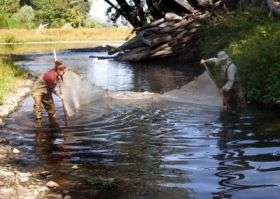
The Academy of Natural Sciences' scientists Shane Moser (left) and David Keller use seine nets to look for the dwindling bridle shiner, a key indicator of environmental health. Credit: The Academy of Natural Sciences, or ANSP
Where have all the bridle shiner gone? That’s the mystery The Academy of Natural Sciences’ fish scientists are trying to answer, and the outcome will shed light on the environmental health of the Upper Delaware River.
Bridle shiner—not easy to spot at less than two inches long—once were abundant in the mid-Atlantic region, including small streams in Southeastern Pennsylvania. Their steady decline has prompted Pennsylvania to classify the fish as endangered. Now, the Academy is swimming the tide to lay the groundwork for an environmental management plan for the species and its habitat.
The Academy’s Patrick Center for Environmental Research, in partnership with the Upper Delaware Scenic and Recreational River and the Delaware Water Gap National Recreation Area, is in the midst of a two-year project to discover and describe the status of the little minnow in the Upper Delaware River basin. Academy fisheries scientists David Keller and Shane Moser, under the direction of Dr. Richard Horwitz, have cast their seine nets and gone snorkeling many times at various locations over the last year with varying results. Their findings will shed light on the health of the Upper Delaware River and will factor into decisions made about the flow of the river.
“The presence and absence of fish helps us define preferred habitat for the fish, which helps us locate potential sites for sampling,” explained Horwitz. “We've located several sites with populations of the species, and in other places we've found a few fish on one visit, but not on subsequent visits. These sites may lead us to sites with large populations.”
Academy studies reveal possible causes of the species’ decline may include changes in water quality due to siltation, nutrient enrichment and changes in flow patterns, and the introduction of predators, such as largemouth bass, as well as competitors for food. Interestingly, a decline in the beaver population also may factor into the decline.
“We’ve found bridle shiner in ponds formed by beaver activity,” said Horwitz. “Beaver were once extirpated or nearly extirpated in the region. Beaver have become re-established and numbers have been increasing, which may provide new habitats for the bridle shiner.”
The results of the Academy’s studies, which will continue into 2008, will factor into the Delaware River Basin Commission’s flow management plans for the river. Bridle shiner prefer slow-moving, shallow waters that flow over beds of aquatic plants. The Upper Delaware River region provides drinking water, supports a number of native fish species, and is popular for sport fishing and other recreational activities. Flow management can affect all these resources; in addition, flooding is a concern in some riverside communities.
“Our goal is to develop management plans to protect the fish and its habitat,” said Horwitz. “Water flow and temperature in the Upper Delaware River’s backwater habitats are key to doing this.”
The historical status of bridle shiner in Pennsylvania is known mostly from early 20thcentury collections held at the Academy. The species was originally described by naturalist Edward Drinker Cope, who discovered the fish in a tributary of the Schuylkill River in Conshohocken, Pa., where it no longer occurs. Cope’s personal collection of fishes, reptiles and amphibians was bequeathed to the Academy in 1898.
Source: The Academy of Natural Sciences
-
2011 a banner year for young striped bass in Virginia
Oct 17, 2011 |
not rated yet |
0
-
Pa. accused of rubber-stamping gas permits
Apr 13, 2011 |
2 / 5 (1) |
0
-
Freshwater mussels discovered in urban Delaware river
Nov 30, 2010 |
5 / 5 (2) |
0
-
Va. sturgeon may be key to ancient fish's recovery
Nov 14, 2010 |
5 / 5 (2) |
0
-
Study provides data that can inform Atlantic sturgeon recovery efforts
Oct 06, 2010 |
5 / 5 (1) |
0
-
Engineers build first sub-10-nm carbon nanotube transistor
Feb 01, 2012 |
4.9 / 5 (31) |
30
-
Something old, something new: Evolution and the structural divergence of duplicate genes
Jan 31, 2012 |
4.6 / 5 (7) |
1
-
The hidden nanoworld of ice crystals: Revealing the dynamic behavior of quasi-liquid layers
Jan 30, 2012 |
5 / 5 (3) |
1
-
Stock market network reveals investor clustering
Jan 27, 2012 |
3.9 / 5 (23) |
8
-
Of microchemistry and molecules: Electronic microfluidic device synthesizes biocompatible probes
Jan 26, 2012 |
5 / 5 (1) |
0
More news stories
Entire genome of extinct human decoded from fossil
(PhysOrg.com) -- In 2010, Svante Pääbo and his colleagues presented a draft version of the genome from a small fragment of a human finger bone discovered in Denisova Cave in southern Siberia. The ...
Feb 07, 2012 |
4.7 / 5 (58) |
46
|
Why are there so few fish in the Earth's oceans?
(PhysOrg.com) -- A Stony Brook University researcher has found that, contrary to popular belief, there are not plenty of fish in the sea.
Feb 08, 2012 |
4.3 / 5 (17) |
26
|
Miami battling invasion of giant African snails
No one knows how they got there. But an invasion of African giant snails has southern Florida in a panic over potential crop damage, disease and general yuckiness surrounding the slimy gastropods.
Feb 10, 2012 |
4.5 / 5 (2) |
5
Deciding to go left or right: Researchers use device to determine that lower animals can navigate too
For decades, scientists have associated binary decision making opting to go left or right with higher-ranking animals, including humans. A team of Harvard researchers, however, is rewriting that ...
Feb 09, 2012 |
4 / 5 (1) |
4
|
Study shows chimps able to understand needs of others
(PhysOrg.com) -- By setting up a unique experiment, a small team of researchers has found that chimpanzees are able to understand need in other chimps, despite their general disinclination to offer aid when ...
Google might launch Drive for cloud storage soon
(PhysOrg.com) -- Google's next big move, according to the Wall Street Journal, is a cloud storage service called Drive. Hardly first to the plate, Google is simply catching up to introducing its cloud reposi ...
Walney offshore wind farm is world's biggest (for now)
(PhysOrg.com) -- The Walney wind farm on the Irish Sea--characterized by high tides, waves and windy weather--officially opened this week. The farm is treated in the press as a very big deal as the Walney ...
Latin America mining boom clashes with conservation
Latin America is experiencing a mining boom as prices rise fuelled by a hike in global demand, but the region is also being hit by a wave of violent protests, strikes and rallies by environmentalists.
Love a click away in Indonesia's Twitter Republic
He was a geeky kid from Yogyakarta, she a glamorous city girl in Jakarta. In a country with one of the world's most vibrant social networking scenes they fell in love on Twitter.
Europeans protest controversial Internet pact
Tens of thousands of people marched in protests in more than a dozen European cities Saturday against a controversial anti-online piracy pact that critics say could curtail Internet freedom.
Navy to begin tests on electromagnetic railgun prototype launcher
The Office of Naval Research (ONR)'s Electromagnetic (EM) Railgun program will take an important step forward in the coming weeks when the first industry railgun prototype launcher is tested at a facility ...