Strange Space Weather over Africa
Something strange is happening in the atmosphere above Africa and researchers have converged on Addis Ababa, Ethiopia, to discuss the phenomenon. The Africa Space Weather Workshop kicked off Nov. 12th with nearly 100 scientists and students in attendance.
The strange phenomenon that brings all these people together is the ion plume—"a newly discovered form of space weather," says University of Colorado atmospheric scientist and Workshop co-organizer Tim Fuller-Rowell.
Researchers liken the plumes to smoke billowing out of a factory smokestack—except instead of ordinary ash and dust, ion plumes are made of electrified gas floating so high above ground they come in contact with space itself. "The plumes appear during geomagnetic storms and they can interfere with satellite transmissions, airline navigation and radio communications," says Fuller-Rowell. Indeed, it is their effect on GPS signals that led to the discovery of plumes over North America just a few years ago.
A typical example is the plume of Nov. 20, 2003:
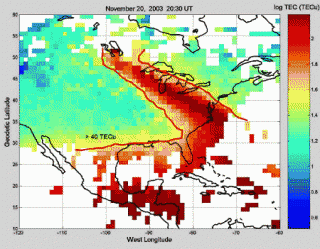
Two days before this map was made, an explosion on the sun had hurled a cloud of magnetized gas—a CME—toward Earth. The plume formed when the CME hit, triggering a strong geomagnetic storm. The plume consists of ionized air at high altitude moving from Florida to Canada at a speed of 1 km/s (2200 mph).
"Okay, now we've seen the 'smoke,' but where is the smokestack?" asks Fuller-Rowell.
The search is leading researchers to Africa.
"Many believe the source of the plumes is near Earth's magnetic equator," explains NASA heliophysicist Lika Guhathakurta who is attending the Workshop. "Africa is a great place to check this possibility because the magnetic equator passes directly over the sub-Sahara."
Just one problem: "There aren't enough sensors in Africa to study the phenomenon," says Fuller-Rowell. The sensor of choice is the dual-frequency GPS receiver. "North America has an abundance of dual frequency GPS receivers—thousands of them in a network we use to monitor North American plumes. But Africa has only a few dozen."
The purpose of the Workshop is to familiarize African space scientists with the plume phenomenon and lay the groundwork for a continent-wide GPS network. "Within a few years we hope to deploy hundreds of receivers," he says.
Ion plumes inhabit a layer of Earth's atmosphere called the "ionosphere." It is a broad region 85 km to 600 km above ground level where ultraviolet radiation from the sun knocks electrons off atoms and molecules, creating a layer of ionized gas or "plasma" surrounding our entire planet. As ham radio operators have known for more than 100 years, the ionosphere can bend, distort, reflect and even absorb radio waves. Plumes amplify these effects.
How important is Africa to the study of this phenomenon? "Consider the list of organizations who have joined forces to sponsor the Africa Space Weather Workshop: NASA, NOAA, the National Science Foundation, the European Office of Aerospace Research and Development (EOARD), the International Center for Theoretical Physics (ICTP), and many others," says Guhathakurta. "It's widely understood that Africa is key to the puzzle."
At the moment only North America has a well-mapped ionosphere. NOAA posts new images every 15 minutes at this website. "Five years from now," says Fuller-Rowell, "we hope to be making realtime maps of the ionosphere over Africa, too."
Africa is plasma incognita—but not for long.
The Africa Space Weather Workshop is organized under the auspices of the 2007 International Heliophysical Year (IHY), continuing the tradition of international research and cooperation begun during the International Geophysical Year (IGY) of 1957. To learn more about the IHY on the web, visit ihy2007.org/ .
Source: by Dr. Tony Phillips, Science@NASA


