Archaeologists to establish true value of Roman silver coins
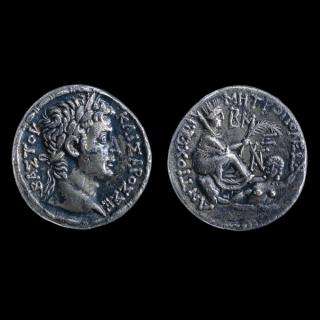
March 5, 2006 A selection of Roman silver coins being used in the study

A selection of Roman silver coins being used in the study.

An archaeologist at the University of Liverpool is examining more than 1,000 Roman silver coins from museums around the world in order to establish their true economic value.

Dr Matthew Ponting, from the University’s School of Archaeology, Classics and Egyptology, is investigating the chemical composition of the coins to further understanding of how and where they were made. Dr Ponting believes that analysis of the coins will also shed more light on the political and economic issues of the Roman Empire.

Dr Ponting and his colleague Professor Kevin Butcher from the American University of Beirut, are using unique analysis techniques to examine the make-up of the coins and establish their silver content. The analysis will also identify particular chemical elements which will help the archaeologists establish where and how the coins were made.

Dr Ponting said: “For the first time we are able to use a combination of chemical and isotopic analysis on these coins. Chemical analysis will give useful trace element ‘finger prints’ telling us about the type of ores exploited and the technology used in smelting and refining the metal.”

The team is analysing the coins by drilling a small hole in their outer edge to get beneath the treated surface and investigate their different layers.

Dr Ponting added: “By measuring the isotopes of lead in the coins it is often possible to ascertain where that metal came from. This is done by comparing the isotopic 'signature’ of the silver coin, with isotopic ‘signatures’ of known Roman silver mining regions. In this way I hope to be able to investigate where Rome was getting its silver from.”

Silver coins formed the backbone of currency in the Roman Empire. Roman emperors manipulated the silver content of the coins to solve short-term financial problems frequently caused by government overspending. For the most part, this manipulation involved the reduction of the silver content of the coinage in conjunction with a drop in weight.

Dr Ponting said: “In the 1970s a study documented the silver contents of Roman Imperial silver coins by analysing their surface. Until recently this was the principal reference for economic historians on the monetary policies of the Roman Empire.

“During the 1990s, however, historians realised that many Roman silver coins were deliberately treated to remove some of the copper from their surface, giving impure coins the appearance of being pure and disguising the debasement of the currency. Analysis of the coins’ surface had therefore overestimated their silver content.”

Source: University of Liverpool


print this article email this article download pdf blog this article bookmark this article     Stumble it Digg this share on Facebook retweet share on Reddit add to delicious
Rate this story - 4.4 /5 (16 votes)


March 5, 2006 all stories

Comments: 0

4.4 /5 (16 votes)
  • Stumble this up

  • Digg this

  • share this

  • hide
  • Related Stories

  • Largest-ever collection of coins from Bar-Kokhba revolt found
    created Sep 09, 2009 | popularity not rated yet | comments 0
  • Heads or tails? It all depends on some key variables
    created Oct 20, 2009 | popularity not rated yet | comments 0
  • Buried Coins Key to Roman Population Mystery?
    created Oct 05, 2009 | popularity not rated yet | comments 0
  • Caistor skeleton mystifies archaeologists
    created Sep 15, 2009 | popularity not rated yet | comments 0
  • A rare discovery: An engraved gemstone carrying a portrait of Alexander the Great
    created Sep 15, 2009 | popularity not rated yet | comments 0


Other News

Study: Credit crisis, debt load a double whammy for investment

Other Sciences / Economics

created 2 hours ago | popularity not rated yet | comments 0

Firms with heavy long-term debt that came due amid the nation's recent credit crisis slashed investment more than three times as much as companies whose paybacks ducked the meltdown, a new University of Illinois study found.


Failing the sniff test: Researchers find new way to spot fraud

Other Sciences / Economics

created 11 hours ago | popularity not rated yet | comments 1

Companies that commit fraud can find innovative ways to fudge the numbers, making it hard to tell something is wrong by just looking at their financial statements. But research from North Carolina State University unveils ...


Remains of Minoan-style painting discovered during excavations of Canaanite palace

Other Sciences / Archaeology & Fossils

created 8 hours ago | popularity 4.5 / 5 (2) | comments 0

The remains of a Minoan-style wall painting, recognizable by a blue background, the first of its kind to be found in Israel, was discovered in the course of the recent excavation season at Tel Kabri. This fresco joins others ...


National anti-gun violence program largely successful, study finds

Other Sciences / Social Sciences

created 5 hours ago | popularity 5 / 5 (2) | comments 0

Project Safe Neighborhoods - a community-based policing effort launched in 2001 - has been largely successful in its goal of reducing violent crime, according to an analysis by Michigan State University, the national research ...


RIT scholars explore the impact of imaging on our reality

Other Sciences / Social Sciences

created 6 hours ago | popularity not rated yet | comments 0

Imaging is the use of machines to enhance humans' ability to perceive things, often by producing visible phenomena that cannot be seen with the naked eye. But, can imaging technology distort reality and even change what humans ...